In astrology, a birth chart is a snapshot of the time you were born. At that moment, the planets line up in different zodiac signs, which creates a unique picture of your personality and potential. Astrology is so much more than your Sun sign.
When you begin to explore beyond basic Sun sign astrology, you quickly learn that there are many parts to consider, from your natal Moon (which represents your emotions and inner self) to your Part of Fortune (which indicates your potential for success and happiness). One of the most essential parts of astrology is the 12 astrological houses in the natal chart.
Have you ever heard of the “houses” of the zodiac? We’re not talking about houses with roofs and walls! If you’re interested in astrology, read on to learn what the 12 houses are, their meaning, and how zodiac signs relate.
Most horoscopic traditions of astrology systems divide the horoscope into a number (usually twelve) of houses whose positions depend on time and location rather than on date. In astrology, houses are a fundamental component of the birth chart that represent different areas of life.
There are 12 houses, each associated with a specific zodiac sign and planetary ruler. The 12 houses in Western astrology represent distinct areas of life experience, shaping how planetary energies manifest in an individual's natal chart. Each house reflects a unique aspect of existence, from personal identity to relationships, career, and spirituality.
Read also: Learn about Rick Levine and his contributions to astrology.
The houses are divisions of the ecliptic plane (a great circle containing the Sun's orbit, as seen from the earth), at the time and place of the horoscope in question. They are numbered counter-clockwise from the cusp of the first house.
If space is the basis for house division, the chosen plane is divided into equal arcs of 30° each. The table below represents the basic outline of the houses as they are still understood today and includes the traditional Latin names. The houses are numbered from the east downward under the horizon, each representing a specific area of life.
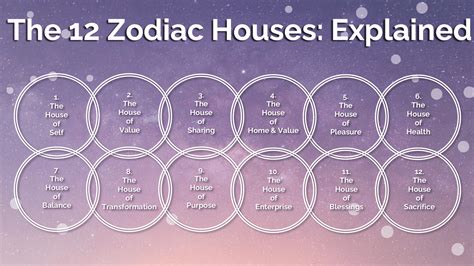
The Zodiac Houses
Twelve Houses in Astrology 101 Beginner Astrology
What are the Astrological Houses?
The signs, planets, and mathematical points in the sky are contained in a “zodiac wheel,” divided into 12 sections, similar to a perfectly sliced pie. These sections are called ‘houses.’ The houses are equal in time and space, 30º each or one-twelfth of a 360º circle. Each house represents a different area of life, from your personality and appearance to your relationships and career. The position of the planets in these houses at the time of your birth can provide insights into various aspects of your life.
Each house is associated with a different area of your life. When a planet occupies a house, it has something to say about the energy of that house. Think of it this way:
Read also: The Secrets of Astrology and Numerology
- Planets are what’s happening.
- The zodiac signs are how the planet operates.
- The houses show where the action is going down.
For instance, understanding that you have a Pisces Moon in your 8th house can empower you with the knowledge that you possess powerful gut instincts. Why? The 8th house is associated with intuition, and so is the Moon. Watery Pisces adds emotional depth, enhancing your intuitive abilities.
The house layout begins with your Ascendant, also called your Rising Sign. It represents the mask you wear and the first impression you make. The Ascendant is the zodiac sign rising over the horizon at the exact minute of your birth. This forms the first house of your natal chart. From here, as you move counterclockwise around the chart, you’ll next come to the second, third, fourth, and so on.
As you glance around the perimeter of each house, you’ll notice a sign on the rim of every house (astrologers refer to this as the “cusp” of the house). These are the signs that mark the beginning of each house, and they provide valuable insights into the energy of that house. For instance, if your 11th house cusp is in Cancer, it suggests that your friends are like family to you.
Angular, Succedent, and Cadent
Now, let’s delve into the categorization of houses. Each house is classified as angular, succedent, or cadent, and this classification adds depth to our interpretation of the chart.
- Angular: The angular houses are considered the most important. Houses 1, 4, 7, and 10 are the angular houses. They mark the cornerstones of your life. Each has a different name: the Ascendant, Imum Coeli, Descendant, and Midheaven. The Ascendant is your image, Imum Coeli your family, Descendant your relationships, and Midheaven your career and public life. These hours are ruled by the four cardinal signs: Aries, Cancer, Libra, and Capricorn, which add the element of action to each house.
- Succedent: The succedent houses (2, 5, 8, 11) are ruled by fixed signs: Taurus, Leo, Scorpio, and Aquarius. The energy is solid, stable, and concerned with security.
- Cadent: The cadent houses (3, 6, 9, 12) are ruled by mutable signs: Gemini, Virgo, Sagittarius, and Pisces. The energy is changeable and aligned with endings.
The Twelve Houses Explained
Each of the 12 zodiac houses is associated with a set of traits, beginning from the self and expanding outward into society and beyond. Each house, or segment, represents a different essential aspect of our lives. In the Movie of You, the houses are like the different sets or stages where the planets (“actors”) play out their roles (given by the zodiac signs). At the moment you were born, the planets were all in specific signs and houses.
Read also: Leo Celebrities and Their Charts
When planets visit any of the 12 houses, they light up those parts of your chart and energize those house traits. To learn more about a house, read about the them below. The first house begins at what would be 9:00 on a clock. From the first house’s “cusp” (or beginning border), we travel around the zodiac wheel in a counter-clockwise direction.
The first six zodiac houses are called the personal houses. They rule our private and immediate lives: individuality, our daily environments, our siblings and peers, parents, and our attempts to define and express who we are. The seventh through the twelfth zodiac houses are the interpersonal houses. They govern relationships, joint ventures, travel, career, society, spirituality and even our transition at the end of life.
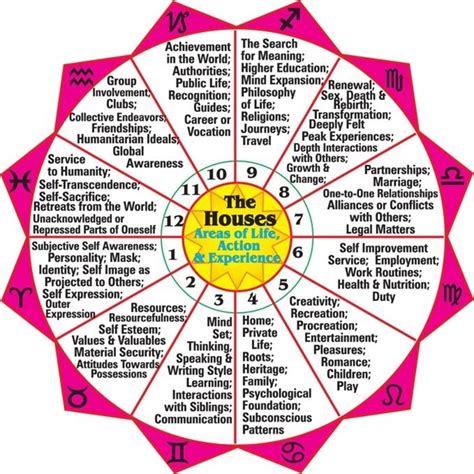
The Astrology Houses
- First: Self-Image. The first house, also called your Ascendant or Rising Sign, is associated with your public image. This is how the world sees you. It’s how you present yourself, from your style to your mannerisms. Your 1st House, also known as your ascendant or rising sign, is determined by the sign on the eastern horizon when you were born. If you’ve ever woken up early to watch the sunrise, you know that the Sun - like the Moon and the other planets - always emerges from the east. In your birth chart, this part of the sky is represented by the left side of the chart wheel. The 1st House is the portal through which you, like the Sun, come into the world. For this reason, the 1st House represents your life, body, and vitality. You might notice that your personality features some qualities of your rising sign and of any planets or points that dwell here. The 1st House governs self-identity, physical appearance, and the persona-the outward expression of one's inner world.
- Second: Money and Values. The second house is all about your money, resources, and values. It can show how you make money, save it, or spend it. If you have self-worth issues, that shows up here, too. In traditional astrology, the Greek word for this house was bios (life) - not because it hosts living organisms or biology lab equipment, but because it signifies all the ways you earn your livelihood. Yes, the 2nd House is the place of money - specifically your money and how you make it, rather than the money you share with others - but it’s also the place for your other material belongings. It’s the storage closet where you keep the sentimental curios, beach-combed stones, hand-me-down tarot decks, and well-loved suitcases you lug from place to place. And it’s your collection of inner resources and your vast repertoire of talents. The Second House relates to personal resources, material possessions, and self-worth.
- Third: Mind and Communication. The third house represents your thinking, learning, and speech. It’s also associated with early education, siblings, short trips, and neighbors. Nicknamed the “temple of the Moon” by the Roman poet Manilius, the 3rd House is all about your local haunts. The Moon is Earth’s nearest neighbor in our solar system, so it’s fitting that the 3rd House represents the folks in your immediate orbit. Today, not everyone knows their neighbors as well as ancient astrologers did 2000 years ago, before the era of digital screens and rapid travel. But in addition to our nearby community, the 3rd House is also the realm of siblings, cousins, kindred friends, and extended family. The Moon is a mirror, a reflector of light. It travels faster than any other body in our sky, so both the Moon and its “temple,” the 3rd House, are traditionally associated with go-betweens. That makes this a place of conversation and communication technology. This is where we transmit and receive all kinds of messages - through social media platforms, text threads, in-person exchanges, love notes, books, podcasts, and language itself. The Third House governs communication, learning, and relationships with immediate surroundings.
- Fourth: Root and Home. The fourth house shows your early upbringing, family, and home. This is your foundation or root. The type of home you like and your mother issues are reflected here. The 4th House is the midnight of your chart, signifying your home, family, and root system. You can think of it as a basement vault, safekeeping your childhood memories and the stories of your caregivers, parents, grandparents, elders, or ancestors. The 4th House represents your lineage, your upbringing, and the life you lead behind closed doors. It’s the private room where you can lounge in your pajamas and devour almond butter straight from the jar. In other words, it’s your abode - the place that looks, sounds, smells, and tastes like home, where you feel safe to nest and rest. The Fourth House represents home, family, and the emotional roots that provide stability.
- Fifth: Creativity and Children. The fifth house rules everything you create, from the art you make to the books you write to your children. It’s the house of self-expression and romance. True love, parenting, sports, leisure, fame, speculation, the stock market, and gambling are fifth-house issues. Hellenistic astrologers described the 5th House as the place of good fortune, which evoked blessings for the body (as opposed to good spirit, which related more to one’s mind or soul). The 5th House is Venus’ boudoir and the site of all sensual pleasures: the oils and dripped honey, the flirtations, and all kinds of leisure activities. Of the 12 houses, the 5th is the most generative. Traditionally, this is the place of children, but it’s also about the fruits of your artistic or intellectual labors. Here you find human offspring as well as the manuscripts, choreographies, recordings, and performances you bring into the world. The 5th House is the place of getting creative and simply having fun. It’s what we do on a Friday night - whether that’s going out to a party or blissfully staying in. The Fifth House governs creativity, romance, and self-expression.
- Sixth: Work and Health. The sixth house might reveal the kind of work you do and how you do it. It’s also your health zone, so clues about your well-being and regimes fall here. Small pets are a sixth house thing, too. The Sixth House relates to health, daily routines, and service to others. The sixth house is the domain of health and service. It rules schedules, organization, routines, fitness, diet and exercise, natural and healthy living, helpfulness and being of service to others.
- Seventh: Relationships. The seventh house is associated with all your partnerships, from business to marriage and everything in between, including enemies. Legal issues and public relations are also in the seventh house’s domain. The Seventh House governs relationships, including marriage, business partnerships, and legal contracts. The seventh house is the sector of relationships and other people. It governs all partnerships, both business and personal, and relationship-associated matters, like contracts, marriage, and business deals.
- Eighth: Intimacy and Shared Resources. Also called the house of transformation, the eighth is focused on all the things we share: loans, legacies, alimony, inheritances, and sex. It’s also associated with death. The Eighth House is associated with transformation, shared resources, and intimacy. The eighth house is a mysterious sector that rules birth, death, sex, transformation, mysteries, merged energies, and bonding at the deepest level. The eighth house also rules other people’s property and money (real estate, inheritances, investments, et.
- Ninth: Expansion and Higher Mind. The ninth house indicates how you broaden your horizons. Do you like to travel? Invest in higher education? Spend time meditating in ashrams? That shows up here. The ninth house is connected to spirituality, philosophy, and publishing. The Ninth House represents higher education, philosophy, and long-distance travel. The ninth house covers the higher mind, expansion, international and long-distance travel, foreign languages, inspiration, optimism, publishing, broadcasting, universities and higher education, luck, risk, adventure, gambling, religion, philosophy, morals and ethics.
- Tenth: Reputation and Career. The tenth house is concerned with career and status. This shows how high you can go - or fall. It’s the house of fame, recognition, and publicity. The Tenth House governs career, public reputation, and social status. The tenth house is at the very top and most public part of the chart. The tenth house governs structures, corporations, tradition, public image, fame, honors, achievements, awards, boundaries, rules, discipline, authority, fathers and fatherhood. The cusp, or border, of the tenth house is also called the midheaven, and it clues astrologers into your career path.
- Eleventh: Social Life and Goals. You can find clues about your friends and groups in this sector. Do you roll deep with a posse or prefer to be a lone wolf? The eleventh house will also highlight your goals and how they happen, including those who help you along the way. The Eleventh House governs friendships, social networks, and community involvement. The eleventh house rules teams, friendships, groups, society, technology, video and electronic media, networking, social justice, rebellion, and humanitarian causes. It also rules originality, eccentricity, sudden events, surprises, invention, astronomy, science fiction and all things futuristic.
- Twelfth: Inner World and Self Undoing. The twelfth house represents your subconscious, introspection, and privacy. It’s also associated with secrets, prisons, and hospitals. The term ‘self-undoing’ refers to how we may unknowingly undermine ourselves or our goals. It’s the place where your subconscious works things out, as well as where you tend to hide. Your hidden enemies can be found here, too. The Twelfth House represents the subconscious, spirituality, and hidden aspects of life. The zodiac completes with the twelfth and final house, which rules endings. This house covers the final stages of a project, tying up loose ends, completions, the afterlife, old age, and surrender. It’s also associated with separation from society, institutions, hospitals, jails, hidden agendas, and secret enemies. And it rules the imagination, creativity, arts, film, dance, poetry, journals, and the subconscious mind.
What if there are no planets in a house?
Now, what if a house is empty, with no planets occupying it? Don’t worry; it doesn’t mean that nothing is happening in that area of your life. It simply suggests that it may not be a major focus. Remember, the skies are always in motion, and planetary transits will eventually touch every house in your chart. When this happens, the issues related to that house are brought to light. For example, if your ninth house is empty, you might find yourself embarking on more adventurous travels when Jupiter transits through that house.
When you interact with your birth chart for the first time, you may notice that some houses are hosting a lot of activity, yet other houses appear sparse or empty. This is normal.
If you add up all the planets in our solar system, plus the two luminaries, you’ll get a cast of 10 main characters: the Sun, the Moon, Mercury, Venus, Mars, Jupiter, Saturn, Uranus, Neptune, and Pluto. Meanwhile, there are 12 houses in your chart. Inevitably, some of those stages are going to be vacant.
Remember: The sky is always changing, and so is your relationship with it. There is no “wrong” or “weird” arrangement. Every chart is perfectly unique - just like every person.
How do I work with empty houses in my birth chart?
Even if you don’t have any planets or points in a house, this area of your life can still be rich and fulfilling. You have all 12 houses in your chart, no matter where the “planetary actors” are. If your 7th House of partnerships looks vacant, this doesn’t mean you won’t form long-term, fulfilling relationships. Similarly, if it seems like your 4th House is unoccupied, this doesn’t mean you won’t have meaningful ties to your home, family, or ancestry.
While your energy may be naturally pulled toward the packed houses, you might find that other areas of life turn out just fine without much attention or effort on your part.
To work with one of your empty houses, all you have to do is identify the house ruler. The CHANI app uses a house system known as whole sign houses. (If you don’t have the app, you can pull up your chart with our online chart tool.) With this method of dividing a chart, each house overlaps completely with one of the 12 signs. The planet that rules a given sign also rules the house in that part of your chart and the corresponding area of your life.
For example, if you’re a Taurus rising, your 7th House of partnerships is Scorpio. Scorpio is ruled by Mars, so this planet is the ruler of your 7th House. This means Mars-like themes of passion, drive, intensity, or impulsiveness could characterize your close relationships, whether romantic or platonic. Mars’ location in your birth chart and its aspects to other planets and points will add more nuance to your interpretation.
If your Mars is in Pisces, which would be the 11th House of community in this example, you might meet your romantic partner or best friend through your social circles or collective endeavors, or themes of friendship might show up in your committed relationships.
When you’re making sense of an empty house in your chart, you can begin by asking yourself these questions:
- What sign is occupying this empty house?
- What planet rules this sign?
- Which house is this planet in? What are the themes of that house?
- How do these themes intersect with the themes of the empty house?
- What aspects is this planet forming with other planets and points?
Remember the above example: If the ruler of your 7th house of committed partnerships is in your 11th House of friendships, you might meet your romantic partner or best friend through your social circles or collective endeavors, or themes of friendship might show up in your committed relationships. The topics of one house are carried into another. This can take time to understand and integrate, but once you do, you’ll start to notice the many ways that house topics can overlap, merge, and show up in your life.
What does it mean to have a full house?
When three or more planets huddle together in the same house, this grouping is called a stellium. The closer the planets are to each other, the more their energies start to intertwine. For example, a stellium involving the Sun, the Moon, and Venus could mean that heart-to-heart connections form a cornerstone of your life.
Venus brings charm and affection to this merger, while the Moon helps you feel nurtured by your bonds. With the Sun on the same stage, your relationships may even influence your sense of your life’s purpose. If you have multiple planets and/or points in one house, that area of your life (such as career for the 10th House, or community for the 11th) will be a focal point for you. But does that mean your empty houses don’t matter? Not at all.