The Church dogmatically and definitely teaches that the devil is a real being who tempts, deceives, and seeks the destruction of souls.
Terrifying Truth: Possessions and Exorcisms are Real
Exorcism prayer represents one of the most powerful spiritual practices in Christian tradition. Throughout history, believers have turned to exorcism prayers during times of spiritual distress. From the Latin prayers of Pope Leo XIII to the powerful intercession of St. Michael the Archangel, these prayers serve as a vital spiritual weapon for Christians facing demonic oppression and spiritual warfare. The rite of exorcism, then, is a continuation of the ministry of Christ Himself.
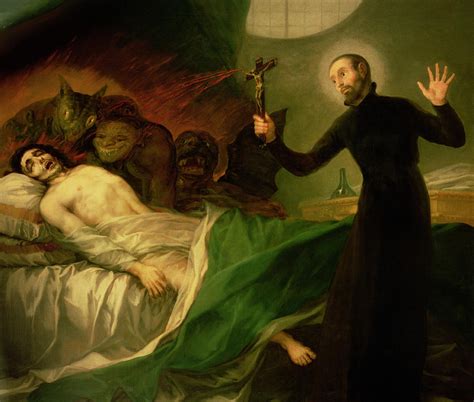
Painting “Saint Francis Borgia Helping a Dying Impenitent” by Francisco Goya
What Is an Exorcism Prayer?
An exorcism prayer is a solemn invocation asking God to free a person, place, or object from demonic influence or possession.
Biblical Foundation: Exorcism Prayer in the Bible
Scripture provides the foundation for all exorcism prayers. The Gospels themselves are filled with accounts of Jesus casting out demons, such as the healing of the Gerasene demoniac (Mark 5:1-20) and the boy possessed by a mute spirit (Mark 9:16-29). These passages form the scriptural foundation of the Church’s exorcistic ministry.
Read also: "The Exorcism of Emily Rose" True Story
Types of Exorcism in the Catholic Church
There are two forms of exorcisms in the Catholic Church: simple and major.
- Simple or Minor Exorcism: This type of exorcism is used in Baptism, the Rite of Christian Initiation of Adults, and the Rite of Baptism for Children. This form of exorcism utilizes prayers to help ward off sin and evil in a person’s life. Prayers are available to the people for their own private usage in their struggles against dark influence.
- Solemn or Major Exorcism: This type of exorcism is only used when there is a genuine case of demonic possession, which is when the devil is present inside someone’s body and exercises control over it, and is meant to cast out the demon to liberate the afflicted person. A bishop or priest who is granted permission by the diocesan bishop or local ordinary is only allowed to perform the Rite of Major Exorcism.
How to Perform an Exorcism Prayer
Performing an exorcism prayer requires spiritual preparation, faith, and a proper approach.
Preparation Steps
The Church has always taught that exorcism is not to be sensationalized or treated superstitiously. As the Rituale Romanum notes, the exorcist should investigate thoroughly whether the case involves true possession or some natural illness.
Before any exorcism is performed, assessments and evaluations are conducted on the afflicted person. After their physical and mental health are both studied, the person may then be referred to an exorcist for examination. In the end, the church makes the decision whether the exorcism should be performed or not.
The Prayer Process
The basic aspects of exorcism include prayer, invocations, and blessings to free a person - whom is still believed to have free will - from demonic possession. When performing an exorcism, the depreciative formula MUST be used before the imperative, and it is not required that you use the imperative. For example, exorcists like to read excerpts from the Bible relating to exorcisms performed by Jesus. Certain prayers like the Lord’s Prayer, Hail Mary, and the Athanasian Creed are also often used. One of the strongest prayers in Catholicism used in an exorcism is the prayer to Archangel Michael against Satan and the Rebellious Angels.
Read also: Become an Exorcist: Training
Important Warnings
The Vatican altered the guidelines for exorcism in 1999. The faithful must never view the devil as equal in power to God. The devils can never do anything which God does not permit.
Catholic Exorcism Prayer Traditions
Throughout history, several prayers have become prominent in Catholic exorcism traditions.
Pope Leo XIII Exorcism Prayer
Pope Leo XIII, who reigned from 1878 to 1903, composed a specific prayer to St. Michael the Archangel. This prayer is often associated with exorcism and spiritual warfare.
The Prayer to St. Michael
The Prayer to St. Michael is a powerful invocation for protection against evil. The complete version is longer and more commanding, directly addressing Satan and rebel angels.
St. Michael the Archangel, defend us in battle. Be our protection against the wickedness and snares of the devil. May God rebuke him, we humbly pray; and do thou, O Prince of the Heavenly Host, by the power of God, thrust into hell Satan and all evil spirits who prowl about the world seeking the ruin of souls. Amen.
Read also: Learn about folklore and science
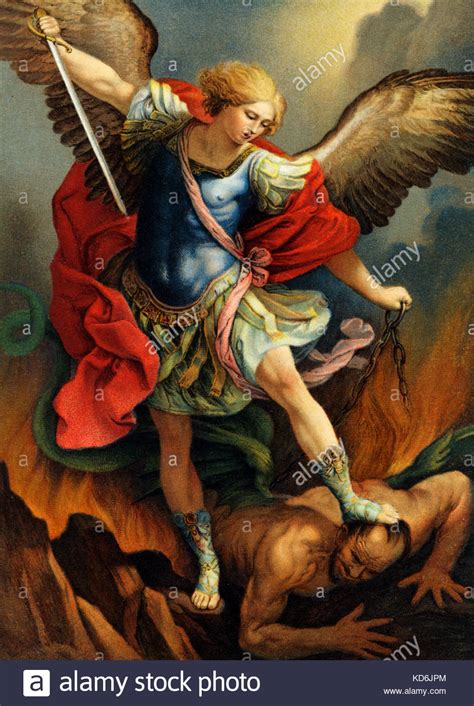
Saint Michael Defeating Satan by Guido Reni
St. Benedict Prayer for Exorcism
St. Benedict of Nursia, the founder of the Benedictine Order, is known for his spiritual protection against evil. The St. Benedict Medal and associated prayers are often used in exorcism and deliverance.
The St. Benedict Medal Prayer
The St. Benedict Medal contains specific Latin initials representing a prayer of exorcism and protection.
The initials on the medal stand for:
- C.S.P.B.: Crux Sancti Patris Benedicti (The Cross of our Holy Father Benedict)
- C.S.S.M.L.: Crux Sacra Sit Mihi Lux (May the Holy Cross be my light)
- N.D.S.M.D.: Non Draco Sit Mihi Dux (Let not the dragon be my guide)
- V.R.S.: Vade Retro Satana (Begone, Satan!)
- N.S.M.V.: Nunquam Suade Mihi Vana (Never tempt me with your vanities!)
- S.M.Q.L.: Sunt Mala Quae Libas (What you offer me is evil)
- I.V.B.: Ipse Venena Bibas (Drink the poison yourself!)
The traditional Rite of Exorcism is a powerful expression of the Church’s faith in Christ’s dominion over all spiritual powers.
Minor Exorcism Prayers
Not every situation requires lengthy formal prayers. Here are some examples of shorter prayers that can be used for personal protection, room blessings, and more:
- Quick Rebuke: “I rebuke you Satan in Jesus’ name."
- St. Michael Short Form: “St. Michael, defend us!"
- "Heavenly Father, I thank You for this new day. I cover myself and my family with the precious Blood of Jesus Christ. I bind every evil spirit that would try to influence my thoughts, emotions, or actions today. St. Michael the Archangel, stand guard over me, my home, and my loved ones. I seal this prayer in the mighty name of Jesus Christ, my Lord and Savior."
Exorcism Prayer Books
Several books contain prayers for use in exorcism and deliverance:
- Rituale Romanum: The traditional Rite of Exorcism is found in the Rituale Romanum, promulgated under Pope Paul V in 1614 and used with little modification until the late 20th century.
- De Exorcismis et Supplicationibus Quibusdam: In 1998, the Vatican issued De Exorcismis et Supplicationibus Quibusdam (“Of Exorcisms and Certain Supplications”), which updated the Rite of Exorcism.
- Minor Exorcisms and Deliverance Prayers: This book contains prayers for use by priests without faculties for the sake of helping to liberate those under diabolic influence, including several different forms of exorcisms.
The traditional Rite of Exorcism is a powerful expression of the Church’s faith in Christ’s dominion over all spiritual powers. Though few Catholics will ever witness a solemn exorcism, all are called to engage in spiritual warfare by living lives of virtue, avoiding sin, praying the Rosary, frequenting the sacraments, and relying on the intercession of the Blessed Virgin Mary. In an age of growing occultism and moral confusion, the traditional exorcism remains a bulwark of truth and a reminder that the Church alone possesses the full means to free souls from bondage to the evil one.