As with most safety equipment, you don’t fully appreciate emergency lighting and exit signs until you need them. Do you manage public buildings, offices, factories, or commercial spaces? If yes, you might have noticed glowing signs that show you the way out during emergency situations.
Any building or structure must comply with emergency exit sign codes to avoid potential fines and violations. In this guide, you will learn about emergency exit sign requirements and placement rules.
Regulatory Bodies and Codes
Several regulatory agencies and codes govern the installation, testing, and inspection of emergency lighting and exit signs. Several regulatory bodies have established codes that govern the installation, inspection, and testing of emergency lighting and exit signs. In addition to these national codes, there are often local requirements that apply to individual jurisdictions. In addition to the requirements stipulated by these bodies, employers must adhere to the requirements of their local authority having jurisdiction (AHJ).
For example, groups like NFPA, OSHA, IBC and NEC make these standard rules for international usage. OSHA stands for Occupational Safety and Health Administration, which provides some basic rules and regulations for protection of the public. OSHA incorporates other standards adopted by standard-producing organizations into their own. Generally, OSHA and NFPA set the requirements for exit signs.
OSHA and the National Fire Protection Association (NFPA) give the general requirements for means of egress.
Read also: Importance of Fire Sprinkler Room Signs
OSHA Requirements
OSHA’s requirements for lighting and marking exit routes fall under their 1910.37(b) laws. OSHA requires that "each exit route be adequately lighted so that an employee with normal vision can see along the exit route".
OSHA also requires that "each exit must be clearly visible and marked by a sign reading "Exit". 1910.37(b)(2). "Each exit route door must be free of decorations or signs that obscure the visibility of the exit route door." 1910.37(b)(3).
NFPA Guidelines
Meanwhile, NFPA also provides additional guidance on exit within its 2015 edition of NFPA 101, Life Safety Code, section 7.10. The requirements state that there is adequate lighting provided for each exit route.
The NFPA 101 Life Safety Code lists the emergency lighting requirements in section 7.9. The Life Safety Code also highlights the NFPA’s requirements for regular testing of egress lights. The test essentially needs both a monthly activation test and an annual test. The annual and monthly tests records must be maintained to be later availed to AHJ for inspection.
In 2000 the NFPA Life Safety Code was updated and now recognizes certain photoluminescent exit signs as an alternative to internally lighted electric powered signs.
Read also: Fire, Water, Earth, Air: A Jungian Perspective
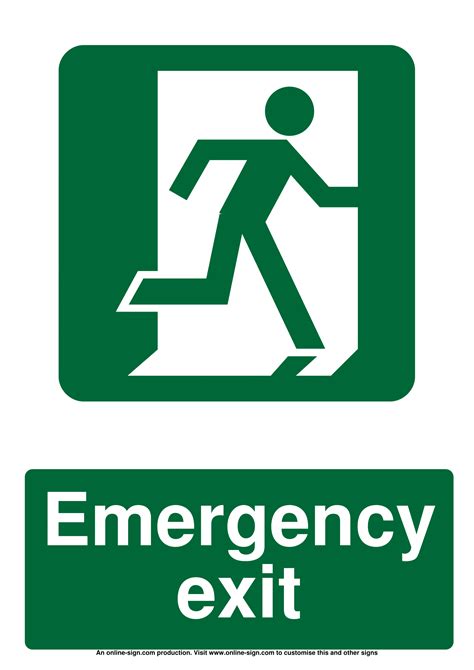
HOW TO INSTALL EXIT SIGN?
Key Requirements for Exit Signs
As a requirement, exit signs must be a distinctive color, and the word “Exit” should have legible letters no less than six inches high. Every sign must have the word "Exit" in plainly legible letters not less than six inches high, with the principal stroke of the letter .75 inches wide (29 CFR 1910.37(b)(7)). The illuminated surface value of the exit sign should have a value of not less than five foot-candles (29 CFR 1910.37(b)(6)).
Each exit sign must be illuminated to a surface value of at least five foot-candles (54 lux) by a reliable light source and be distinctive in color. The light source should give at least 5 foot candles (54 lux) of light.
Exit signs shall be illuminated at all times. Exit signs must always be illuminated. There are no exceptions to this in the Life Safety Code except for three approved existing exit signs.
Each exit sign must be illuminated to a surface value of at least five foot-candles (54 lux) by a reliable light source and be distinctive in color.
Exit signs are used where clear and safe exit routes are needed to help you. But it’s not just for buildings, all the factories, event venues, hospitals, schools, shopping malls and airports also require proper exit paths when the exit isn’t directly visible. Exit signs must be placed where they can clearly guide you during an emergency.
Read also: Safety Tips to Prevent Fires
Illumination Types
Exit signs shall be internally or externally illuminated.
- Externally illuminated: The light source is contained outside of the device or legend that is to be illuminated.
- Internally illuminated: The light source is contained inside the device or legend that is illuminated.
- Photoluminescent: The sign is illuminated by self-contained power sources and operates independently of external power sources.
Every required exit sign must be suitably illuminated by a reliable light source and be visible in both normal and emergency lighting modes (NFPA 101 2006 7.10.5.1).
Photoluminescent Signs
A photoluminescent sign absorbs light from an activation light source in order to emit light (that is, luminescence). The sign continues to emit light for a time after the activation light source has been removed. Photoluminescent exit signs are in the category of an internally illuminated sign.
The face of the photoluminescent sign must be continually illuminated while the building is occupied. The face of the sign shall be illuminated according to its listing from the face of the sign. The illumination has to be a reliable source as determined by the Authority Having Jurisdiction, AHJ. The charging light must be of the same type that is specified on the sign. Photoluminescent signs need a specific type of light and a minimum level of light on the face to assure that the sign will be able to provide adequate illumination in an emergency situation. During illumination the sign shall not be connected to an automatic timer.
Placement and Visibility
Exit signs must be placed where they can clearly guide you during an emergency. Actually, you can not install emergency signs at random places.
The line of sight to an exit sign must be unobstructed at all times. No other brightly illuminated sign, object, or display should be in the line of sight of the exit signs. There should not be any bright sign or board near emergency signs that may confuse people during emergency evacuation.
If it is not possible to immediately identify the direction of the exit route, signs must be put-up to indicate the direction of travel along the exit route. If the direction of travel to the exit or exit discharge is not immediately apparent, signs must be posted along the exit access indicating the direction of travel to the nearest exit and exit discharge.
Exit sign placement shall be such that no point in an exit access corridor or exit passageway is more than 100 feet (30 480 mm) or the listed viewing distance for the sign, whichever is less, from the nearest visible exit sign.
Each sign has a maximum distance limit like if you are placing exit signs in the hallway then must install them after 75 to 100 feet distance.
According to them, exit signs should be placed at a height between 2 meters to 2.7 meters from the floor.
Emergency signs should remain visible even during power failures, meaning a backup power source is required to keep your sign board on for at least 30 minutes. All the emergency lights must turn on automatically during power cuts and work for at least 30 minutes.
In case of stairways and ramps which continue beyond the main exit level, always mark that it’s not an exit.
Floor-Level Exit Signs
Meanwhile, some buildings need low-level exit signs. The ICC states that the bottom of low-level exit signs should have a minimum of 10’’ and a maximum of 12’’ from the floor level.
Where exit signs are required in Group R-1 occupancies by Section 1011.1, additional low-level exit signs shall be provided in all areas serving guestrooms in Group R-1 occupancies and shall comply with Section 1011.5. The bottom of the sign shall be not less than 10 inches (254 mm) nor more than 12 inches (305 mm) above the floor level. The sign shall be flush mounted to the door or wall. Where mounted on the wall, the edge of the sign shall be within 4 inches (102 mm) of the door frame on the latch side.
Color Considerations
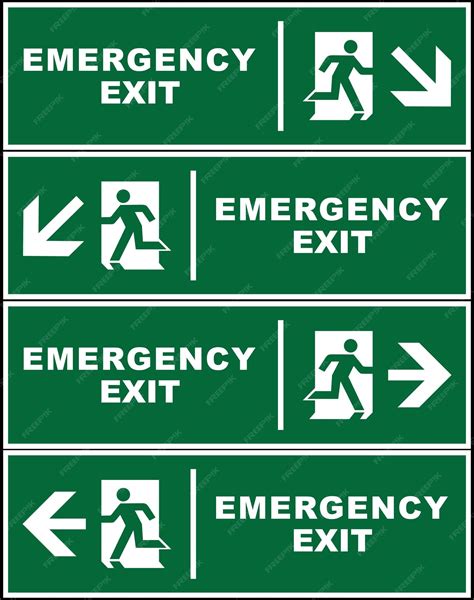
In many countries, red exit signs are used most commonly because red is the color of danger and warning. Actually, It instantly grabs your attention and represents urgency which is important in emergencies. Green exit signs are also used as emergency exit signs because green is commonly linked with safety & permission. It signals you to move forward during emergencies and clearly shows the safe path for panicked persons to follow.
Emergency Lighting
Emergency lighting is also known as egress lighting and needs to illuminate and identify corridors, stairwells, and exits to enable a safe and orderly evacuation from a facility. Need emergency lighting and exit sign services for your business?
Lights must be appropriately aimed to illuminate the exit routes; otherwise, the lighting will be counter-productive. Lights must be aimed appropriately to illuminate the walkway.
Any emergency equipment such as generators and associated transfer switch equipment that collectively provide power to an egress lighting system should be installed, tested, inspected, and maintained according to NFPA code.
Maintaining Compliance
It is essential to schedule monthly and annual inspections to ensure that your emergency exit sign lights remain up to code and you replace them when necessary. Exit signs must be illuminated at all times and include a backup battery for continued illumination in case of a power outage.
Basically, regular testing and maintenance are required to keep them in working condition. If emergency exit lights aren’t working then it is a serious safety risk you may face legal issues for this.
Obstructions and Access
Exit routes must be free and unobstructed. No materials or equipment may be placed, either permanently or temporarily, within the exit route. The exit access must not go through a room that can be locked, such as a bathroom, to reach an exit or exit discharge, nor may it lead into a dead-end corridor.
Employee Alarm System
An employee alarm system must be operable. Employers must install and maintain an operable employee alarm system that has a distinctive signal to warn employees of fire or other emergencies, unless employees can promptly see or smell a fire or other hazard in time to provide adequate warning to them.
Exceptions
1. Exit signs are not required in rooms or areas that require only one exit or exit access.
2. Main exterior exit doors or gates that are obviously and clearly identifiable as exits need not have exit signs where approved by the building official.
3. Exit signs are not required in occupancies in Group U and individual sleeping units or dwelling units in Group R-1, R-2 or R-3.
4. Exit signs are not required in dayrooms, sleeping rooms or dormitories in occupancies in Group I-3.
5. In occupancies in Groups A-4 and A-5, exit signs are not required on the seating side of vomitories or openings into seating areas where exit signs are provided in the concourse that are readily apparent from the vomitories. Egress lighting is provided to identify each vomitory or opening within the seating area in an emergency.
Final Thoughts
In the end, you now understand all legal requirements for emergency exit signs. If you ignore these rules, it can lead to serious safety risks and trouble for you. Need guidance on emergency lighting and exit requirements for your commercial building?
Remember, lights must be aimed appropriately to illuminate the walkway. If you need high-quality emergency exit signs manufacturer & supplier in China, Jackwin is your perfect partner.