The Incarnation Cross in Human Design is referred to as the “life theme” or “life purpose.” It’s a central narrative that informs how one moves through the world and contributes to the collective. But calling it a “life purpose” probably oversimplifies its significance. Rather than ascribing a singular mission to it, the Incarnation Cross describes the energetic background of one’s life journey and gives insight into the essence of what a person is here to experience, learn, and express.
The Incarnation Cross is often misunderstood as something synonymous with life purpose. While this is one of the greatest tools in understanding one’s life themes, the Incarnation Cross cannot be seen as a rigorous “to-do list” toward fulfillment; it just naturally reflects the energies of the person carried within, and their contribution toward one’s own way through life. For instance, a person with the Right Angle Cross of the Sleeping Phoenix will inevitably emanate transforming energy. How that comes to expression in their job, relationships, or creativity depends on other things in the chart and in their life circumstances. It’s a compass, not a map.
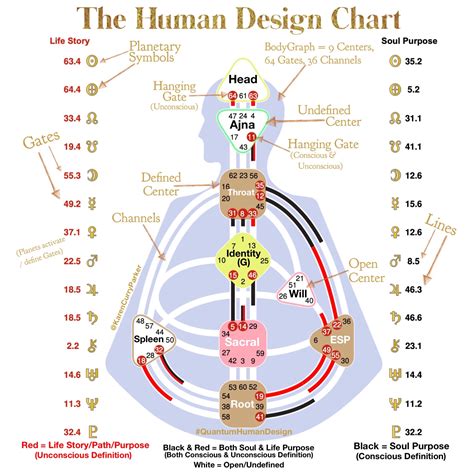
Example of a Human Design Chart
Origins of the Incarnation Cross
The origins of the Incarnation Cross come from the synthesis of seven main systems that make up what is called the Human Design System: ancient wisdom (astrology, the I Ching, the Kabballah Tree of Life, and the Chakra system), as well as modern science (neutrinos, quantum physics, and the human genetic code). In order to give structure to the major themes each carries, Ra Uru Hu synthesized this framework.
The Incarnation Cross draws heavily from both the Sun and Earth gates, which have traditionally been associated with purpose and grounding. The term “cross” in Incarnation Cross comes from the fact that these four gates cross each other on the Human Design mandala when mapped out, forming the shape of a cross. This crossing point represents the balancing of the conscious and unconscious influences and how they interact within one’s life.
Read also: Human Design: Triple Split Explained
The Incarnation Crosses are categorized into four types, each associated with a specific direction and energy. Though these crosses play a significant role in understanding one’s purpose, they are just one component of the intricate Human Design System.
The Seven Systems in Human Design
The Incarnation Cross originates in the combination of the seven main systems upon which Human Design is based:
- Astrology: Associations of the Sun and Earth, in that order, as most determining factors for the Incarnation Cross, have, since time immemorial, been carried out with identity, purpose, and grounding.
- The I Ching: Each of the gates in a Human Design chart is a representation of the hexagrams of the I Ching. The crossing of gates in Incarnation Crosses brings dynamic themes of change, balance, and flow into play.
- The Kabballah Tree of Life: In the very structure of the cross, there is a balance between higher and lower energies, indicating a way of harmonizing spiritual and earthly realms.
- The Chakra System: The gates and centers each have their correspondences within human energy dynamics, illustrating how each cross channels and expresses these forces uniquely.
- Neutrinos: These tiny subatomic particles pass through everything and play a vital role in Human Design by carrying information that imprints your design at birth and three months prior, connecting your Incarnation Cross to the fabric of the cosmos.
- Quantum Physics: Human Design reveals the interconnectedness of all things, showing how your Incarnation Cross reflects both the celestial mechanics of the universe and your unique quantum potential.
- The Human Genetic Code: Human Design links directly to your DNA, with gates corresponding to genetic codons that shape the energetic patterns of your life’s themes and purpose.
Understanding the Angles: Right, Left, and Juxtaposition
There are 3 kinds of prefixes you can have in front of your incarnation cross. Left Angle - Your purpose is transpersonal, meaning you must interact with others to fulfill it. Right Angle - Your purpose is solely personal, meaning you work alone to fulfill it. Juxtaposition - Your purpose is your purpose regardless of interaction or no interaction. Universe don’t really give a holy heck gosh darn if anyone else is there for the ride with you. Just get it done, okay?
Every Incarnation Cross is either one of three types: Right Angle, Left Angle, or Juxtaposition. These types determine the perspective and approach to life a person has toward themselves and others.
1. Right Angle Crosses (Personal Theme)
The Right Angle Cross is primarily associated with Personal Destiny. Right Angle Crosses have to do with personal karma and themes. Individuals with Right Angle Crosses are here to concentrate on their personal journey, growth, and self-discovery. In other words, they are less concerned with the group or interpersonal repercussions of what they do; they are focused on themselves. For instance, someone with a Right Angle Cross of the Vessel of Love might spend their whole life investigating and expressing the energy of love in all its forms: self-love, love for others, or universal love.
Read also: Human Design: Closed Taste
Such individuals often find that their path, while deeply personal, serves as an example or guide for others. There’s a certain magnetic quality to those with a Right Angle Cross. Others are drawn to their authentic nature and the clarity with which they move through life. Challenges for them might arise when they feel pressured to conform or live according to someone else’s expectations. The beauty of the Right Angle Cross is in witnessing the ripple effect.
Characteristics:
- Self-contained individual development
- Themes are self-sustaining and less influenced by others
- The purpose tends to emerge through personal experiences
2. Left Angle Crosses (Interpersonal Theme)
The Left Angle Cross signifies a transpersonal destiny, suggesting that one’s life purpose is intertwined with others. Left Angle Crosses relate to transpersonal karma, meaning that these individuals have a strong connection with the lives of other people. The themes of such individuals often involve making a difference, connection, or relationship in some group dynamic. They can fulfill their purpose in guiding, teaching, or leading others. For example, the Left Angle Cross of Education contains an innate impulse to teach or share knowledge and wisdom with others; hence, education or guidance becomes the core theme.
These individuals often find themselves in positions where they are either guiding or being guided. There’s a dance of give and take, where both parties benefit from the relationship. Challenges for those with a Left Angle Cross often revolve around relationships. They might find themselves in situations where they feel they’re giving more than they’re receiving or vice versa. The beauty of this cross is in the shared journey. When two individuals come together for mutual evolution, the growth experienced is profound. The Left Angle Cross teaches the value of interconnectedness.
Characteristics:
Read also: Profile 1/3: Investigator Martyr
- Centered on relationships and group influence
- Themes usually involve cooperation or impact on others
- Purpose might develop through interactions and mutual experiences
3. Juxtaposition Crosses (Fixed Theme)
The Juxtaposition Cross signifies a fixed fate. Juxtaposition Crosses fall between Right and Left Angle Crosses and represent a special, fixed life theme. People with this cross have a very defined role or frequency that they have come in to represent. Their life purpose will feel less fluid and more about holding some sort of space or message. For instance, the Juxtaposition Cross of Alertness has a theme of being extremely aware of their surroundings; they are a type of lookout in the community.
Those with this cross have a specific and focused purpose in life. It’s like they’re on a straight road, moving towards a predestined goal. Because of this fixed nature, individuals with a Juxtaposition Cross often find comfort in routines and consistency. However, the challenge lies in the possibility of becoming too rigid. A strict adherence to routine or resistance to change can become limiting. Another aspect of this cross is that while the journey is fixed, the destination’s impact is broad. It’s essential for Juxtaposition Cross bearers to trust their path.
Characteristics:
- Fixed and unchanging themes
- Tend to be more fixed in the way they live their life
- Life Purpose is related to expressing a particular essence or function
The Three Angles in Human Design: Right Angle, Left Angle, Juxtaposition
INCARNATION CROSS HUMAN DESIGN (DISCOVER YOUR DESTINY?!)
Symbolism of the Cross
The cross itself symbolizes balance and alignment. Its four quadrants-the Conscious Sun, Conscious Earth, Unconscious Sun, and Unconscious Earth-symbolize the fusion of light and shadow, self and other, grounding and aspiration. Each element has its role:
- The Sun Gates represent the conscious (black) and unconscious (red) expression of the individual. These gates are the “what” of the cross and shape both the outward themes and internal drivers.
- The Earth Gates represent conscious (black) and unconscious (red) grounding and stability, offering a foundation that allows the Sun’s energies to be brought into the world. These gates are the “how,” anchoring the journey.
The cross itself symbolizes a meeting point: the sacred intersection of internal drives and external expression. It’s the symbolic crucible where identity is forged, lessons are learned, and life themes are played out. In many ways, the Incarnation Cross represents the “storyline” of our personal movie that overlays the journey of self-realization.
Archetypal Significance
The Incarnation Cross names, such as the “Cross of the Sleeping Phoenix” or the “Cross of the Vessel of Love,” carry archetypal significance. These names are not simply labels; they evoke mythic narratives and universal energies that transcend the individual. For instance:
- The Right Angle Cross of the Sleeping Phoenix symbolizes cycles of death and rebirth, transformation, and renewal.
- The Left Angle Cross of Masks speaks to the interplay between authenticity and the personas we present to the world.
- The Juxtaposition Cross of Alertness embodies hyper-awareness and the necessity of vigilance in a changing environment.
These archetypes not only inform the life themes of the individual but also connect them to the collective of humanity. Through the cross, individuals become a conduit for archetypal energies that ripple out into the world at large.
Mythic Narratives
Myths are really the deep undercurrents in understanding the Incarnation Crosses in Human Design. Every cross is so much more than a technical arrangement of gates and planetary influences; it’s suffused with rich, archetypal stories echoing through time, resonating with the human psyche. These mythic narratives actually provide a framework for understanding the energies and life themes that are represented in one’s design.
For instance, the names of certain Incarnation Crosses, such as the Cross of Consciousness or the Cross of the Sphinx, bring to mind universal stories that deeply resonate with the human experience. The Cross of Consciousness speaks of an eternal journey of awakening, self-awareness, and seeking truth; the Cross of the Sphinx carries the energy of guidance, direction, and searching for meaning. These archetypal symbols connect the individual into a larger collective experience, providing a lens through which to view their life’s themes and challenges. Mythology brings a sense of universality, showing how one’s personal journey mirrors greater cosmic patterns.
Universal Archetypes and the Human Condition
These universal archetypes are associated with the human condition of struggling, triumphing, learning, and growing. Much deeper layers are to be discovered about the meaning and purpose in life while researching the mythological connections of these gates and how they interact in the cross. Mythology in the Incarnation Crosses provides a bridge between the abstract and the tangible. It turns the abstract energies into understandable stories where one can get in touch with their design in the most personal way and yet be universally significant.
To bring the cosmic narrative alive through the cross, mythology allows it to become a storytelling tool rather than an analytical one. The history and symbolism of the Incarnation Cross deepen its meaning in Human Design. It is not only a guide to personal growth but also a map of how individual energy contributes to the collective. In knowing this history and symbolism, one will be able to appreciate the Incarnation Cross as a vital key in unlocking not only one’s personal purpose but also the collective human existence.
Incarnation Cross Gate in an Undefined Center
In Human Design, the placement of a gate that forms part of an Incarnation Cross in an undefined center carries significant implications for one’s energetic expression and life purpose. When a gate is located in an undefined center, its energy becomes less fixed and more susceptible to external influences. This undefined status means that instead of having a consistent, reliable way of expressing that particular theme or quality, the individual may experience fluctuations based on their environment, the people they interact with, and the energy dynamics at play.
An Incarnation Cross represents a person’s life’s design and purpose, synthesizing several key themes of one’s chart. When one of these critical gates lies in an undefined center, it introduces a level of variability and potential for learning through experience. This placement often indicates that the individual is here to explore that theme in a more fluid and dynamic way, absorbing different perspectives, and ultimately integrating diverse energies into a coherent personal narrative. It can also signal an area where conditioning from others may occur, making it essential for the individual to develop awareness and discernment regarding which influences are authentically theirs and which are imposed externally.
Embracing this undefined quality allows for a richer, more flexible approach to life’s challenges. It encourages continuous growth and adaptation, teaching the individual to navigate life with openness and curiosity, ultimately evolving a more expansive understanding of their unique design.
Finding Your Incarnation Cross
The Incarnation Cross is found through the Sun and Earth positions in your conscious (black) and unconscious (red) charts. These are found in the first two columns of your Human Design bodygraph, usually notated by a gate number. For instance, the Vessel of Love consists of these gates:
- Conscious Sun: Gate 10.5
- Conscious Earth: Gate 15.5
- Unconscious Sun: Gate 34.6
- Unconscious Earth: Gate 20.6
These four gates make up your Incarnation Cross. The Incarnation Cross’s proper name is in most chart-generating software programs, and this will generally include a broad outline of the entire theme.
Finding Your Incarnation Cross on Your Chart
Addressing Confusion and Embracing the Journey
If you don’t understand your Incarnation Cross, it’s good to remember that Human Design is a journey not a destination. The Incarnation Cross can seem abstract or overwhelming at first, as it represents such a huge theme of purpose and life direction. However, not fully understanding this at the beginning does not take away its power and value.
Here’s what you can do if there is any confusion:
- Start with the basics. Focus first on understanding your Type, Strategy, and Authority. These foundational aspects of Human Design provide the tools for navigating life in alignment, which naturally leads to a deeper understanding of the Incarnation Cross over time.
- Explore the gates. Familiarize yourself with the gates that form your Incarnation Cross. Learn their meanings, both singly and in relationship to each other, within your conscious personality and unconscious design. This really starts to define what special characteristics and challenges you bring into your life’s journey.
- Recognize patterns. The Incarnation Cross will often mirror patterns or themes that have repeated themselves in your life. Look back at major events, relationships, or turning points in your life to see if they are described by the energies of your cross.
- Seek Guidance. Working with a Human Design analyst will bring clarity.
The Overarching Storyline of Our Lives
Ra Uru Hu, the founder of Human Design, had an incredible gift for merging complex systems into something deeply personal and profound. He created a framework that connects the vastness of celestial mechanics to our unique energetic blueprint. The Incarnation Cross, in particular, is like the overarching storyline of our lives. It’s where the grand, universal order intersects with our personal experiences. It’s not abstract-it’s how those themes play out in the very real, everyday moments of our lives. It’s our piece of the greater cosmic puzzle, and it unfolds in a way that’s both universal and uniquely ours. One might say it is our unique movie in which we have the starring role.
tags: #inkarnationskreuz #human #design