Jimmy Page, the legendary guitarist of Led Zeppelin, is not only known for his musical virtuosity but also for his deep interest in the occult. This fascination, particularly with the work of Aleister Crowley and Austin Osman Spare, significantly influenced Led Zeppelin's music and imagery, leaving a lasting impact on rock culture.
It’s easy to turn your nose up at any mention of Aleister Crowley, especially if you have little interest in the occult and esoteric world in which he thrived. For the uninitiated, Crowley (1875-1947) was a British writer who used sex, drugs and magic -often simultaneously - to try to attain altered states of mind and who achieved such a level of notoriety for his activities that he was brandished the ‘wickedest man in the world’. If not wicked, he was certainly a character.
To give a flavour of Crowley’s often bizarre intersections with normal society, in the early days of the Second World War he was tapped up by British intelligence officer Ian Fleming, who asked him to take part in an ‘occult disinformation plot’ against Adolf Hitler’s deputy Rudolf Hess, a fervent believer in astrology and the occult. Crowley was keen, but the plot was ultimately shelved; Fleming, however, later used Crowley as the model for villain Le Chiffre in his first James Bond novel, Casino Royale, in 1953.
Another fan of Crowley was Scientology founder L Ron Hubbard. It is claimed Hubbard took part in ‘sexual magick’ (magick was a term favoured by Crowley) with a couple called Jack and Betty Parsons in an attempting to create a magical child, thus fulfilling a prophecy from Crowley’s The Book Of The Law. Crowley was not impressed, writing in one of his typically entertaining letters: ‘Apparently Parsons or Hubbard or somebody is producing a Moonchild.
Crowley was bisexual and a heavy drug user, eventually becoming addicted to heroin. He also enjoyed peyote, handing it out at parties. On one occasion in New York he gave some to the novelist Theodore Dreiser, who became uncomfortable and asked if there was a doctor in the area. This freeness with sex and drugs saw Crowley embraced by the rock and roll generation, particularly after he appeared on the cover of Sgt Pepper.
Read also: Unveiling Jimmy Fallon's zodiac sign
In 1977, Essex rockers Eddie And The Hot Rod wrote a song that was partly inspired by Crowley’s famous motto: ‘Do what thou wilt is the whole of the law’. The band rewrote this as “Do Anything You Wanna Do”, a spirited ode to self-empowerment, and attached the lyrics to a perky pop tune that quickly reached the Top Ten. In recognition of his contribution to the song’s genesis, the band decided to put Crowley on the cover of the single. Great cover, big mistake.
According to rumour, this image soon came to the attention of Jimmy Page, a Crowley apostle who lived in the Crowley’s old house, had a vast collection of Crowley paraphernalia and was fascinated by the occult. The band were told that Page placed a curse upon Eddie And The Hot Rods for their disrespectful treatment of the Great Beast. From that moment, the band were plagued by problems. They were dropped by their label, their manager became hooked on heroin and they never bothered the higher reaches of the chart again.
Page's interest in the occult extended beyond Crowley to include figures like Austin Osman Spare. In recent years it has become known that the world’s most prolific collector of paintings by Austin Osman Spare, sometimes described as Britain’s greatest unknown artist, is Jimmy Page. The work he has collected includes Spare’s 1907 Portrait of the Artist.
It should not surprise you to learn that Spare was not only a visionary artist, but also a philosopher and occult musician; he was the inspiration for what is now known as chaos magic. One of Spare’s specialities were his sidereal paintings, as though you were looking at a cinema screen from the side. Looking at Spare’s paintings, you may receive similar impressions as you would when listening to the music of Led Zeppelin: images from the far, far past coupled with those from a distant science-fiction future - what you imagine and what you see are equally valid and interrelated.
Always taken with notions of mysticism and other worlds, Spare - like his mentor for a brief time, Aleister Crowley - claimed to have had direct experience of the existence of extra-terrestrial intelligence. (Around the time of the recording of Led Zeppelin IV, Spare was championed by Kenneth Grant, a protégé of Crowley, in the popular Man, Myth and Magic encyclopaedia partwork, which commenced publication in 1970.)
Read also: Page of Cups Interpretations
Among the several methods through which Spare communicated his art were his use of sigils, influenced by Egyptian hieroglyphics. He would elaborate these sigils by condensing letters of the alphabet into what have been described as ‘diagrammatic glyphs of desire, which were to be integrated in postural practices’ - yoga, in other words. These sigils would thereby become ‘monograms of thought, for the government of energy’. Spare was endeavouring to rediscover the evangelical concept of the ‘word’ as a magical complex image.
Also a writer, in his grimoire The Book of Pleasure Spare spoke of the Zos Kia Cultus, a philosophy of magic he developed that focuses on one’s individual universe and the influence of the magician’s will on it; a way of thinking - influenced by Aleister Crowley - that was very familiar to Jimmy Page.
And Zos, of course, is only one letter away from Zoso. For his part Jimmy Page has often maintained that Zoso was intended purely as a representative of Saturn, the ruling planet of his Capricorn sun sign, the ruler of hard work, adamantine will and strength, and necessary strengthening restriction. The influence of Austin Osman Spare on Jimmy Page’s choice of rune - or sigil - seems rather clear.
This interest manifested in various ways, most notably in the symbolism and imagery associated with Led Zeppelin IV. Each member of Led Zeppelin was represented on the sleeve by a sigil, a rune-like symbol, a clear reflection of Page’s occult interests, and also of Robert Plant, even if the latter’s were less obsessive: the singer’s fondness for the Viking oracle method of runes had been solidified on the group’s trip to Iceland. These were not archetypal symbols. But devised by each individual in the band. Both John Paul Jones and John Bonham took their sigils from Rudoph Koch’s The Book of Signs.
But what of Jimmy Page’s rune? The sigil that became known as Zoso, by which Led Zeppelin IV was sometimes termed before Jimmy himself adopted it as a kind of sobriquet? (He even named his own photographic autobiography, published much later, Zoso.) As might be expected from the ever precise and measured Jimmy Page, the origins of Zoso were considerably more arcane.
Read also: Reconciliation in Tarot
The occult elements of the sleeve were only followed through on the central gatefold image. A painting that was a re-working of the Hermit, the ninth card of the major arcana in the Rider-Waite tarot pack, which represents Prudence. The staff the Hermit bears is a symbol of his authority. In its archetypal sense, the Hermit, a reclusive, solitary figure, shines the light of a lamp on matters and desires to give solitary time for thought to himself, whilst simultaneously not permitting others to stand in his way.
As an image it evidently appealed to him: in the 1976 Led Zeppelin film The Song Remains the Same, he would chose such a character as a representation of himself. The painting of the Hermit on the inner sleeve was by a supposed friend of Jimmy Page’s called Barrington Coleby.
Visiting a second-hand shop in Reading, on the way to Headley Grange with Jimmy Page, Robert Plant unearthed a nineteenth-century painting of a rustic character bent low by the burden he carried on his back. This figure, Jimmy would immediately have noted, bore a distinct resemblance to ‘Old George’ Pickingill, who it was believed had first instructed Aleister Crowley in the occult arts. Is this story true? Or was the image of this fellow created specifically for the album? Furthermore, although this rustic figure is considerably older, there is a distinct resemblance to the character in the tarot card the Ten of Wands.
Whatever its provenance, this was the central image that featured on the front sleeve of Led Zeppelin’s fourth album, affixed to a decaying house wall and overlooked by a Birmingham tower block; almost unnoticed is a poster for Oxfam that reads: ‘Someone dies from hunger everyday.’ Were Led Zeppelin - or more likely Jimmy Page, who was heavily involved with the design of each LP sleeve - professing to be carrying the weight of the eco world on their back?
Led Zeppelin became one of the best-selling music groups in the history of audio recording. Various sources estimate the group's worldwide sales at more than 200 or even 300 million albums. With 111.5 million RIAA-certified units, they are the second-best-selling band in the United States. Led Zeppelin were the progenitors of heavy metal and hard rock. Their sound was largely the product of Page's input as a producer and musician.
The band's individualistic style drew from a wide variety of influences. They performed on multiple record-breaking concert tours that earned them a reputation for excess. Led Zeppelin broke up in 1980 following the death of Bonham at Page's home.
The Curse of Led Zeppelin | Music's Dark Side
In conclusion, Jimmy Page's fascination with the occult, particularly his deep dive into the teachings of Aleister Crowley and the artistic expressions of Austin Osman Spare, played a pivotal role in shaping the unique identity of Led Zeppelin. This influence permeated their music, album art, and overall mystique, contributing to their enduring legacy as pioneers of hard rock and heavy metal.
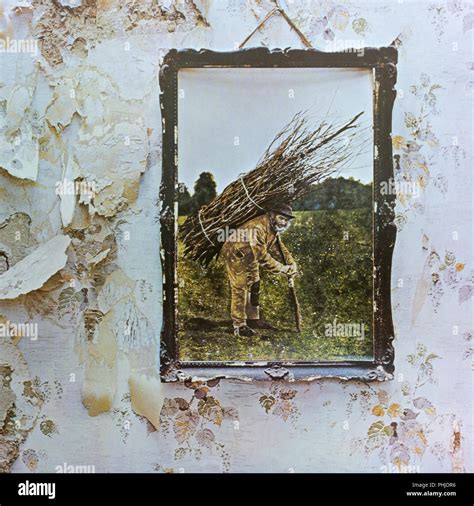
Led Zeppelin IV Album Cover, showcasing occult symbolism
Table: Key Figures Influencing Jimmy Page's Occult Interests
| Figure | Influence |
|---|---|
| Aleister Crowley | His writings and philosophies on magic and altered states of consciousness |
| Austin Osman Spare | His sigils, art, and theories on chaos magic and the power of the individual will |

Jimmy Page