The constellation Libra, known as the Scales or the Balance, is one of the 12 zodiac constellations representing an inanimate object. It is located in the southern sky and is associated with justice and balance. Libra is the only constellation in the sky to represent an object rather than a living being!
Libra is the 29th constellation in size, occupying an area of 538 square degrees. It lies in the third quadrant of the southern hemisphere (SQ3) and can be seen at latitudes between +65° and -90°.
The neighbouring constellations are Centaurus, Hydra, Lupus, Ophiuchus, Scorpius, Serpens Caput and Virgo.
The constellation name Libra is pronounced /ˈli:brə /. In English, the constellation is known as the Scales. The genitive form of Librae, used in star names, is Librae (pronunciation: /ˈlaɪbriː/). The three-letter abbreviation, adopted by the International Astronomical Union (IAU) in 1922, is Lib.
Libra belongs to the zodiac family of constellations, along with Aries, Taurus, Gemini, Cancer, Leo, Virgo, Scorpius, Sagittarius, Capricornus, Aquarius and Pisces.
Read also: Libra Man: Love & Relationships
Libra contains four stars with known planets and does not have any Messier objects. The brightest star in the constellation is Zubeneschamali, Beta Librae, with an apparent magnitude of 2.61. The constellation hosts 83 visible stars (brighter than magnitude 6.50). There is one meteor shower associated with the constellation, the May Librids.
Libra contains four formally named stars. The star names approved by the International Astronomical Union (IAU) are Brachium (Sigma Librae A), Zubenelgenubi (Alpha2 Librae), Zubenelhakrabi (Gamma Librae A), and Zubeneschamali (Beta Librae).
The best time of the year to see the constellation of Libra is during the month of June, when it appears higher above the horizon around 9 pm.
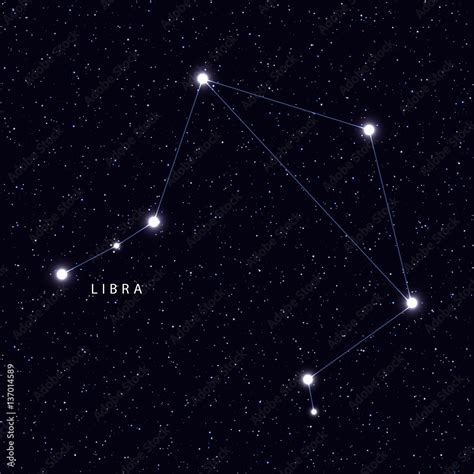
Libra constellation map by IAU and Sky&Telescope magazine
Historical Background and Mythology
Libra's historical background and mythology intertwine with the cultural narratives of ancient civilizations, spanning across various epochs and geographical regions.
Read also: Libra Full Moon: Spiritual Awakening
Ancient Greeks knew the part of the sky occupied by the Libra constellation as Chelae, or “claws,” and considered it part of Scorpio constellation. Chelae represented the Scorpion’s claws. The association of this region of the sky with scales was established by the Romans in the 1st century BCE.
Once Libra became associated with balance, its association with Scorpio’s claws faded and the one with the goddess of justice, the Greek Dike or Astraeia, represented by the constellation Virgo, became stronger.
As a reminder that Libra was once considered a part of the constellation Scorpius, the brightest star in Libra, Beta Librae, has the name Zubeneschamali, which means “the northern claw” in Arabic, while Alpha Librae, Zubenelgenubi, is “the southern claw.”
It is said that Moon was located in Libra when Rome was founded. The Romans considered Libra to be a favoured constellation, one associated with balanced seasons and equal length of night and day. The Sun was at the autumnal equinox in Libra until the year 729, when the precession of the equinoxes shifted the equinox to Virgo. The autumnal equinox will move to constellation Leo in the year 2439.
Libra constellation: facts about the scales
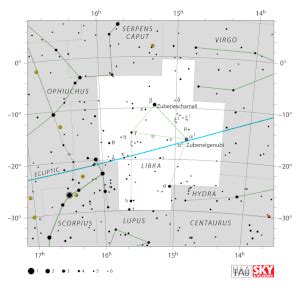
Figure 1. IAU chart of Libra. Credit: IAU and Sky & Telescope.
Read also: Libra Ascendant: Traits, Love, and Life Path
In ancient Mesopotamia, the constellation of Libra was associated with the sun's entry into the autumnal equinox, marking the beginning of the fall season. The Babylonians, renowned for their advanced astronomical observations, considered this celestial event as a pivotal moment in their agricultural calendar, signifying the transition from warmth and abundance to colder months and scarcity.
In Greek mythology, the scales of Libra are often attributed to the goddess Themis, who personified divine law and order. Themis was considered one of the Titans, primordial deities who ruled the cosmos before the reign of the Olympian gods. As the embodiment of justice, Themis was often depicted holding scales to symbolize the careful weighing of evidence and the fair dispensation of judgment.
Another prominent figure associated with Libra in Greek mythology is Astraea, the daughter of Zeus and Themis. Astraea, meaning "star-maiden," represented innocence and purity and was revered as the goddess of justice. According to myth, she lived among mortals during the Golden Age, a period of peace and prosperity when humanity lived in harmony with the gods. However, as humanity's moral character deteriorated, Astraea retreated to the heavens, becoming the constellation Virgo.
The Romans adopted many of the Greek myths and associated their own deities with celestial phenomena. In Roman mythology, Libra is often linked to Lustitia, the goddess of justice and fairness. Depicted blindfolded and holding scales and a sword, Lustitia personified impartial judgment and the rule of law.
Throughout history, the symbolism of Libra as a representation of balance, fairness, and justice has persisted across diverse cultures. Its presence in the night sky continues to inspire contemplation and reflection on the moral and ethical principles that govern human civilization.
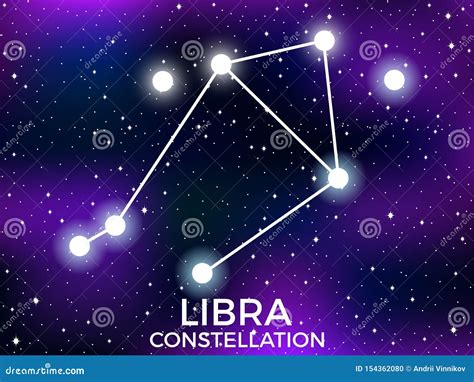
Libra constellation, image: Till Credner (CC BY-SA 3.0)
Major Stars in Libra
Libra is one of the fainter constellations of the zodiac. It does not contain any first or second magnitude stars. Like all zodiac constellations, it is easily visible from the northern hemisphere.
The three brightest stars in Libra - Zubeneschamali, Zubenelgenubi and Brachium - are easy to find because they shine at third magnitude and appear as the extended claws of the brighter Scorpius. Together with the fainter Zubenelhakrabi, they form the main constellation figure of the celestial Scales.
Zubeneschamali and Zubenelgenubi form the balance beam and Brachium and Zubenelhakrabi mark the weighing pans. Upsilon and Tau Librae are sometimes included as part of one of the weighing pans.
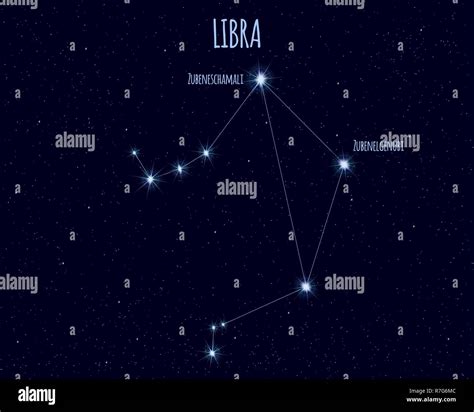
The brightest stars of Libra, appearing right of the Scorpion’s claws, image: Wikisky
Zubeneschamali - β Librae (Beta Librae)
Zubeneschamali (β Lib) is the brightest star in Libra. It has an apparent magnitude of 2.61 and is approximately 185 light years distant from the solar system.
The star’s proper name, Zubeneschamali, comes from the Arabic phrase al-zuban al-šamāliyya, which means “the northern claw.” The name dates back to the time when the stars of Libra were seen as part of Scorpius and represented the Scorpion’s claws. The star’s Latin name is Lanx Borealis, or “the northern scale.”
Zubeneschamali has the stellar classification B8 V, indicating a hot blue-white main sequence star. It has a mass of 3.5 solar masses and a radius 4.9 times that of the Sun.
The star is a very fast spinner, with a projected rotational velocity of 250 km/s. It shines with a luminosity of 130 Suns and has an estimated age of only 80 million years.
Beta Librae is catalogued as a single star, but it shows small periodic variations in luminosity (0.03 of a magnitude), which may indicate the presence of a companion.
Zubenelgenubi - α Librae (Alpha Librae)
Zubenelgenubi (α Lib) is the second brightest star in Libra. It lies approximately 75 light-years away.
The name Zubenelgenubi is derived from the Arabic phrase al-zuban al-janūbiyy, which means “the southern claw.” The system is also sometimes known as Kiffa Australis or Elkhiffa Australis. Both names are partial Latin translations and come from the Arabic phrase al-kiffah al-janūbiyy, which means “the southern pan (of the scales).” An older Latin name for the star is Lanx Australis, or “the southern scale.”
Alpha Librae is in fact a multiple system composed of an F-type main sequence star (α1 Lib) and an A-type star (α2 Lib) that is coming to the end of its main sequence lifetime. The brighter Alpha2 Librae has an apparent magnitude of 2.741 and Alpha1 Librae shines at magnitude 5.153.
The two components are separated by 231 arcseconds in the sky, corresponding to a physical distance of about 5,400 astronomical units (AU). Both visual components - Alpha1 and Alpha2 Librae - are themselves spectroscopic binary stars.
The components of Alpha1 orbit each other with a period of 5,870 days at an angular separation of 0.383 arcseconds (10 AU). The components of Alpha2 Librae have masses of 1.95 and 1.79 solar masses.
The Alpha Librae system may have another component. The star KU Librae lies at a separation of 2.6 degrees, corresponding to a physical distance of about 1 parsec. Even though it has a similar proper motion and may be just close enough to be gravitationally bound to the other stars, KU Librae has a different abundance of metals and may not be related to the system.
The Alpha Librae system lies close to the ecliptic and can be occulted by the Moon and, much less frequently, by planets. It will next be occulted by a planet (Mercury) on November 10, 2052.
Brachium - σ Librae (Sigma Librae)
Brachium (σ Lib) is a red giant of the spectral type M2.5III. It has an apparent magnitude of 3.29 and lies approximately 288 light-years away. It has 2.2 times the Sun’s mass and a radius 108 times that of the Sun.
The evolved giant star has an effective temperature of 3,596 K and shines with 1,820 solar luminosities.
The star’s traditional name, Brachium, is Latin for “arm.” Sigma Librae was historically also known as Cornu (Latin for “horn”). It once shared the names Zubenalgenubi or Zuben el Genubi (Arabic for “the southern claw”) with Alpha Librae and Zuban Alakrab (“the claws of the Scorpion”) with Gamma Librae.
Brachium only got the Bayer designation Sigma Librae in the 19th century. It was previously known as Gamma Scorpii, even though it appears quite far from the border with the Scorpius constellation. The designation was confirmed by the International Astronomical Union (IAU) on July 31, 1930.
Brachium is classified as a semi-regular variable star with a single pulsation period of 20 days. It exhibits small variations in magnitude of 0.10 to 0.15 over short periods of 15 to 20 minutes every 2.5 to 3 hours. The star’s brightness varies between magnitude 3.20 and 3.46.
Brachium has a 16th magnitude companion at a separation of over an arcminute.
Methuselah - HD 140283
HD 140283 is one of the oldest stars known, believed to have been created shortly after the Big Bang. Nicknamed the Methuselah Star, it is a subgiant star that is very metal poor and consists almost entirely of hydrogen and helium. The star’s iron content is less than 1 percent that of the Sun.
Based on the data obtained with the Hubble Space Telescope, the star’s age was estimated to be 14.46 billion years in 2013. This would make it older than the universe itself. However, the value is uncertain, with a margin of error of 0.8 billion years. More recent studies have derived an age of 13.7 billion years or 12 billion years.
The aging star, cataloged as HD 140283, lies 190.1 light-years away. The star is rapidly passing through our local stellar neighborhood. The star’s orbit carries it through the plane of our galaxy from the galactic halo that has a population of ancient stars.
 UK Schmidt telescope)
The Anglo-Australian Observatory (AAO) UK Schmidt telescope photographed the star in blue light. Credit: Digitized Sky Survey (DSS), STScI, AURA, Palomar, Caltech, and UKSTU, AAO
HD 140283 has an apparent magnitude of 7.205 and lies 202.4 light years away. It has a mass of 0.81 solar masses and a radius 2.04 times that of the Sun. With a surface temperature of 5,787 K, it is 4.82 times more luminous than the Sun.
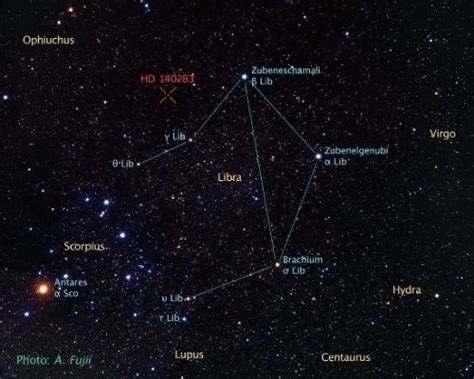
Libra stars and the location of HD 140283. Image: NASA, ESA, H. Bond (STScI and Pennsylvania State University), E. Nelan (STScI), D. VandenBerg (University of Victoria), G. Schaefer (CHARA, Mt. Wilson Observatory), and D. Harmer (NOAO)
HE 1523-0901
HE 1523-0901 is a very old red giant located approximately 9,900 light-years away. It has an apparent magnitude of 11.129. Like its Libra neighbour Methuselah, HE 1523-0901 is among the oldest stars discovered to date.
It has an estimated age of 13.2 billion years, close to the age of the universe itself. The star is believed to have formed from the remnants of the earliest stars that went out as supernovae when the universe was still very young.
tags: #libra #constellation #story