If you've heard the phrase "Mercury in retrograde" and associated it with communication mishaps, tech glitches, and general chaos, you’re not alone. This astrological phenomenon has earned a reputation for disrupting our lives. But what exactly is Mercury in retrograde, and how can we make the most of it? Let’s dive in.
Three to four times a year, the planet Mercury becomes a trending topic online. This isn’t because of new scientific discoveries being made, or new missions launching to study the rocky world. It’s because Mercury enters into a period of retrograde orbit, which is popularly believed to have astrological significance. Even if you're not the most astrologically saavy, you know about Mercury Retrograde and its infamous reputation. For many, it's known as the one astrological thing that messes up your life and is to blame for every minor and major inconvenience. And while it definitely can be all of that, it's also a bit more complicated.
Mercury Retrograde Explained
What Is Mercury Retrograde?
In astrology, Mercury governs communication, technology, travel, and intellectual processes. When Mercury is in retrograde, it appears to move backward in its orbit when observed from Earth. Of course, it’s not actually reversing; it’s an optical illusion caused by the relative positions of Mercury and Earth in their orbits around the Sun. Astrologers interpret this phenomenon as a time when Mercury's influence is "reversed," leading to disruptions in the areas it rules. Mercury retrograde happens about three to four times a year, lasting approximately three weeks each time.
What Is Retrograde Motion?
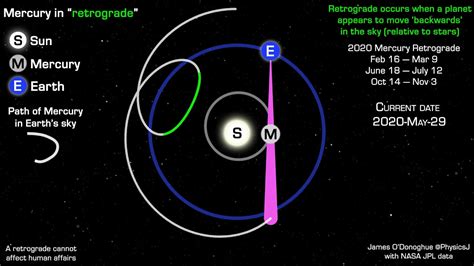
The astronomical explanation for retrograde motion starts with understanding that the planets in our solar system orbit the Sun at different distances and speeds. While we orbit the Sun ourselves, we can observe the other planets moving across our sky, following their own paths. Sometimes, it can appear (from our perspective) that a planet has abruptly switched directions and has started to move in reverse across the sky. In reality, Mercury doesn’t actually move backward. What we see is an optical illusion created by the positions and speeds of Earth and Mercury as they orbit the Sun. Because Mercury orbits the Sun faster than Earth does, there are moments when it appears to slow down, stop, and reverse direction-like a car passing another on the highway. This is why we call the phenomenon apparent retrograde motion, as it only looks like the planet is moving backward (“retrograde motion”)!
When we say that a planet is in retrograde it means that from the perspective of Earth, a planet’s motion across the sky goes backwards night after night compared to its usual direction for a period of time. This happens when Earth overtakes a slower-moving planet in its orbit around the Sun, or is overtaken by a faster-moving planet. Retrograde motion is technically called “apparent retrograde motion” since it’s not an actual change in the planet’s motion through space, but rather an effect caused by our perspective from Earth.
Read also: Intellect Meets Intuition
What causes retrograde motion?
Every planet moves around the Sun in the same direction. Normally, when you observe a planet’s location in the sky over several nights, each night it will appear to have moved a little farther in one direction relative to the stars behind it. When a planet is in retrograde, it appears to move a little farther to the opposite direction each night instead.
This happens because the closer a planet is to the Sun, the faster it moves in its orbit around the Sun. This means that Mercury and Venus move through space more quickly than Earth, and will occasionally lap Earth just like runners moving more quickly around a track. Likewise, the more distant planets Mars, Jupiter, Saturn, Uranus, and Neptune all move slower than Earth, and will occasionally be lapped by Earth.
Because Mercury only takes 88 days to orbit the Sun compared to Earth’s 365, it overtakes us in this way three to four times a year, appearing to move backwards for about three weeks at a time. This frequency is probably the reason that Mercury’s is the most famous of the retrogrades, although its recent popularity as an explanation for things going awry may have roots in pop culture.
Common Experiences During Mercury Retrograde
Many people report challenges in the following areas during Mercury retrograde:
- Communication: Misunderstandings, arguments, or delayed responses are common.
- Technology: Glitches, breakdowns, and data loss can occur. Back up your data beforehand!
- Travel: Canceled flights, lost luggage, or general travel delays often occur. Allow extra time and have a Plan B.
- Decision-Making: The retrograde period can cloud judgment, making it a less-than-ideal time to sign contracts or make major life choices.
What Mercury Retrograde Isn’t
It’s important to remember that Mercury retrograde isn’t a time of doom and gloom. While it can bring challenges, it’s not an astrological curse. Instead, it’s a period to slow down, reflect, and revisit aspects of your life that may need more attention.
Read also: Weddings and Mercury Retrograde
How to Thrive During Mercury Retrograde
Rather than fearing Mercury retrograde, you can use its energy to your advantage. Here’s how:
- Reflect and Reassess: Retrogrades are perfect for introspection. Revisit old projects, review past decisions, or refine your plans.
- Slow Down: Avoid rushing through tasks. Double-check details and take your time to ensure accuracy.
- Stay Flexible: Be prepared for unexpected changes and approach them with patience. Flexibility is key during this time.
- Reconnect: Mercury retrograde can bring people from your past back into your life. Use this time to strengthen relationships or gain closure.
- Backup and Plan Ahead: Back up important files and documents before retrograde begins. When traveling, keep extra time and resources in mind.
Mercury and the Zodiac Signs
The type of influence you feel also depends on which of the 12 zodiac signs Mercury is in when it goes retrograde. For example:
- Mercury in Aries may spark impulsive words.
- Mercury in Pisces may cloud emotional clarity.
During retrogrades, we’re called to stop and be fully present before resuming forward motion. When planets resume their apparent forward motion, we also make a 180 and have a chance to progress with new awareness and direction. When we just keep going, par for the course, it’s easy to go through the motions and not pay attention to major signals trying to get our attention. It’s like falling asleep in the car as it coasts at a steady 50 mph. But when we have to hit the brakes and take a detour for 200 miles in the direction we just came from before getting back on the highway, we wake up! Are you on course? When it comes to communication, are you speaking your truth clearly? Do you really listen to others? To your inner voice? What’s going on with those thoughts in your head? Are they supporting your true desires or stuck in a negative loop?
Mercury in Retrograde Dates
Here's a breakdown of Mercury Retrograde dates for 2025 and 2026:
What are the dates for Mercury Retrograde in 2025?
There are three Mercury Retrograde periods a year, and they often cover two signs at once but not always. So far, you've already survived the first two periods! Now, there's just one more to go through, and it's happening now until November 29.
Read also: Jupiter and Mercury Aspects
Looking ahead to 2025, Mercury will enter retrograde during the following periods:
- March 15 to April 7, 2025: Mercury retrogrades in Aries, a time that may prompt reevaluation of personal goals and communication styles.
- July 18 to August 11, 2025: This retrograde occurs in Leo, potentially affecting creativity and self-expression.
- November 25 to December 15, 2025: Mercury will once again retrograde in Sagittarius, similar to the current period, influencing travel and philosophical outlooks.
During these times, it’s advisable to exercise caution in communication, double-check travel plans, and avoid making significant commitments or decisions. Instead, focus on reflection, reassessment, and completing unfinished business.
What are the dates for Mercury Retrograde in 2026?
Mercury Retrograde will begin once again on February 26, 2026, and end on March 20, 2026. In 2026, Mercury will be in retrograde during the following periods:
| Mercury Retrograde Period | Dates (Eastern Time) |
|---|---|
| First Retrograde | February 26-March 20, 2026 |
| Second Retrograde | June 29-July 23, 2026 |
| Third Retrograde | October 24-November 13, 2026 |
Note: These dates are based on Eastern Time (ET) and may shift slightly depending on your time zone.
FAQs About Mercury Retrograde
Here are some frequently asked questions about Mercury Retrograde:
Q. Is Mercury really moving backward?
A: No. Mercury retrograde is an optical illusion caused by the relative speeds and positions of Earth and Mercury in orbit. The planet only appears to move backward in the sky.
Q: How long does a Mercury retrograde period last?
A: Typically, Mercury retrogrades last about 3 weeks, but the pre‑ and post‑shadow periods can extend the effect by a week or more before and after the retrograde phase.
Q: What is a Mercury retrograde “shadow period”?
A: The shadow period includes the weeks before and after the main retrograde when Mercury passes over the same zodiac degrees. Effects may begin to ramp up before the retrograde and linger afterward, making this a time to stay mindful.
Q: Is Mercury retrograde always negative?
A: Not at all. While challenging for communication and travel, Mercury retrograde is also ideal for reflection, review, and revising-especially existing plans rather than launching new ones.
Q. Does Mercury retrograde affect everyone the same way?
A: Not exactly. Each retrograde occurs in a specific zodiac sign, and that sign’s energy colors the experience. Your own birth sign may also influence how you experience Mercury retrograde.
tags: #mercury #in #retrograde #right #now