Moldavite is a rare and remarkable green tektite gemstone with an ancient volcanic origin. Often referred to as the "stone of transformation", Moldavite has fascinated people for centuries due to its vivid green color and mystical properties.
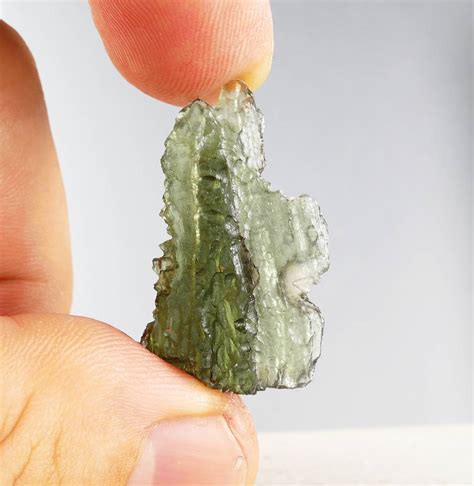
A high-quality Moldavite specimen from the Czech Republic.
Formation and Origin
The stone was formed roughly 15 million years ago during a meteorite impact in an area that is now the Czech Republic. The intense heat of this meteorite collision melted the surrounding sand and rock, catapulting it into the air where it cooled into glass - this unique glass is what we know today as Moldavite.
According to legend, Moldavite was formed from the meteor that crashed in what is now the Moldau Valley region of the Czech Republic around 15 million years ago. The intense heat of the meteor's impact liquefied the surrounding rock, forming a fragile glass tektite that took on a deep green color.
Moldavites were created following meteor impact which melted material and launched it into the air. As the material was airborne, it cooled and solidified. However, the plasma-like vapor at the impact site separated primary melt droplets from other residual vapor.
Read also: Wearing Moldavite Safely
Moldavites' highly textured surfaces are now known to be the result of pervasive etching by naturally occurring CO2 and humic acids present in groundwater.
Because of their extremely low water content and chemical composition, the current consensus among earth scientists is that moldavites were formed about 14.7 million years ago during the impact of a giant meteorite in the present-day Nördlinger Ries crater.
Most moldavites are from South Bohemian localities, with just a few found in South Moravian localities. Rare moldavites have been found in the Lusatian area (near Dresden), Cheb basin area (West Bohemia) and Northern Austria (near Radessen), with a few examples found in Southwestern Poland (Lower Silesia) which are thought to have been transported from the Lusitanian sub-strewn field.
Principal occurrences of moldavites in Bohemia are associated with Tertiary sediments of the České Budějovice and Třeboň basins. The most prominent localities are concentrated in a NW-SE strip along the western margin of the České Budějovice Basin. The majority of these occurrences are bound to the Vrábče Member and Koroseky Sandy Gravel.
In Moravia, moldavite occurrences are restricted to an area roughly bounded by the towns of Třebíč, Znojmo and Brno. The colour of Moravian moldavites usually differs from their Bohemian counterparts, as it tends to be brownish.
Read also: Benefits of Moldavite
Taking into account the number of pieces found, Moravian localities are considerably less productive than the Bohemian ones; however, the average weight of the moldavites found is much higher. The oldest (primary) moldavite-bearing sediments lie between Slavice and Třebíč.
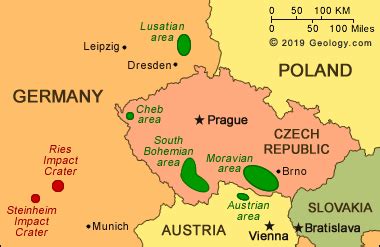
Map showing the location of the Ries and Steinheim impact craters, along with areas where moldavite has been found.
Chemical Composition and Physical Properties
The chemical formula of moldavite is SiO2(+Al2O3). Its properties are similar to those of other types of glass, and reported Mohs hardness varies from 5.5 to 7.
Moldavite can be transparent or translucent with a mossy green color, with swirls and bubbles accentuating its mossy appearance.
The color of Moldavite depends on several factors, such as the composition of the rock that was hit by the meteorite, the temperature and pressure of the impact, the oxidation and reduction of iron, and the exposure to sunlight and radiation.
Read also: Spotting Real Moldavite
Moldavite also has a striking color, which varies from light green to dark green, sometimes with brownish or yellowish shades. The color of moldavite can also change over time, because of natural or artificial processes. Some moldavites can become lighter or darker, depending on the environment they are kept in.
Key Physical Properties of Moldavite:
- Color: Green (ranging from pale to deep forest green)
- Transparency: Transparent to translucent
- Luster: Vitreous (glass-like)
- Hardness: 5.5 on the Mohs scale
- Density: 2.32 to 2.38 g/cm³
- Fracture: Conchoidal (smooth, curved surfaces)
- Refractive Index: 1.47 to 1.52
Historical Context
Moldavites were discovered by prehistoric people in the Czech Republic and Austria and were used to make flaked tools. In the modern world, moldavites are often used, rough or cut, as semi-precious stones in jewelry. They have purported metaphysical qualities and are often used in crystal healing.
Moldavite was introduced to the scientific public for the first time in 1786 as "chrysolites" from Týn nad Vltavou in a lecture by Josef Mayer of Prague University, read at a meeting of the Bohemian Scientific Society (Mayer 1788).
In 1900, Franz Eduard Suess pointed out that the gravel-size moldavites exhibited curious pittings and wrinkles on the surface, which could not be due to the action of water, but resembled the characteristic markings on many meteorites.
He attributed the material to a cosmic origin and regarded moldavites as a special type of meteorite for which he proposed the name of tektite.
Throughout history, moldavite has been prized for its intense vibration and metaphysical properties. It resonates with the heart chakra, accelerating spiritual growth and enhancing intuition.
Metaphysical Properties and Uses
Moldavite has long been prized for its mystical properties and spiritual symbolism. In Czech folklore, Moldavite was believed to bring good fortune and fertility. It was incorporated into dowry gifts and wedding decorations as a blessing for new beginnings.
Due to its mystical green hue and mythic origins, moldavite is sometimes called the 'Stone of the Holy Grail'. It is thought to quicken spiritual evolution and facilitate inner journeys of self-discovery.
Moldavite's high vibration is said to accelerate spiritual growth and evolution. Its energy resonates with the heart chakra, helping to clear out old emotions and patterns.
Moldavite has a cleansing effect that supports detoxification of the cells, blood, and organs. The stone's high vibration helps open, activate, and balance the upper chakras, particularly the third eye and crown chakras. Moldavite can enhance inner vision and psychic abilities.
Moldavite assists in emotional healing by helping to release old wounds, traumas, and perceived limitations. Moldavite helps identify unhealthy emotional patterns so they can be acknowledged, shifted and released.
Working with Moldavite facilitates profound spiritual transformation, inner purification, and increased light quotient.
Moldavite is known for its powerful healing properties that can benefit us both physically and emotionally. The energy of Moldavite is said to accelerate healing by stimulating cellular repair and regeneration.
Its vibration resonates with the heart chakra, energizing the entire body and promoting optimal health and vitality. By rebalancing energy flow, Moldavite can alleviate a wide range of minor to moderate health complaints over time.
Moldavite is known for its ability to heal and transform on an emotional level:
- Releases pent-up emotions: Moldavite's high-frequency vibration helps to bring suppressed emotions to the surface to be expressed and released.
- Eases sadness and grief: Its compassionate green ray resonates with the heart chakra, helping to dissipate sadness, grief and heartache.
- Overcomes inner resistance: This stone has a disruptive energy that breaks down inner walls and resistance to change.
- Inspires self-discovery: Moldavite facilitates gaining insight into the underlying reasons for recurring emotional issues.
- Encourages emotional detachment: By raising awareness of emotional patterns, Moldavite helps gain healthy detachment from stories, drama and pain.
- Heightens empathy and compassion: This stone opens the heart to increase compassion for self and others.
- Energizes passion and creativity: Moldavite activates the lower chakras, firing creativity and passion.
MOLDAVITE - Crystal for Accelerated Spiritual Transformation 💙🔮🔥
Moldavite is known as a stone of spiritual awakening and inner transformation. Moldavite can deepen and intensify meditation. Its high vibration works to open the third eye and crown chakras, creating a flow of cosmic energy through your body.
Holding Moldavite while meditating brings clarity to one's connection with spirit guides, angels, and source energy. By accelerating spiritual evolution, Moldavite also enhances inner vision and psychic abilities through meditation.
Meditating with Moldavite can activate a powerful spiritual awakening and connection to the divine consciousness that embodies our universe. Placing Moldavite over the heart chakra encourages unconditional love and inner wisdom.
Moldavite helps integrate cosmic downloads and revelations during meditation into your everyday consciousness. For accelerated transformation, meditating with Moldavite daily is highly effective.
Moldavite is known as the 'stone of transformation' and its high vibration energy is believed to greatly accelerate spiritual growth and evolution. Many believe it has an innate ability to manifest desires and intentions into reality.
The green vibrations of the stone can stimulate the heart chakra, the source of human manifestation powers. Meditating with it is said to intensify your thoughts and put you in closer alignment with universal energies and synchronicities meant for you.
Moldavite can activate your imagination to visualize your goals and bolster faith in your inner world of optimism and inspiration. Carrying or wearing Moldavite keeps its vibrations flowing around you, activating your inner light and magnetizing what you focus on into your life.
Placing intentions under Moldavite or gazing into it while visualizing can amplify and accelerate the manifestation process.
Moldavite is known as a stone of transformation and spiritual evolution. As such, it is a powerful addition to daily routines and rituals. Place the stone in the room where you practice yoga, meditation, or breathwork.
Wear jewelry when you need to make an important decision or gracefully navigate a challenging situation. Carry a small tumbled crystal in your pocket to revitalize your energy and perspective throughout the day.
Put stones on your desk or workspace to inspire creative solutions and innovative ideas. Add elixir to your bath water for a revitalizing soak. Place it in the corners of a room before meditating to open and expand energetic flow.
Hold a piece of raw moldavite during chakra healing sessions to accelerate results. Set intentions while gazing through or into a moldavite. The key is to intentionally utilize moldavite's capabilities whenever possible.
Cleansing and Care
Moldavite is a powerful stone that absorbs negative energies, so it's important to cleanse it regularly:
- Salt water bath - Soak your gemstone in sea salt water overnight to draw out impurities.
- Smudging - Light a sage smudge stick and hold it in the smoke to purify its energies.
- Sunlight - Place it in direct sunlight for 4-6 hours. The light will help reset its vibrations.
- Moonlight - Leave it out overnight under the light of a full moon to infuse it with lunar energy.
- Sound - Using a singing bowl, bell, or clapping over the gemstone will shake off dense energies through resonance.
- Earth - Bury your gemstone in soil for 24 hours so the earth element can neutralize vibrations.
- Meditation - Hold it during meditation and visualize a white light entering, cleansing away impurities.
Regular cleansing keeps Moldavite fully charged and optimized for channeling its mystical properties. Experiment to find which methods work best for you.
Identifying Genuine Moldavite
Moldavite has some amazing physical and optical properties that make it a desirable gemstone. It is hard enough to be cut and polished into different shapes and sizes. It can refract and reflect light in different ways. It is lighter than most other rocks and minerals. It has a glassy and shiny look. It breaks into smooth and curved pieces.
How to identify real Moldavite:
- Green to brown color.
- Under magnification: lechatelierite (a high-temperature form of SiO2) inclusions, abundant gas inclusions, and flow lines.
- Low refractive index.
Table 1: Properties of Moldavite and its Imitations
| Property | Natural Moldavite | Imitations |
|---|---|---|
| Inclusions | Lechatelierite "wires," gas bubbles, flow lines | Lack of lechatelierite, fewer bubbles |
| Surface | Etched, rough | Smoother, potentially polished |
| Fluorescence | Variable | May be absent or different color |
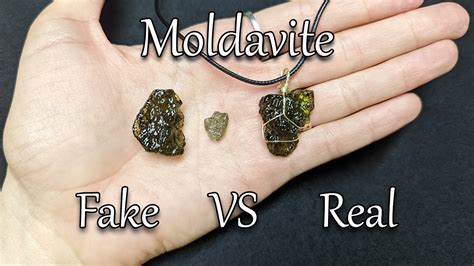
Two moldavites from southern Bohemia, Czech Republic (top row) and two recent imitations from China (bottom row).
If you are offered a faceted moldavite over two carats or any moldavite without eye-visible bubbles, there is a good chance that it is fake.
Most specimens of genuine moldavite contain trapped gas bubbles and flow structures that are visible under a magnification of 10x and often with the unaided eye. The gas bubbles are sometimes round, but more often they are elongate, stretched by the stress under which the glass cooled.