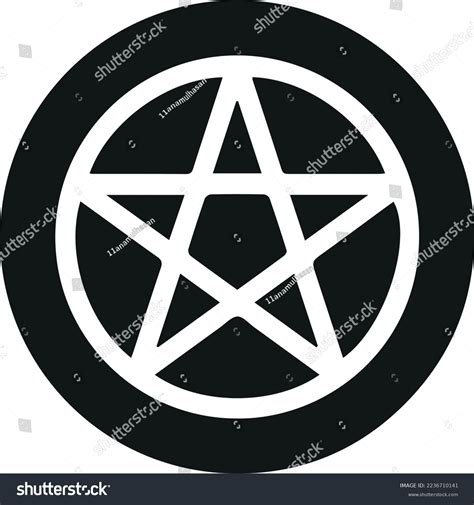
The pentagram, a five-pointed star typically drawn with a continuous line, holds a significant place in various cultures and religions, especially in Wicca. Its meaning has evolved through time, serving as a symbol of protection, perfection, humanity, and, at times, even the Devil. This article delves into the symbolism of the pentagram within Wicca, its historical roots, and its representation of the five elements.
Historical Roots and Evolution
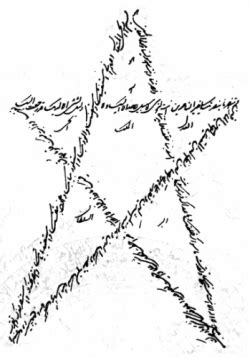
The pentagram has been in use for thousands of years, appearing in ancient Egypt, Mesopotamia, and Greece. It was a symbol of the Greek mathematician and philosopher Pythagoras and his disciples. Some sources say the Pythagoreans regarded it as a symbol of health and knowledge, and in some depictions the Greek letters for the word “health” are placed at its points. During the Middle Ages in Europe, pentagrams symbolized the five knightly virtues and were used to defend against witches, evil spirits, and demons.
In the 16th century, Heinrich Cornelius Agrippa von Nettesheim published a version of the pentagram that symbolized man as a perfected work of God. The French occultist Éliphas Lévi in the 19th century expanded on this concept with the “tetragrammaton pentagram,” which includes a variety of symbols that represent human existence.
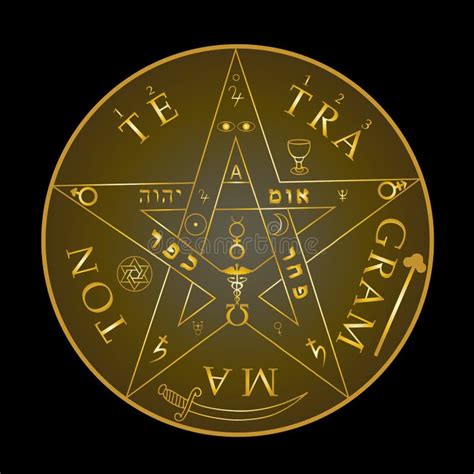
Tetragrammaton pentagram, image from the 1910 American edition of Transcendental Magic, Its Doctrine and Ritual, written by French occultist Éliphas Lévi.
The Pentagram in Different Religions
Pentagrams have been used in various religious contexts. Among Muslims, it is known as Solomon’s seal, representing love, truth, peace, freedom, and justice. It is also the official symbol of the Bahāʾī Faith, called the haykal, meaning “temple” or “body.” Among Christians, it has symbolized the five wounds of Christ, the Star of Bethlehem, and Christ himself.
Read also: Differences Between Pentagram and Pentacle
The Pentagram in Wicca
In modern times, the pentagram is most often associated with Neo-Pagan religions, especially Wicca. It is often depicted enclosed in a circle, a symbol known as a pentacle. In these traditions, the five points often represent the five elements of air, fire, water, earth, and spirit.
For Wiccans, the pentagram may also symbolize masculine and feminine, or the Triple Goddess (three points) and the Horned God (two points). Many Neo-Pagans consider the pentagram a symbol of protection and may use it to invoke or banish spirits.
Upright vs. Inverted Pentagram
The upright pentagram (one point uppermost) is an ancient symbol of protection from evil. The lower four points represent the classical elements, while the fifth point represents spirit, the fifth element or quintessence. Thus, the pentagram symbolizes the four elements of the material world connected with, but ruled by, the spirit.
When the pentagram is placed within a circle, it stresses our connection with the universe as a whole. In Witchcraft, the upper three points represent the Goddess in her threefold aspect of Maiden, Mother, and Crone. The lower two points represent her consort God, in his twin aspects of God of Light and God of Darkness. However, in all these interpretations, it is important to remember that all the points are connected - each an aspect of the other, all part of the same whole.
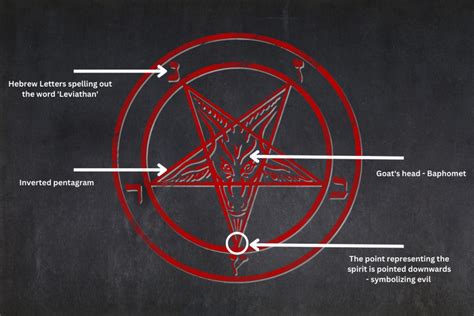
The inverted pentagram (two points facing upward) is sometimes associated with negative or “black” magic and devil worship. It may represent the physical world dominating the world of spirit. The sigil of Baphomet, one of the main symbols of the Church of Satan, depicts a goat with its horns in the upturned points of the star. However, some traditions of Witchcraft employ the inverted pentagram as a POSITIVE symbol of advanced degree, where the two points uppermost represent the horns of light, symbol of ‘the Horned God’, consort to the Great Goddess.
Read also: Understanding anemia spiritually
The Pentacle
The word ‘pentacle’ refers to a shallow dish (usually inscribed with a pentagram) and used as an altar tool by modern Witches, serving a purpose similar to the ‘paten’ at a Roman Catholic Mass. Common variations of this tool include a dish of earth, a disk of copper, a dish of silver, or a disk of wax.
The Five Elements
Each point on the star represents one of the four natural elements: earth, air, fire, and water. The fifth point represents the mysterious fifth element, which is spirit, or consciousness. When the spirit is depicted above the four physical elements, this is typically regarded as a symbol of balance and health. When the physical elements take priority over the higher knowing of spirit, imbalance occurs.
In witchcraft, the pentagram is often used as a symbol to represent the completion of a spell. Each of the five elements is needed in order to draw an idea from the realm of imagination to the realm of “real world” manifestation.
For example:
- Air: The idea
- Water: The desire
- Fire: The drive to make it happen
- Earth: Gathering the tools needed to create the thing
- Spirit: You, the master builder
By bringing all of the elements together and doing what it takes to make your dream a reality, you are completing the puzzle.
Read also: Hamsa Hand: Symbolism and history
Personal Experience and Balance
The five-pointed star, like many things, is in fact a totally neutral symbol. It represents nature in general, and the place of the human being in the universe. For me, the elements have been a wonderful starting point in learning to understand universal law, and my place within it. Without each of the four natural elements, life as we know it would not exist. Without the fifth element of spiritual consciousness, the Universe wouldn’t be able to experience its own magnificence.
If you happen to notice that you’re feeling unhealthy physically, spiritually, mentally, or emotionally, it’s because something in your life is out of balance. But our spiritual journey does not always develop in a straight line. We experience ebbs and flows, peaks and valleys, just like the tides, the breath, and the seasons.
Table: The Elements and Their Correspondences
| Element | Symbolism | Association |
|---|---|---|
| Air | Idea, Intellect | East, Spring |
| Water | Desire, Emotions | West, Summer |
| Fire | Drive, Passion | South, Autumn |
| Earth | Tools, Resources | North, Winter |
| Spirit | Consciousness, The Self | Center |