Fire doors are a critical component of building safety, designed to slow the spread of smoke, fire, and toxic gases during a fire event. They not only allow staff and visitors to evacuate during an emergency but also limit structural damage. Understanding the regulations and standards surrounding fire doors and their signage is crucial for ensuring compliance and maximizing safety.
Simply put, fire doors are barriers that slow down the spread of smoke, fire, and toxic gases during a fire event. Fire Door is defined in Chapter 2 of the International Building Code as the door component of a fire door assembly. Here, a fire door assembly is any combination of a fire door, frame, hardware, and other accessories that together provide a certain degree of fire protection to the opening the assembly is applied to. Fire doors form an integral part of a building’s passive fire protection system.
According to the National Fire Protection Association (NFPA) and the International Building Code (IBC), fire door assemblies must adhere to specific criteria for both life safety and the protection of property. The NFPA and IBC are not regulatory agencies. They do not have the power to enact or enforce fire codes. That power is reserved for state and municipal authorities. While some adopt NFPA or IBC regulations wholesale, others make changes that apply only to their local communities.
Fire doors and other opening protectives are covered under NFPA 80. This standard regulates the installation and maintenance of assemblies and devices used to protect openings in walls, floors, and ceilings against the spread of fire and smoke.
General Requirements for Exit Doors
Understanding the general requirements for exit doors is crucial for ensuring building safety and compliance. Here are the key regulations outlined in Title 24, Part 2:
Read also: Importance of Fire Sprinkler Room Signs
- Application: This section applies to every exit door. Buildings or structures used for human occupancy shall have at least one approved exit door (Title 24, Part 2, Section 2-3303(a).).
- Type: Exit doors shall be of the side swinging type. Exception: As provided in Section 3235(g) (Title 24, Part 2, Section 2-3303(a).).
- Design and Construction: Every door required to serve as an exit shall be designed and constructed so that the way of exit travel is obvious and direct. Windows which could be mistaken for doors shall be made inaccessible to occupants by means of barriers or railings.
- Width and Height: Every required exit doorway shall be of a size that permits the installation of a door not less than 3 feet in width and not less than 6 feet 8 inches high. When installed in exit doorways, exit doors shall be capable of opening at least 90 degrees and shall be mounted so that the clear width of the exitway is no less than 32 inches. In computing the exit width required, the net dimension of the exitway shall be used. Exception: Existing buildings may be less than 3 feet in width if the clear width of the exitway is not less than 28 inches (Title 24, Part 2, Section 2-3303(e).).
- Door Leaf Width: No leaf of an exit door shall exceed 4 feet in width (Title 24, Part 2, Section 2-3303(f).).
- Swing: Exit doors shall swing in the direction of exit travel when serving:
- Any assembly building.
- An occupant load of 50 or more (Title 24, Part 2, Section 2-3303(b)(1).).
Locking Mechanisms: Exit doors must be openable from the direction of exit travel without the use of a key or any special knowledge or effort whenever the building is occupied.
- Exception for mental, penal, or corrective institutions where supervisory personnel is continually on duty and effective provisions are made to remove occupants in case of fire or other emergency.
- This requirement shall not apply to exterior exit doors in Group B occupancies, if such doors are unlocked during business hours and there is a readily visible, durable sign on or adjacent to the door stating ‘THIS DOOR TO REMAIN UNLOCKED DURING BUSINESS HOURS.‘ The sign shall be in letters not less than one-inch high on a contrasting background. The locking device must be of a type that will be readily distinguishable as locked.
- Exit doors in places of employment in Group B occupancies, may be locked whenever the locking device or mechanism is controlled by an effective mechanical/electrical or electronic system acceptable to the Division and approved for the purpose by the State Fire Marshal.
Change in Floor Level at Doors: Regardless of the occupant load, there shall be a floor or landing on each side of a door. The floor or landing shall be no more than 1 inch lower than the threshold of the doorway. Where a door opens over a landing, the landing shall be at least as wide as the door, and at least 5 feet long (Title 24, Part 2, Section 2-3303(i)(1) and (i)(2).). Exception: Where the door opens into the stairway of a smokeproof enclosure, the landing need not have a length of 5 feet (Title 24, Part 2, Section 2-3303(i)(2) Exception 1).
In existing installations where there is no landing, doors shall be conspicuously marked with a sign stating ‘Danger! Stairway -No Landing‘ or equivalent wording, and there shall be adequate illumination (Title 24, Part 2, Section 2-3303(i)(2) Exception 5).
Special Doors: Revolving, sliding, and overhead doors shall not be used as required exits.
- Manually operated horizontal sliding doors may be used when serving an occupant load of 10 or less.
- Power operated doors conforming to SFM 33.1, as shown in Chapter 2-60 of Part 2 of Title 24.
Power-Operated Doors: Where a required door is operated by power, such as a door with photo-electric actuated mechanism that opens the door upon the approach of a person, or a door with power-assisted manual operation, the design shall be such that in event of power failure the door may be opened manually to permit exit travel or closed to safeguard means of egress.
Read also: Dominant Zodiac Traits
No power-operated door shall be considered a required exit unless it also swings by manual means (Title 24, Part 2, Section 2-3303(g)(2).).
Double Acting (Swinging) Doors: Doors swinging both ways and located between rooms such as kitchen and dining room, or storeroom and sales floor, shall be provided with view panels. One shall be provided for each door of swinging double doors.
- Windows, if used, shall be kept free of dirt or other obstruction to vision.
- The bottom of the view panel or window shall be no more than 48 inches above the floor (Title 24, Part 2, Section 2-3303(b)(2)(C).).
- The size of the view panel or window shall be no less than 200 square inches (Title 24, Part 2, Section 2-3303(b)(2)(B).).
- Guards shall be placed over windows which are not of the shatter-proof or wired glass type (Title 24, Part 2, Section 2-3303(b)(2)(D).).
- Glass in swinging doors shall conform to the provisions of Section 3242(d) (Title 24, Part 2, Section 2-3303(b)(2)(E).).
- Double acting doors shall not be used as exits serving a tributary occupant load or more than 100, nor shall they be used as part of a fire assembly, nor equipped with panic hardware (Title 24, Part 2, Section 2-3303(b)(2)(A).).
Turnstiles: Turnstiles shall not be considered as providing any exit width (Title 24, Part 2, Section 2-3303(n)(1).).
Doors in Folding Partitions: When permanently-mounted folding or movable partitions are used to divide a room into smaller spaces, exits from these enclosures shall be provided as required under Section 3228 (Title 24, Part 2, Section 2-3303(o).).
Bolts: Manually-operated edge bolts or surface-mounted flush bolts and surface bolts are prohibited on required exit doors. When exit doors are installed in pairs and automatic flush bolts are used, the door leaf with these bolts shall have no door knob or surface-mounted hardware. The unlatching of any leaf shall not require more than one operation (Title 24, Part 2, Section 2-3303(c)(2).).
Read also: Countries by Zodiac Sign
Latches: A latch or other fastening device on a door shall be provided with a knob, handle, panic bar, or other simple type of releasing device, the method of operation of which is obvious.
Panic Hardware:
- Panic hardware shall cause the door latch to release when a force not exceeding 15 pounds is applied to the releasing device in the direction of exit traffic.
- Hand activated door opening hardware shall be centered between 30 inches and 44 inches above the floor. Latching and locking doors that are hand activated and which are in a path of travel, shall be operable with a single effort by lever type hardware, by panic bars, push-pull activating bars or other hardware designed to provide passage without requiring the ability to grasp the opening hardware. Locked exit doors shall operate as above in the egress direction. Exception: Doors to individual hotel or motel units shall operate similarly, except that when the bolt and unlatching operation is key operated from corridor or exterior side of the unit door, large bow keys (2 inch full bow or 1 1/4 inch half bow) shall be provided in lieu of lever type hardware on the corridor side. Separate dead lock activation on room side of the corridor doors in hotels and motels shall have handle or large thumb turn in an easily reached location.
- Panic hardware shall not be equipped with any locking or dogging device, set screw, or other arrangement which can be used to prevent the release of the latch when pressure is applied to the bar.
- No lock, padlock, hasp, bar, chain, or other device, or combination thereof, shall be installed or maintained at any time on or in connection with any door on which panic hardware is required, if such device prevents the free use of the door for exiting.
All fire doors need to be equipped with a closing device. Automatic closing hinders the spread of fire and prevents escape routes from becoming choked with hazardous fumes. Positive latching devices ensure that a door remains securely closed even after someone passes through.
Fire door frames are required to have an embossed label listing its fire resistance rating - how long it can withstand open flames before it fails (typically 20, 45, 60, 90, or 180 minutes). Door labels confirm that the door has been tested and certified according to current safety standards. It also allows inspectors to verify that the door was installed in the correct location. (Certain areas require stronger doors.
A fire door assembly not only includes the door itself, but the equipment attached to it (frame, hinges, locks, latches, handles, door closers etc.). All fire doors are required to have steel-bearing hinges. In addition to their strength and durability, the bearings reduce friction, ensuring doors open and shut smoothly, even when subjected to heavy use. The hinges must also match the door rating.
For the safety of building occupants, there can be nothing blocking the fire door. Any equipment or hardware that might interfere with its operation (e.g. Astragals are vertical strips of wood or metal attached to the edge of a door, to cover the gap between two swinging doors. Double fire doors that aren’t on an egress path require an overlapping astragal to function as a smoke barrier and prevent dangerous fumes from passing between rooms.
Hold-open devices ensure your entryways are accessible to everyone, regardless of physical ability. They’re common in healthcare facilities, which often install fire doors along their main corridors. To ensure safety, these doors require a heat fusible link ‒ an automatic closer containing heat-sensitive metal that melts when heated to a certain temperature (165°F, for example).
A strike back is the metal plate that the door’s latch or bolt fits into. Typically, an open strike back is used whenever a fire door is equipped with an electromagnetic hold-open device. When the fire alarm activates, the magnet powers down, which releases the closer. Once it swings the door shut, the latch engages the strike back, securing it.
Glazing is a glass panel installed in a fire door. It’s a safety feature that allows people to evaluate conditions on the other side without exposing themselves to danger. To ensure it can hold together during a fire, all glazing must be made of wire glass - glass embedded with wire mesh for added durability, at least a quarter-inch thick.
Vents are allowed on fire doors, though they have to be handled carefully, since they’re a potential point of weakness. In some cases, fire vents can be installed for ventilation, air circulation, and temperature control, but only on doors 1.75 inches thick with a 45-90 minute fire rating. Combining them with glazing or fire exit hardware, such as a push bar, is forbidden.
Fire-rated doors are required to have a non-combustible surface, such as steel or fire-rated wood veneers.
Comply with building and fire codes with necessary signage. Exit routes must be free and unobstructed. No materials or equipment may be placed, either permanently or temporarily, within the exit route. The exit access must not go through a room that can be locked, such as a bathroom, to reach an exit or exit discharge, nor may it lead into a dead-end corridor. If the direction of travel to the exit or exit discharge is not immediately apparent, signs must be posted along the exit access indicating the direction of travel to the nearest exit and exit discharge. Each exit sign must be illuminated to a surface value of at least five foot-candles (54 lux) by a reliable light source and be distinctive in color. The fire retardant properties of paints or solutions must be maintained. An employee alarm system must be operable. Employers must install and maintain an operable employee alarm system that has a distinctive signal to warn employees of fire or other emergencies, unless employees can promptly see or smell a fire or other hazard in time to provide adequate warning to them.
Fire exits must be clearly marked at all times. Besides being placed prominently on or near the door, signs should also contain instructions on how to exit.
As stated in IFC Section 705.2.2, when required by the fire code official, fire door signs shall be permanently displayed on or near each fire door. The letters on the sign should be at least 1” (25 mm) high. Signs identifying doors designed to be normally kept open should read, “FIRE DOOR-DO NOT BLOCK”.
As specified in Section 4.1.4 of NFPA 80, fire door signs are meant for informational purposes only and must not exceed 5% of the area of the face of the fire door that they are attached to. Additionally, these signs can neither be installed on glazing material in fire doors nor can be installed at a place on the door where they may impair or interfere with the proper operation of the door.
Attaching a fire door sign on a fire door with nails or screws can, and in all likelihood will, void the label on the door and affect its performance under fire conditions.
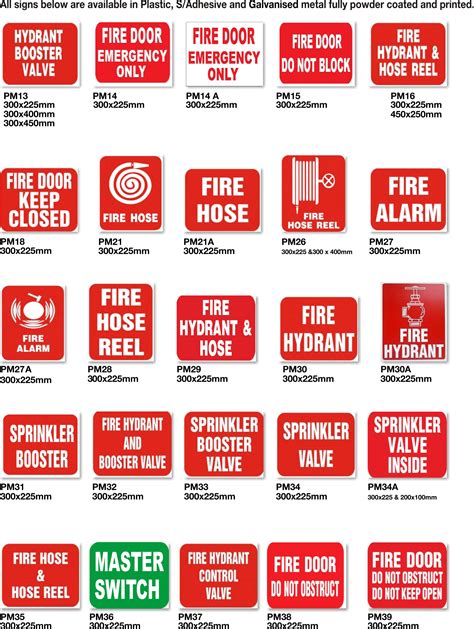
Here is a summary of the key requirements for fire door signage:
| Requirement | Description |
|---|---|
| Sign Placement | Permanently displayed on or near each fire door. |
| Letter Height | At least 1” (25 mm) high. |
| Sign Content | For doors normally kept open: “FIRE DOOR-DO NOT BLOCK”. |
| Sign Area | Must not exceed 5% of the face of the fire door. |
| Installation | Must not be installed on glazing material or where it may interfere with door operation. |
Fire doors are designed to save lives, but can’t perform their role without regular inspections carried out by qualified personnel. Most fire doors need to be examined at least once a year. Doors in high-traffic areas may require more frequent inspections, however. Besides evaluating the door, inspectors test its hardware as well, including the frame, hinges, seals, and closing mechanisms, to ensure they’re intact and fully functional.