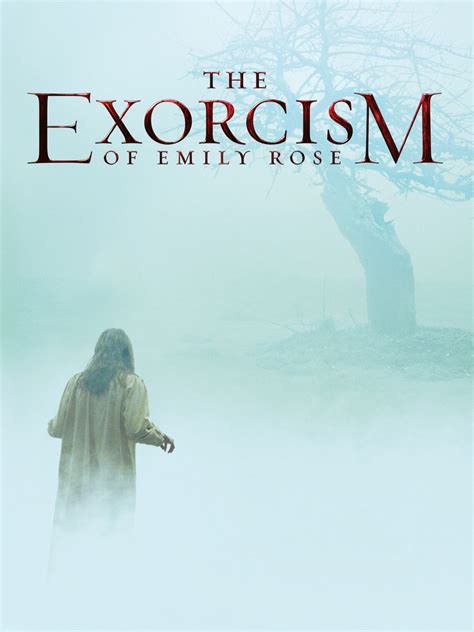
The Exorcism of Emily Rose (2005) combines two compelling genres: Courtroom Dramas and Scary Movies, particularly those dealing with demonic possession. The film, directed by Scott Derrickson, is loosely based on the true story of Anneliese Michel, a Bavarian girl who died in the 1970s after nearly a year of exorcism.
The film is a study in opposing worldviews, confronting the medical world and religion. It revolves around the trial of Fr. Moore (Tom Wilkinson), who administered the failed exorcism, charged with negligent homicide. The narrative predominantly follows the defense lawyer, Erin Bruner (Laura Linney), as she prepares her case, with flashbacks depicting past events.
The Catholic Church’s guidelines regarding possible cases of demonic possession, as with purported miracles and apparitions, insist on a default stance of skepticism. Perhaps the bottom line regarding whether a medical framework or a spiritual one best accounts for a particular case might be which approach proves more effective in treating the condition. If drugs or therapy allow a patient to function normally, it seems reasonable to view the patient’s condition in naturalistic terms.
Unfortunately, this is little help with the tragic case of Emily Rose (Jennifer Carpenter), who dies after both medical science and religion fail to help her. Perhaps this is because Emily herself chooses to discontinue both taking her medication and undergoing exorcism. Emily comes to believe that her sufferings may serve some good purpose by showing a skeptical world evidence of unseen realities.
Read also: "The Exorcism of Emily Rose" True Story
This, perhaps, is what writer-director Scott Derrickson and co-writer Paul Harris Boardman want to do: raise questions, not supply answers. Inspired by a true story of Anneliese Michel, a Bavarian girl who died in the 1970s after almost a year of exorcism, The Exorcism of Emily Rose is a study in opposing worldviews.
The Courtroom Drama and Characters
This confrontation of worldviews takes the form of a courtroom drama structured around the trial of Fr. Moore (Tom Wilkinson), who administered the failed exorcism. Cognizant of the potential pitfalls of going after a man of the cloth, the DA’s office strategically chooses Ethan Thomas (Campbell Scott), a practicing Protestant, to prosecute Fr. Moore.
Pitted against him is Erin Bruner (Laura Linney), a rising star with her eye on a law firm partnership, who’s been unwillingly charged with representing Fr. Of course Fr. Moore refuses the plea bargain. Moreover, he wants to testify - not to clear his own name, but because he insists that Emily’s story must be told. Erin quickly realizes that she’s at sea after an opening statement from Ethan that’s so compelling that she can only defer her own opening statement until beginning the defense.
The film is enormously aided by effective performances from most of the principals. Linney persuasively embodies her character’s conflicted inclinations and inner struggle. Wilkinson brings absolute conviction to the role of a sincere priest whose culpability in Emily’s death remains an open question.
Read also: Become an Exorcist: Training
The courtroom drama offers some good moments, and Emily’s story, though limited to flashbacks, is genuinely chilling. They’re also real to Fr. Moore, who eventually seeks to cast them out, embarking upon a ritual familiar to countless moviegoers, albeit in a somewhat sensationalized form, from William Friedkin’s 1973 horror classic The Exorcist.
The TRUE Story Of The Exorcism Of Emily Rose | Anneliese Michel Possession.
Themes and Nuances
While The Exorcism of Emily Rose overtly has a secular lawyer defending a spiritual explanation opposing a Sunday school lawyer suggesting a scientific reason, I also appreciated the nuance in distinguishing types of Christianity and the intersection of faith and profession. The prosecutor, played by Campbell Scott, is a Protestant, specifically a Methodist. Instead of his faith preventing him from performing his duties, it is a motivating factor.
He is a man of faith and science offended that another person who presents as a Christian abused his spiritual authority and tries to use his secular authority to rectify a violation done in the auspices of Jesus’ name, i.e. blasphemy. On the other hand, the performance can be read as a Christian who does not believe in the supernatural and does believe in science. This movie recognizes that many Protestants don’t see Catholics as sharing the same faith and treat them with derision.

Read also: Learn about folklore and science
The Exorcism of Emily Rose surprised me by suggesting that the possession was not a punishment, but a sign that the titular character was a saint vulnerable to spiritual forces. The Exorcism of Emily Rose’s nonlinear storyline actually makes the lately tedious possession story seem fresh, especially as opposing equally plausible, less supernatural theories are explored. It also helps that the trial actually resembled a trial as opposed to a stage for characters to tell their life stories and give long speeches while the judge spouts some wise nonsense that completely resolves the conflict.
I did raise an eyebrow when the defense let her client testify, and she accepted the case without looking at the evidence. Maybe do a little homework before negotiating? The cast is a huge asset because the majority of the cast is respected and rarely appears in supernatural movies, which lends credibility to what could solely be a sensational story line.
Realism and Impact
Although Emily Rose is more grounded in the real world than The Exorcist, both films are ultimately about failed exorcisms. On one level, there’s a certain realism to this; cases of possession can resist exorcism for weeks, months or even longer - especially, perhaps, in cases where demonic influence has become deeply entrenched through involvement in spiritually hazardous occupations, such as occult involvement.
What makes Emily’s case so disturbing is that she is a pious girl from a devout Catholic family, presumptively in the state of grace (Fr. Doubtless, God’s ways are often inscrutable, yet I can’t help wondering why He might prefer possible evidence of demonic influence to trump evidence of the Church’s God-given authority to help and heal those suffering from demonic power.
The film’s postscript points out that the girl’s grave is now a site of pious devotion and pilgrimages. Yet is this automatically a good thing? Some pious souls may find inspiration in almost any claim of miracles or apparitions, no matter how dubious or ill-founded. Others, not unreasonably, may find such devotion superstitious and an obstacle to their own faith.
I’m grateful to The Exorcism of Emily Rose for offering another cinematic point of reference for the phenomena of possession and exorcism, and for its sympathetic depiction both of the believer Fr. Moore and the skeptic Erin Bruner.
Despite its flaws, The Exorcism of Emily Rose is a worthwhile story for the issues it raises and explores, though I find it ultimately tragic rather than inspiring. The exorcism failed. The girl died. The priest was indicted. The film is thought-provoking and raises questions about faith, science, and the nature of evil.