The Roman Rite of Exorcism, deeply rooted in Christian tradition, addresses the belief in a world of demons and the potential for demonic influence on individuals. This ancient practice, formalized in texts like the Rituale Romanum, serves as a means for the Church to combat what it sees as extraordinary satanic influence known as possession.
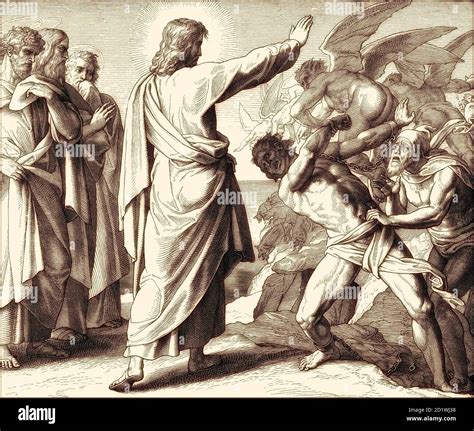
Exorcism of the Gerasene demoniac by Gustave Doré
The Reality of Evil: A Core Belief
The existence of a world of demons is a teaching of revealed religion which is perfectly clear to all who know Sacred Scripture and respect and accept its word as inspired of God. It is part of the whole Christian-Judaeo heritage. There are some who hold that even if revelation were not so absolute, an inference of the existence of evil spirits can be drawn from the magnitude of evil in the world.
As Franqois Mauriac writes in his life of St. Margaret of Cortona: "Evil is Someone, Someone who is multiple and whose name is legion... It is one thing to be in the realm of the demons, as we all are when we have lost the state of grace, and quite another to be held and surrounded, literally possessed by him."
The first book of the Holy Bible recounts the seduction of Adam and Eve by the Prince of Darkness; but it is to the last book that we must go for his origin. "Then war broke out in heaven; Michael and his angels battled against the dragon. The dragon and its angels fought back, but they did not prevail and there was no longer any place for them in heaven. The huge dragon, the ancient serpent, who is called the Devil and Satan, who deceived the whole world, was thrown down to earth, and its angels were thrown down with it." (Rv 12:7-9)
Read also: "The Exorcism of Emily Rose" True Story
Christ our Lord overcame Satan on the cross, and ever since the latter's empire is shaken. Man is delivered from the power of darkness and transferred to the kingdom of the Son. Yet the devil is not completely vanquished or trodden underfoot once for all, and the warfare against him is carried out by Christ and His Church until the end of time.
Therefore, St. Paul is prompted to admonish us: "Put on the armor of God so that you may be able to stand firm against the tactics of the devil. For our struggle is not with flesh and blood but with the principalities, with the powers, with the world rulers of this present darkness, with the evil spirits in the heavens... In all circumstances, hold faith as a shield, to quench all the flaming arrows of the evil one." (Eph 6.11-16)
Against these unclean spirits the Church uses as her weapons prayers, blessings, holy water, and other sacramentals to combat the ordinary power that the former wield over men. But apart from this ordinary and general power that Providence allows Satan there is also a special and terrible satanic influence called possession -- the domination by the demon over man's bodily organs and his lower spiritual faculties.
That Christ reckoned with this satanic power in the same way that the Church has throughout her centuries is evident from the New Testament; see for example Mt 9.32-34, Lk 8.2, Mk 9.13 if. To be possessed can mean that Satan has gained mastery over the will so devastatingly that sinfulness passes beyond ordinary depravity in the world, and its cause must be sought in a power above the order of nature.
To be possessed can mean that Satan has beclouded the intellect, so that the light of faith cannot illuminate it. To be possessed can mean that Satan has befuddled a person's reason; in fact, simple and superstitious folk have wrongly made lunacy synonymous with diabolical infestation. In some instances of possession recounted in the New Testament, molestation by the devil is manifested in various disturbances of the human body itself, where he has gained control over a man's sight, hearing, speech, or the physical organism in general. (Mk 5:1ff)
Read also: Become an Exorcist: Training
Christ handed down to the Church the power He once exercised over demons. The early Christians were deeply influenced by what they had learned of their Master's dealing with evil spirits, and there was on their part frequent use of the charismatic gifts of healing the sick and driving out devils. But the prayers and forms used for exorcism in the first centuries have not come down to us, outside the ones used in baptism.
Historical Context of Exorcism
Exorcism became part of the baptismal rite somewhere around 200 A.D. Thus the ancient liturgical records which date from the third century, those dealing with baptism, give us the early Christians' belief about Satan and his intervention in the affairs of man. In the devil's hatred for God he .turned on man, who is made in God's image. In consequence of original sin men are no longer temples of the Holy Spirit but rather the habitations of the demon.
Not too much distinction is made between the possessed and the unbaptized. Isidore of Seville puts both on the same level, and says that exorcism is the ceremony of banishing the most wicked influence of the devil from catechumens and possessed alike. (Dictionnaire D' Archéologie Chrétienne et de Liturgie, V, Pt. 1, 963 if.)
The evidence would indicate that in the early Church acts of exorcism consisted mainly in the sign of the cross, invoking the name of Jesus, and renunciations of Satan and adjurations and threats uttered against him. But later on, especially in the Latin Church, the rites of exorcism become more and more numerous, until in the highly imaginative Middle Ages there is actually a profusion of them.
To this period we must attribute beliefs and practices which are superstitious to an extreme. Devils are believed to exist in the guise of certain material bodies. Demonic possession is confounded with epilepsy and other mental or psychic disorders. Rituals of this time prescribe that the subject remain in the presence of the exorcist throughout the period of exorcism, that he observe a strict fast and limit his diet to blessed water, salt, and vegetables, that he wear new clothes, that he abstain from the marital act.
Read also: Learn about folklore and science
No less complicated are the injunctions for the exorcist. And by the time we come to the fourteenth century magical practices have been introduced into the ceremonies.
Some minds might still discern traces of a certain naivete, yet at any rate it has been purged of the unfortunate accretions of a period ruled much more by human credulity than by the unadulterated doctrine of the Church. No longer, for example, does the official text afford any grounds for the erroneous notion that diabolical possession is necessarily a divine retribution visited upon a grievous sinner. God allows this terrible evil in His wisdom without the afflicted person being necessarily at fault.
It is one thing to have fallen into the slavery of sin or to be afflicted with a bodily or mental infirmity, and quite another to have the devil enter into a man and take possession of him.
The general rules for exorcism that follow are a clear indication that we have come a long way from the superstitious notions that prevailed in the era of the Middle Ages. Noteworthy among these rules are the ones that direct that the parties concerned should have recourse to the holy sacraments, and that the sacred words of Holy Writ should be employed rather than any forms devised by the exorcist or someone else.
General Rules Concerning Exorcism
The instructions given below indicate that the Church has carefully guarded the extraordinary power over Satan committed to her by Christ, and that Catholic exorcism is poles removed from any form of dabbling in the spirit world which springs from human chicanery or malice.
According to the Roman Rite of Exorcism, specific guidelines are in place for conducting an exorcism:
- A priest -- one who is expressly and particularly authorized by the Ordinary -- when he intends to perform an exorcism over persons tormented by the devil, must be properly distinguished for his piety, prudence, and integrity of life.
- He should fulfill this devout undertaking in all constancy and humility, being utterly immune to any striving for human aggrandizement, and relying, not on his own, but on the divine power.
- Moreover, he ought to be of mature years, and revered not alone for his office but for his moral qualities.
- In order to exercise his ministry rightly, he should resort to a great deal more study of the matter (which has to be passed over here for the sake of brevity), by examining approved authors and cases from experience; on the other hand, let him carefully observe the few more important points enumerated here.
- Especially, he should not believe too readily that a person is possessed by an evil spirit; but he ought to ascertain the signs by which a person possessed can be distinguished from one who is suffering from some illness, especially one of a psychological nature.
Signs of possession may be the following:
- Ability to speak with some facility in a strange tongue or to understand it when spoken by another.
- The faculty of divulging future and hidden events.
- Display of powers which are beyond the subject's age and natural condition.
- Various other indications which, when taken together as a whole, build up the evidence.
In order to understand these matters better, let him inquire of the person possessed, following one or the other act of exorcism, what the latter experienced in his body or soul while the exorcism was being performed, and to learn also what particular words in the form had a more intimidating effect upon the devil, so that hereafter these words may be employed with greater stress and frequency.
He will be on his guard against the arts and subterfuges which the evil spirits are wont to use in deceiving the exorcist. For oftentimes they give deceptive answers and make it difficult to understand them, so that the exorcist might tire and give up, or so it might appear that the afflicted one is in no wise possessed by the devil.
Once in a while, after they are already recognized, they conceal themselves and leave the body practically free from every molestation, so that the victim believes himself completely delivered. Yet the exorcist may not desist until he sees the signs of deliverance.
At times, moreover, the evil spirits place whatever obstacles they can in the way, so that the patient may not submit to exorcism, or they try to convince him that his affliction is a natural one. Meanwhile, during the exorcism they cause him to fall asleep, and dangle some illusion before him, while they seclude themselves, so that the afflicted one appears to be freed.
Some reveal a crime which has been committed and the perpetrators thereof, as well as the means of putting an end to it. Yet the afflicted person must beware of having recourse on this account to sorcerers or necromancers or to any parties except the ministers of the Church, or of making use of any superstitious or forbidden practice.
Sometimes the devil will leave the possessed person in peace `and even allow him to receive the holy Eucharist, to make it appear that he has departed. In fact, the arts and frauds of the evil one for deceiving a man are innumerable. For this reason the exorcist must be on his guard not to fall into this trap.
Therefore, he will be mindful of the words of our Lord (Mt 17.20), to the effect that there is a certain type of evil spirit who cannot be driven out except by prayer and fasting. Therefore, let him avail himself of these two means above all for imploring the divine assistance in expelling demons, after the example of the holy fathers; and not only himself, but let him induce others, as far as possible, to do the same.
If it can be done conveniently the possessed person should be led to church or to some other sacred and worthy place, where the exorcism will be held, away from the crowd. But if the person is ill, or for any valid reason, the exorcism may take place in a private home.
The subject, if in good mental and physical health, should be exhorted to implore God's help, to fast, and to fortify himself by frequent reception of penance and holy communion, at the discretion of the priest. And in the course of the exorcism he should be fully recollected, with his intention fixed on God, whom he should entreat with firm faith and in all humility. And if he is all the more grievously tormented, he ought to bear this patiently, never doubting the divine assistance.
He ought to have a crucifix at hand or somewhere in sight. If relics of the saints are available, they are to be applied in a reverent way to the breast or the head of the person possessed (the relics must be properly and securely encased and covered). One will see to it that these sacred objects are not treated improperly or that no injury is done them by the evil spirit. However, one should not hold the holy Eucharist over the head of the person or in any way apply it to his body, owing to the danger of desecration.
The exorcist must not digress into senseless prattle nor ask superfluous questions or such as are prompted by curiosity, particularly if they pertain to future and hidden matters, all of which have nothing to do with his office. Instead, he will bid the unclean spirit keep silence and answer only when asked. Neither ought he to give any credence to the devil if the latter maintains that he is the spirit of some saint or of a deceased party, or even claims to be a good angel.
But necessary questions are, for example: the number and name of the spirits inhabiting the patient, the time when they entered into him, the cause thereof, and the like. As for all jesting, laughing, and nonsense on the part of the evil spirit -- the exorcist should prevent it or contemn it, and he will exhort the bystanders (whose number must be very limited) to pay no attention to such goings on; neither are they to put any question to the subject. Rather they should intercede for him to God in all humility and urgency.
Let the priest pronounce the exorcism in a commanding and authoritative voice, and at the same time with great confidence, humility, and fervor; and when he sees that the spirit is sorely vexed, then he oppresses and threatens all the more. If he notices that the person afflicted is experiencing a disturbance in some part of his body or an acute pain or a swelling appears in some part...
The Exorcist: A Profile
The priest who performs an exorcism must be carefully selected. He must be known for his piety, prudence, and moral integrity. This undertaking requires unwavering constancy and humility, devoid of any personal ambition, relying instead on divine power. Maturity and moral qualities are essential attributes for this role.
Before undertaking this ministry, the priest must thoroughly study the subject, consulting approved authors and learning from documented cases. He must also be cautious, avoiding the assumption that a person is possessed without carefully evaluating the signs that distinguish possession from psychological or other illnesses.
| Characteristic | Description |
|---|---|
| Piety | Deep religious devotion and commitment to God. |
| Prudence | Wisdom and careful judgment in dealing with complex situations. |
| Integrity | Moral uprightness and honesty. |
| Humility | Absence of pride and reliance on divine power rather than personal strength. |
| Maturity | Emotional and spiritual maturity to handle intense situations. |
Resources for Further Study
For those seeking a deeper understanding of the Roman Rite of Exorcism, several resources are available:
- The Rite Of Exorcism The Roman Ritual: Rules, Procedures, Prayers of the Catholic Church by Michael Freze, S.F.O.
- The Complete Guide To Demonology & The Spirits of Darkness by Michael Freze, S.F.O.
- The Traditional Catholic Rites of Exorcism: (English) - Volume 1 published by CreateSpace.
These books provide extensive background on the history of the Rite, current rules and procedures, and traditional prayers of exorcism and deliverance.