When we talk about how planets and moons move, we often use terms like direct motion and retrograde motion. Direct motion, also called prograde motion, is when a planet or moon moves in the same direction as most other objects in its solar system. Retrograde motion is the opposite.
Prograde and retrograde are terms used to describe the direction of motion of an object in space relative to the rotation of its primary body (e.g., a planet or star).
Apparent Retrograde Motion (Visual Explanation)
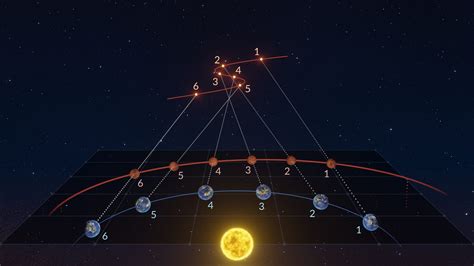
Apparent retrograde motion of Mars as seen from Earth.
In the context of planetary motion, retrograde motion can also refer to the apparent backward motion of a planet as observed from Earth.
Real vs. Apparent Retrograde Motion
For some space objects, like the moons in the Carme group around Jupiter, this backward movement is real. Sometimes, a planet in our sky might look like it's changing direction and moving backward for a short time.
Read also: Interpreting Blood Dreams
This is called apparent retrograde motion because it only seems to happen. It creates a kind of "loop" or "squiggle" in its path before going back to normal. This strange effect happens because Earth is also moving! We see it when outer planets, like Mars or Jupiter, are near a point called opposition.
Imagine two cars driving on two different circular tracks that are next to each other. One car is on the inner track, and the other is on the outer track. The car on the inner track will finish its circle faster because it has a shorter distance to travel. From the point of view of the driver in the inner car, the car on the outer track will seem to fall behind, even though both are moving at the same speed. This is similar to how apparent retrograde motion works for planets.
Mathematical and Dynamical Aspects
Mathematically, retrograde motion is characterized by an angular velocity vector that points in the direction opposite to the primary body's spin axis, determined via the right-hand rule applied to the body's velocity.
For a satellite in a simple Keplerian orbit around a primary of mass M, the orbital angular momentum vector h=r×v has a negative z-component when referenced to the primary's north pole, corresponding to an orbital inclination greater than 90 degrees.
Detection of retrograde motion relies on both direct imaging and spectroscopic techniques to discern the direction of motion. For orbital retrograde, long-term astrometric tracking reveals clockwise looping against the stellar background when viewed from the primary's north, distinguishable from prograde by the sense of revolution over multiple periods.
Read also: Decoding Common Dreams
Orbital Inclination
Orbital inclination refers to the angle between the plane of an orbiting body's path and a reference plane, most commonly the equatorial plane of the primary body around which it orbits.
The inclination i is formally computed using the formula i=arccos(n⋅k), where n is the unit normal vector to the orbital plane and k is the unit vector along the reference plane's polar axis; this dot product yields the cosine of the angle between the planes.
In terms of stability, protoplanetary disk interactions dampen inclinations through tidal torques and gravitational drag, preferentially aligning orbits toward coplanarity and favoring prograde configurations during planetary formation. Over longer timescales, secular perturbations from gravitational influences of companion bodies induce gradual changes in inclination, causing oscillations or drifts that can shift orbits between prograde and retrograde regimes without immediate energy loss.
Precise measurement of orbital inclination relies on astrometry, which tracks angular positions across the sky to reconstruct the orbital plane, and radar ranging, which provides direct line-of-sight distances and velocities for high-accuracy orbit determination, particularly for near-Earth objects and inner solar system bodies.
Axial Tilt
Axial tilt, also known as obliquity, is defined as the angle between a celestial body's rotational axis and the normal to its orbital plane.
Read also: Understanding Mercy as a Gift
This angle determines the direction of the body's rotation relative to its orbital motion: rotations with an obliquity less than 90° are prograde, aligning with the orbital direction, while those exceeding 90° are retrograde, opposing it.
In astronomical conventions, obliquity is measured relative to the orbital plane, with the rotational angular momentum vector L given by L=Iω, where I is the moment of inertia and ω is the angular velocity vector. The sign of ω along the orbital normal distinguishes prograde (positive) from retrograde (negative) rotation, directly tied to the obliquity's magnitude and orientation.
Dynamical effects on obliquity arise primarily from gravitational torques exerted by the central star or companion bodies, inducing precession of the rotational axis. These torques cause the spin axis to trace a conical path around the orbital normal over timescales ranging from millennia to millions of years, as observed in Earth's 26,000-year precession cycle driven by solar and lunar influences.
Over evolutionary timescales, tidal interactions generally reduce obliquity by dissipating rotational energy, eroding tilts toward 0°-a process termed "tilt erosion" that can occur in under 0.1 billion years for Earth-like planets around low-mass stars, potentially desynchronizing initial prograde rotations into aligned states.
Measurements of obliquity rely on observations of spin-orbit coupling, where the alignment between rotation and orbit is inferred from photometric variations or radial velocity anomalies during transits, as in the Rossiter-McLaughlin effect for exoplanets, revealing projected obliquities with uncertainties as low as a few degrees.
Angular Momentum
In orbital and rotational mechanics, the direction of angular momentum is defined using the right-hand rule, where the vector L points perpendicular to the plane of motion, with its orientation determined by curling the fingers of the right hand in the direction of rotation and extending the thumb along L.
For prograde motion, this vector aligns parallel to the primary system's overall angular momentum (typically pointing northward from the reference plane, such as the ecliptic), whereas retrograde motion produces an antiparallel vector.
As a collapsing cloud or accreting body contracts, its orbital angular momentum decreases while rotational angular momentum increases to maintain this balance, often favoring prograde alignment due to the initial net momentum of the parent cloud.
During disk accretion, shear and curvature in orbiting clouds transfer orbital momentum into prograde spin, with the rotational component gaining δLrot≃0.05−0.15 MclΩ0Rcl2 for spherical clouds, where Mcl, Ω0, and Rcl are the cloud's mass, initial angular velocity, and radius, respectively.
Retrograde angular momentum components often trigger dynamical instabilities. In binary systems, retrograde disks around one component become unstable to global tilting via resonances like the retrograde Lindblad resonance, leading to warped structures and ejections of test particles at large radii (e.g., beyond 50 times the binary separation).
Computational modeling with N-body integrators like REBOUND enables prediction of these direction flips by evolving systems under gravity, incorporating spins and tides to track angular momentum vectors over time.
Formation and Evolution of Prograde Systems
Protoplanetary disks form from the gravitational collapse of rotating molecular clouds, where conservation of angular momentum results in a flattened structure exhibiting Keplerian rotation aligned in the prograde direction relative to the central star's spin.
This prograde alignment arises as the cloud's initial net angular momentum, typically inherited from large-scale galactic shear or turbulence, is amplified during the collapse, leading to differential rotation where inner regions orbit faster than outer ones.
Planetesimals emerge within these disks through mechanisms like the streaming instability, which concentrates dust particles into dense clumps under the influence of aerodynamic drag, preferentially forming bodies on prograde orbits that match the disk's rotational direction. This instability thrives in the midplane where radial pressure gradients cause gas to orbit sub-Keplerianly, trapping and aligning dust streams in the prograde flow, thereby yielding planetesimals with initial angular momentum vectors parallel to the disk's.
Planetary migration in protoplanetary disks, classified as Type I for low-mass planets and Type II for gap-opening giants, generally preserves the prograde orbital direction by exchanging angular momentum with the disk gas through lindblad torques, resulting in inward or outward radial shifts but no reversal of the sense of rotation unless external torques intervene.
In Type I migration, the planet's gravitational interaction with disk density waves transfers angular momentum outward, causing the planet to spiral inward while maintaining its prograde path.
Factors Influencing Retrograde Motion
Giant impacts during the early stages of planetary formation can dramatically alter a body's rotational direction, leading to retrograde spin relative to its orbital motion.
These high-energy collisions involve protoplanets or larger bodies striking at oblique angles, imparting significant angular momentum that reverses the spin axis or induces extreme axial tilts approaching 90 degrees or more.
Gravitational capture events, particularly through three-body interactions, frequently result in retrograde satellite orbits around giant planets. In the restricted three-body problem involving a planet, a perturber (such as another planet or planetesimal), and a small body, temporary captures occur when the small body's energy is reduced below zero relative to the planet.
For irregular satellites, tidal disruption of incoming binary asteroids during close passages facilitates capture: the binary separates at a tidal disruption radius given by rtd≈aB(3MPm1+m2)1/3, where aB is the binary separation, MP the planet's mass, and m1,m2 the binary components' masses; this yields a velocity change Δv1≈G(m1+m2)aBm2m1+m2, enabling the primary fragment to enter a bound, often retrograde orbit with lower Jacobi constants (around 3.01) that enhance survival against ejection.
Close encounters with comets or asteroids can induce temporary retrograde paths in small bodies through perturbations that flip their orbital inclination.
Fossil evidence for ancient impacts that induced such rotational changes is preserved in isotopic anomalies within planetary materials.
Examples in the Solar System
In the Solar System, all eight planets exhibit prograde orbital motion around the Sun, meaning their orbital directions align with the overall angular momentum of the system, with inclinations relative to the ecliptic plane generally less than 8° for the inner planets (Mercury through Mars) and under 3° for the outer planets (Jupiter through Neptune).
Among the outer planets, rotations are predominantly prograde, with Jupiter's minimal 3.1° tilt and Saturn's 26.7° tilt exemplifying typical orientations that produce seasons through moderate obliquity. Neptune follows suit with a prograde rotation at 28.3° tilt.
Dwarf planets in the outer Solar System display prograde orbits but often retrograde rotations, mirroring patterns seen in some giant planets.
Ceres, the dwarf planet in the inner Solar System, has a prograde orbit with an inclination of 10.6° and prograde rotation with negligible axial tilt. Pluto orbits prograde at an inclination of 17.14° to the ecliptic-significantly higher than the planets' but still under 90°-yet rotates retrograde with an axial tilt of 119.61°.
Orbital eccentricities, such as Pluto's 0.25 or Eris's 0.44, have negligible direct influence on the prograde or retrograde nature of orbits or rotations, as direction is determined by angular momentum vectors rather than shape.
Natural Satellites
Natural satellites of the giant planets in the Solar System are classified into regular and irregular types based on their orbital characteristics.
Regular satellites, such as Jupiter's four Galilean moons-Io, Europa, Ganymede, and Callisto-orbit in a prograde direction, aligned with the planet's rotation, and lie nearly coplanar with the equatorial plane.
Irregular satellites, in contrast, exhibit highly eccentric, inclined, and often retrograde orbits, suggesting origins external to the planet's formation environment.
For example, Saturn's moon Phoebe follows a retrograde orbit with an inclination of approximately 151° relative to Saturn's equatorial plane, placing it in near opposition to the planet's rotation direction. Similarly, many of Jupiter's and Saturn's irregular satellites have inclinations exceeding 90°, with retrograde examples comprising about two-thirds of the known population across the giant planets.
Planetary Rings
Planetary ring systems consist of countless small particles, primarily ice and dust, that orbit in a prograde direction within the planet's equatorial plane, matching the sense of the planet's rotation.
In Saturn's rings, for instance, the particles' Keplerian motion is prograde, with velocities decreasing outward from the planet. Shepherd moons, such as Prometheus and Pandora, play a key role in enforcing this directional alignment and maintaining ring structure through gravitational perturbations that confine particles to narrow bands, like the F ring.
The prevalence of retrograde irregular satellites, which account for over 50% of all known natural satellites of the outer planets (as of 2025) when including both regular and irregular populations, is primarily attributed to capture mechanisms during the early Solar System's dynamical instability.
Collisional encounters or three-body interactions could temporarily bind passing objects, with retrograde captures favored due to the geometry of heliocentric approaches.
Small Bodies
Small bodies in the Solar System, including asteroids, comets, and meteoroids, generally follow prograde orbits aligned with the ecliptic plane, but notable exceptions involving retrograde motion arise due to dynamical interactions and evolutionary processes.