The Virgo Cluster, the closest large cluster of galaxies to our own, presents a fascinating target for astronomers and amateur observers alike. Located approximately 54 million light-years away, this cluster is a dense collection of galaxies bound together by gravity.
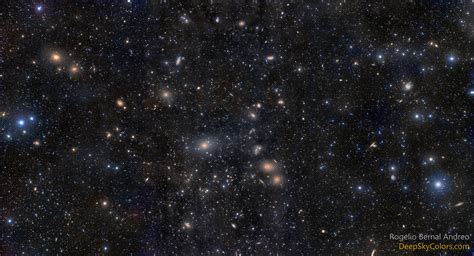
Virgo Cluster. Image: Wikimedia Commons/Kees Scherer
Size and Composition
The Virgo Cluster has a diameter of approximately 15 million light-years. It contains an estimated 1,300 to 2,000 member galaxies. These galaxies are diverse, with about 58% being spirals, 27% ellipticals, and the remainder irregulars.
Astronomers estimate that it contains a total mass of about 1.2 quadrillion times the mass of the Sun. The arrangement of galaxies within the cluster is not random; rather they are organised into smaller groupings of which the most prominent are designated Virgo A and Virgo B.
The key force in astronomy is gravitational attraction. Planets orbit stars, and stars are part of galaxies. But even galaxies come together into groups with dozens of members. One of the larger structures in the Universe are galaxy clusters; collections of thousands of galaxies. And our Milky Way is no exception.
Read also: Interpreting Blood Dreams
The Virgo Cluster lies at the heart of the larger and more massive Virgo Supercluster, which also contains the Local Group - the group of galaxies that includes our own, the Milky Way - as an outlying member. The Local Group actually experiences the mass of the Virgo Supercluster as the Virgocentric flow. As a result, the Local Group of galaxies will likely eventually fall into the Virgo Cluster.
Notable Galaxies within the Virgo Cluster
Many of the brighter galaxies in this cluster, including the giant elliptical galaxy Messier 87, were discovered in the late 1770s and early 1780s and subsequently included in Charles Messier's catalogue of non-cometary fuzzy objects.
The most massive of the galaxies making up the Virgo Cluster is Virgo A or M87, a huge Elliptical Galaxy at the centre of the group. Despite its size, this is not the brightest of the objects in the cluster; that is Virgo B or M49, another Elliptical Galaxy that lies some four million light years closer to the Milky Way than Virgo A.
Here are some of the Messier galaxies that are members of the Virgo Cluster:
- Messier 49
- Messier 58
- Messier 59
- Messier 60
- Messier 61
- Messier 84
- Messier 86
- Messier 87
- Messier 89
- Messier 90
- Messier 85
- Messier 88
- Messier 91
- Messier 98
- Messier 99
- Messier 100
Of these, Messier 49, Messier 59, Messier 60, Messier 87, Messier 89 are elliptical galaxies, while Messier 84, Messier 85 and Messier 86 are either lenticular or elliptical. Messier 88, Messier 90, Messier 98, Messier 99 and Messier 100 are spiral galaxies and Messier 58, Messier 61 and Messier 91 are barred spirals.
Read also: Decoding Common Dreams
Other prominent galaxies in the Virgo Cluster include NGC 4216, NGC 4262, NGC 4435, NGC 4438, NGC 4450, NGC 4526, NGC 4527, NGC 4550, NGC 4567, NGC 4568, NGC 4571, NGC 4651, and NGC 4654.
The cluster has three distinct subgroups of galaxies: Virgo A, centred on Messier 87, a group centred on Messier 86, and Virgo B, centred on Messier 49. Some sources include a Virgo C subcluster around Messier 60 and a Low Velocity Cloud (LVC) centred on the spiral galaxy NGC 4216.
The Virgo A subcluster is the largest and dominates the cluster, with members including Messier 87, Messier 88, Messier 89, Messier 90, Messier 58, Messier 84, Messier 85, Messier 91, and Messier 100. The subclusters are in the process of merging and will eventually form a vast single cluster.
The larger subclusters are surrounded by smaller galaxy clouds, which mostly include spiral galaxies and are known as the S Cloud, N Cloud and Virgo E.
Observing the Virgo Cluster
The Virgo Cluster extends across approximately 8 degrees centered in the constellation Virgo. Some of its most prominent members can be seen with binoculars and small telescopes, while a 6-inch telescope will reveal about 160 of the cluster's galaxies on a clear night.
Read also: Understanding Mercy as a Gift
The centre of the Virgo Cluster is located between the bright stars Vindemiatrix in Virgo and Denebola in Leo constellation, which is where the most prominent cluster members can be found.
The easiest way to locate Denebola is to find the Spring Triangle, a prominent spring asterism formed by Denebola, the considerably brighter Arcturus in Boötes constellation and Spica, the brightest star in Virgo.
Arcturus and Spica can be located using the stars of the Big Dipper. The curved line formed by the arc of the Dipper’s handle first leads to Arcturus and then to Spica. These are the brightest stars along this imaginary line and easy to spot, even in less than ideal conditions.
Denebola, Beta Leonis, forms a nearly equilateral triangle with Arcturus and Spica. It lies east of Regulus, Leo’s brightest star, and marks the tail of the celestial Lion. Leo is easily recognized for the Sickle, a backward question mark formed by some of its brightest stars, representing the Lion’s head and mane. Regulus sits at the bottom of the Sickle.
To find galaxies within the cluster, one can start with the magnitude 4.9 star Rho (ρ) Virginis as a departure point. A trio of stars surrounding Rho forms a northwest-pointing arrowhead ⅔° across that makes field orientation and size easy to determine.
After centering Rho in the eyepiece field, move about 1½° north. You should come across a pair of nebulous spots ½° apart. These are the elliptical galaxies M59 and M60. M59 is the more westerly of the pair - the one that exits first when you keep your scope still and allow them to drift out of the eyepiece field.
Trace a line from M60 through M59 and extend it about twice that distance, and you’ll come to the barred spiral M58. By following a trail of stars less than a degree northwest of M58, you’ll arrive at the 10th-magnitude elliptical galaxy M89.
From M87, move west and slightly north until you encounter two smudges separated by ⅓°. These are the 9th-magnitude elliptical galaxies M84 and M86. They are the brightest members of a remarkable 1½°-long arc of galaxies known as Markarian’s Chain.
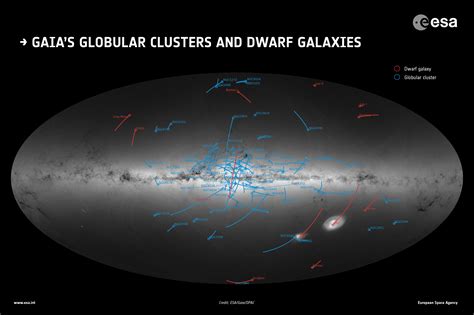
Globular clusters, dense bunches of hundreds of thousands of stars, have some of the oldest surviving stars in the Universe. Image: NASA, ESA, and E. Peng (Peking University, Beijing)
While alternating glances between eyepiece and chart, you may get lost. Don’t despair. Just return to Rho and begin anew. Each successive journey will proceed more smoothly as you gain familiarity with the path.
The constellation of Virgo, & especially the northern Wing is one of the constellations which encloses the most Nebulae.
The Virgo galaxy cluster is one of two sky regions I find most challenging to navigate - the other being the tangle of star clusters and nebulae in the Scutum/Sagittarius portion of the Milky Way.
Here is a list of proper names, designations, constellations, right ascension, declination, distance, diameter, number of galaxies, brightest galaxy, optimum visibility and notes for the Virgo Cluster:
| Property | Value |
|---|---|
| Proper Names | Virgo Cluster, Virgo Group |
| Designation | Virgo I |
| Constellations | Coma Berenices, Virgo |
| Right Ascension | 12h 26m 32s |
| Declination | +12° 43' 24" |
| Distance (to central point) | c. 65,000,000 light years (c. 19,928,700 parsecs) |
| Diameter (Actual) | c. 15,000,000 light years |
| Number of Galaxies | 1,300 - 2,000 |
| Brightest Galaxy | M49 |
| Optimum Visibility | April |
| Notes | A large and populous cluster of hundreds of galaxies spreading across the border between Virgo and Coma Berenices. |