The pentacle and the pentagram are both fascinating symbols that have captivated the human imagination for centuries.
In simple terms, a pentacle is a 5 pointed star with interlocking lines surrounded by a circle. A pentagram is still a 5 pointed start with interlocking lines, but it stands on its own, without being enclosed by a circle.
In this article, we embark on a journey to unravel the profound meanings and differences between these two mystical symbols. Join us as we explore their origins, symbolism, and their significance in various spiritual and magical practices.
Differences Between a Pentacle and Pentagram
The pentacle and the pentagram have ancient origins, rooted in different cultures and civilizations. The pentagram, a renowned emblem consisting of a five-pointed star, can trace its roots back thousands of years to ancient Mesopotamia, where it was intertwined with the worship of the Sumerian goddess Inanna.
This mesmerizing symbol found its way into the spiritual and mystical practices of many cultures, including ancient Greece and Egypt. It held diverse interpretations, embodying concepts such as the five elements, the five senses, and the five directions (north, south, east, west, and the center).
Read also: The phrase "So Mote It Be"
On the other hand, the pentacle emerged as a variation of the pentagram, characterized by the inclusion of a circle that encloses the five-pointed star. While the pentagram boasts an extensive historical lineage, the pentacle is often considered a more recent adaptation of the symbol.
The circle surrounding the pentagram adds an extra layer of significance, as it symbolizes unity, eternity, protection, and the cyclical nature of life. It serves as a visual representation of the interconnectedness of all things and the continuous flow of energy within the universe.
The Pentacle is arguably the most recognized symbol associated with paganism, Witchcraft, and Wicca. This symbol can be found upon many an altar, a door wreath, drawn on paper, jewelry, charms, tarot cards, artwork-anywhere pagan ideas hold sway.
The pentacle has many meanings, all of which are interrelated.
The word is first recorded in English usage in 1561, from earlier French use. The French word had the meaning of "talisman". ...it seems most likely that it comes through Italian and French from the root pend- "to hang", and so is equivalent to a pendant or charm hung about the neck.
Read also: New Funko Pops Revealed
Pentacles, despite the sound of the word, often had no connotation of "five" in the old magical texts, but were, rather, magical talismans inscribed with any symbol or character.
Many varieties of pentacle can be found in the grimoire called the Key of Solomon.
Pentacles are almost always shaped as disks or flat circles.
Pentacles are also used in Wicca, alongside other magical tools.
In the Hermetic Order of the Golden Dawn and Wicca, pentacles symbolize the classical element earth.
Read also: Discover Your Wiccan Identity
In the 1909 Rider-Waite-Smith tarot deck (the pentacles of which were designed by Arthur Edward Waite), and subsequent tarot decks that are based upon it, and in Wicca, pentacles prominently incorporate a pentagram in their design.
Much like conventional playing cards, the Minor Arcana of the tarot are divided into four suits. The 1909 Rider-Waite-Smith tarot deck was the first to use an actual suit of pentacles, where Arthur Edward Waite designed the pentacles as golden disks with a pentagram on them.
Gerald Gardner, known by some as the 'Father of Wicca', got his concept of pentacles in large part from the 1909 Rider-Waite-Smith tarot deck[citation needed], in which the pentacles are disks that are covered with a pentagram.
In Gardner's 1949 book High Magic's Aid and 1954 book Witchcraft Today, Gardner defined a pentacle as a "five-pointed star", intending to mean a pentagram.
The term pentacle is used in Tilings and patterns by Branko Grünbaum and G. C.
A pentacle (also spelled and pronounced as pantacle in Thelema, following Aleister Crowley, though that spelling ultimately derived from Éliphas Lévi)[1] is a talisman that is used in magical evocation, and is usually made of parchment, paper, cloth, or metal (although it can be of other materials), upon which a magical design is drawn. Pentacles may be sewn to the chest of one's garment, or may be flat objects that hang from one's neck or are placed flat upon the ground or altar.
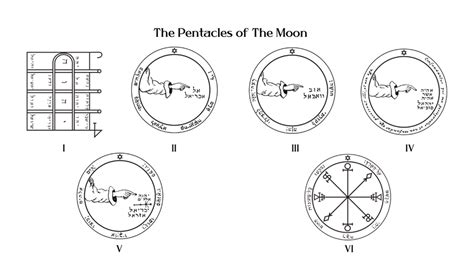
The "First Pentacle of the Moon" from the Key of Solomon.
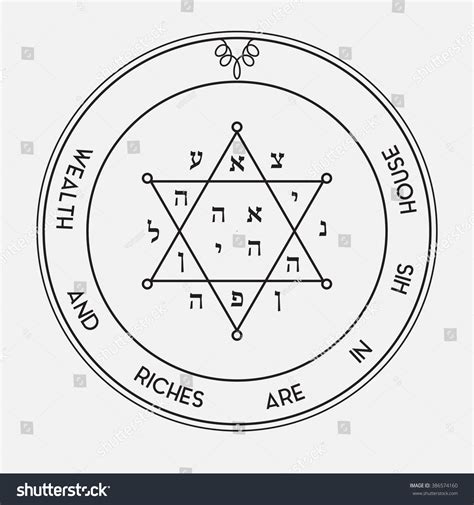
The Second Pentacle of Jupiter, from the Key of Solomon (Clavicula Salomonis). This was found on the body of Anselm, Bishop of Würzburg, on the night of his death in 1749.
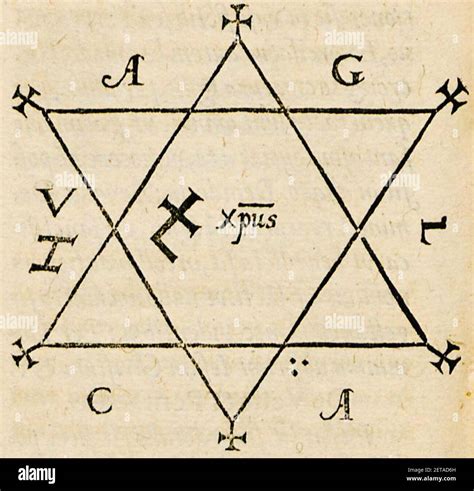
The pentacle in the 1500s grimoire Heptaméron.
The first documents to depict pentacles were the 16th-century grimoires called the Heptameron by pseudo-Pietro d'Abano, and the Key of Solomon.
In the Heptaméron, there is only one pentacle, whereas in the Key of Solomon, there are dozens of different pentacles. The Heptameron's pentacle is a hexagram that is embellished by patee crosses and letters, whereas the Key of Solomon's pentacles have a very broad variety of designs, only two of which are pentagrammic.
Here be the symbols of secret things, the standards, the ensigns, and the banners, of God the conqueror; and the arms of the almighty One, to compel the aerial potencies. I command ye absolutely by their power and virtue that ye come near unto us, into our presence, from whatsoever part of the world ye may be in, and that ye delay not to obey us in all things wherein we shall command ye by the virtue of God the mighty One.
Symbolic Meanings & Magical Uses
Both the pentacle and the pentagram hold significant meaning within various magical and spiritual traditions. They have become integral symbols in practices such as Wicca, Paganism, ceremonial magic, and occultism.
Their presence in rituals, talismans, and jewelry symbolizes protection, invocation of spiritual forces, connection with higher realms, and the pursuit of personal growth and enlightenment.
Delving deeper into the realm of symbolism, the pentacle embodies the concept of wholeness and completeness. The circle enveloping the pentagram signifies the eternal and infinite nature of existence, offering a sense of harmony and balance. It represents the unification of the five elements-earth, air, fire, water, and spirit-and their interconnected influence on the world.
This unity extends beyond the material realm and encompasses the spiritual, the metaphysical, and the cosmic.
Conversely, the pentagram, in its unenclosed form, maintains its intrinsic symbolism and elemental associations. Each of the five points represents one of the elements, with the upward-facing point typically representing spirit or the divine. The pentagram, without the encompassing circle, exudes a distinct energy, emphasizing the dynamic nature of the individual elements and their interaction.
The upright pentacle denotes Spirit ruling over the other elements, binding them together in a creative fashion, and how an individual is in fact a micro-chasm of the universe (because the same energy that composes the universe also resides within a human being).
It embodies the power of transformation, balance, and spiritual evolution, encouraging seekers of wisdom to explore the depths of their existence.
Both the pentagram and the pentacle find application in magical and ritualistic practices. The pentagram is often used as a symbol of protection and invocation, serving as a focal point for rituals and ceremonies.
It is associated with harnessing elemental energies, directing intentions, and connecting with the divine. The pentacle, with its circular form, acts as a tool for the consecration and amplification of magical energy.
It is commonly used in Wiccan and Pagan traditions as an altar tool and a symbol of sacred space.
In many old grimoires dealing with magical evocation, the pentacle is described as being hung about the neck, providing protection and authority to the operator.
The pentacle is of central importance in the evocation of spirits.
In the Golden Dawn magical system, the Earth Pentacle is one of four elemental "weapons" or tools of an Adept. There is, therefore, nothing movable or immovable under the whole firmament of heaven which is not included in this pantacle, though it be but "eight inches in diameter, and in thickness half an inch." Fire is not matter at all; water is a combination of elements; air almost entirely a mixture of elements; earth contains all both in admixture and in combination.
In the Golden Dawn system, the pentacles are not suspended from the neck, but wrapped in a cloth covering.
Interpretations and Variations
The interpretations of the pentacle and pentagram can differ among various belief systems and personal perspectives. In Wicca, the pentacle is associated with the Goddess and the five points represent the elements and the divine feminine energies.
It is viewed as a symbol of protection, fertility, and spiritual wholeness. The pentagram, in ceremonial magic, is often linked to the five points of the Tarot suit of coins or pentacles, representing material abundance and manifestation.
Both symbols can represent the 4 elements: Earth, Air, Fire and Water with the fifth point indicating Spirit or Divinity. However, interpretations can vary widely, and individuals may find personal meaning and significance in these symbols beyond traditional associations.
Celtic knotwork can be incorporated in the Pentacle to further represent the interconnectedness of nature and the elements.
An inverted pentacle is not something one sees often, as most witches-regardless of Tradition-would consider this akin to blasphemy; much as a Christian would consider an inverted cross to be a form of blasphemy. This being said, some Traditions will use an inverted pentagram: this serves the purpose of indicating a second degree iniations and/or fulfilling a stage of growth. Never, never, never it is used as a sign of evil, bad intention, or of nefarious spirits.
The inverted pentacle, with the point down instead of up, has sparked a lot of debate as to its meaning. Adopted by the practice of Satanism, it has come to be seen as a representation of the Devil or Satan, though Wiccans and most Pagans do not believe in such an entity.
To them, it is the idea of Spirit, represented by the top point when facing upright, being brought down to Earth or the power of manifestation. It also represents "drawing down" the power from the heavens to Earth as a symbol of manifestation. Satanists view the inverted pentacle as a symbol of exercising their own will, power, and independence to control nature.
There is variation from Tradition to Tradition (and from Practitioner to Practitioner, in the case of Solitary Witches) as to which pentacle point represents what-however it is consistent that the top point represents spirit.
The pentacle itself is closely tied to the Earth Element, but the top point is a reminder of our inescapable link with Spirit, can be even be used as a means of evoking spirit.
At first glance, this seems all very simple and straight forward, but take just a moment to reflect what it means. In wearing the pentacle one is declaring a recognition of having all the energies of creation at one’s disposal. Just think of the contrast between that and other forms of religion that throw their lives up the ladder to their God, or gods and leave it up to the Divine to run their affairs for them. A witch doesn’t shuffle off things in that manner-a witch looks within, reviews knowledge, takes stock of the tool box, forms a plan and then throws themselves and all their energy into that plan, sometimes asking the gods to lend a little “oomph” to what their doing.