Welcome to the Buckland Museum of Witchcraft and Magick in Cleveland, OH! It stands as the first museum in the United States to celebrate witchcraft, the occult, the paranormal, and their related cultures!
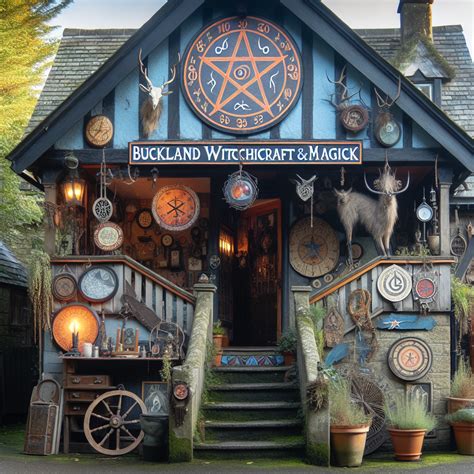
Many visitors stumble upon it while looking for things to do in Cleveland, while others plan their entire visit around this unique attraction. The Buckland Museum of Witchcraft and Magick offers a fun and exciting experience for everyone!
Founded by Raymond Buckland, the man famous for bringing witchcraft to the US in the ‘60s, Cleveland’s premier witchcraft museum is a single-story sanctuary. Its walls and display cases are filled with a hodgepodge of occult-related objects and ephemera.
Inside, visitors can peruse everything from tasseomancy teacups and crystal balls to archival records of the Salem witch trials and the eponymous founder’s own sacred possessions.
Visiting the Museum
Read also: Understanding Witchcraft in Scripture
Due to limited space, purchasing tickets in advance is highly recommended. Tickets purchased online are the best way to guarantee entry.
The museum is located at 2155 Broadview Road, Cleveland, 44109 (near the Zoo), and consists of a magickal gift shoppe and exhibit space. Museum days & hours vary depending on season. Tours are highly recommended and should be booked in advance online. Tours are $8 if paid online in advance, $10 at the door.
The Buckland Collection
The Buckland collection includes artifacts from Raymond Buckland, Gerald Gardner, Lady Rowan, Olwen, Aiden Breac, Aleister Crowley, Sybil Leek, Anton LaVey, Oberon Zell, Mat Auryn, Israel Regardie, Christopher Penczak, Stewart Farrar, Janet Farrar, Scott Cunningham, Lilith Dorsey, Peter Levenda, Najah Lightfoot, Lon Milo DuQuette, M.
The Museum's History
Read also: Urdu Article: Understanding Witchcraft
Raymond Buckland founded The Buckland Museum of Witchcraft and Magick in 1966. After visiting the late Gerald Gardner’s collection on the Isle of Man, Raymond was inspired to start a collection of his own. While working for British Airways, he was able to acquire many of the artifacts in this collection from all around the world.
He initially displayed his museum on a few shelves in the basement of his Long Island, N.Y. home. However, over time, Raymond’s witchcraft collection rapidly grew to well over 500 artifacts. The museum was in existence in this New York location from 1966 to 1973.
During that time, it was featured in numerous magazine and newspaper articles and was the subject of a television documentary. The New York Times, New York Post, Newsday, Look Magazine, Cosmopolitan, Esquire, Scholastic Voice, and many more, including foreign magazines, had featured articles about the museum. Raymond was also interviewed on a large number of radio stations and both national and international television.
In 1973, Raymond Buckland moved to New Hampshire where he opened the museum from 1973 to 1976, and then in Virginia from 1977 to 1979. The museum collection was briefly reestablished in New Orleans in 1999 where it passed through multiple hands before being curated by Rev. Velvet Reith.
In 2015, the artifacts were turned over to the Temple of Sacrifice, a coven based in Columbus, Ohio, founded by Raymond Buckland. Toni Rotonda, APS of T.O.S., is the museum collections current owner.
Read also: Understanding Witchcraft
Married couple Jillian Slane and Steven Intermill reached out and told her they could find a home for the collection in Cleveland.
Steven became involved in setting up the museum in Cleveland when Toni brought the collection up from Columbus. Then there was an explosion of interest. Steven was initially running the museum part-time, but went full-time as director about five years ago. Now he spends all his days dedicated to preserving the artifacts and telling stories of various forms of the craft.
The first museum location was in Tremont in A Separate Reality, a record store on West 14th Street. Steven set up the Witchcraft Museum in an unused side room of that store. It quickly doubled in size.
Raymond Buckland and the Wiccan Tradition
Buckland was the first person in the United States to openly admit to practicing Wicca, the pagan, earth-centered religion whose followers are referred to as “witches.” He’s also credited with forming America’s first-ever coven, headquartering the like-minded group in Islip, Long Island.
As Intermill explains, the Wiccan leader began his career as a copywriter, but soon “felt there was something spiritual in nature that was lacking.” This led him to the work of Dr. Gerald Gardner, the so-called Father of Witchcraft, who ran a museum of magic on the Isle of Man.
Buckland and his wife, Rosemary-whose coven names were Robat and Rowan, respectively-made a pilgrimage to the self-governing British Crown Dependency, where the storied Wiccan subsequently took the couple under his wing. Upon returning to the States, Buckland followed in his mentor’s footsteps by deciding to exhibit his own collection of relics via an appointment-only operation in his Long Island basement.
While working a day job for British Airways, the globetrotting Buckland was able to amass artifacts from all over the world. Soon, his little museum was later the subject of a 1972 documentary, Occult: X Factor Or FRAUD, and newspapers like The New York Times began to take notice. The Metropolitan Museum of Art even requested to feature some of Buckland’s Outsider art pieces in a prominent exhibit.
A Unique Approach to the Supernatural
The Buckland Museum was the first of its kind in the US to take an anthropological approach to showcasing the supernatural.
At first, the museum was a traveling show, moving between New Hampshire, Virginia, and New Orleans, where it was ultimately placed under the care of Wiccan priestess Velvet Rieth, who was instrumental in preserving Buckland’s pride and joy. As Rieth’s health began to deteriorate in 2015, Intermill’s partner at the museum, Toni Rotonda, retrieved the items and brought them to the Temple of Sacrifice, a coven Buckland founded in Columbus, Ohio.
Steven Intermill and the Museum Today
Intermill, who grew up poring over books about UFOs and Bigfoot, had always been drawn to the occult. “He was very generous,” Intermill says of the founder. “He was generous with his time. He was generous with his things. He was generous with his heart.”
Today, Intermill leads small group tours through the museum’s magical aisles, telling the story of Buckland, his relationship with Dr. Gardner, and the museum’s development. Because the collection is simply too large, Intermill rotates display items into specific exhibits. Currently on view is a show exploring the tradition of reading tea leaves, featuring objects on loan from the Museum of Tasseomancy in Hamilton, Ontario.
Intermill notes that the museum welcomes visitors from all walks of life, perhaps the most famous being Lil Bub, the feline Instagram superstar born with a perpetually stuck-out tongue. “Everybody's cool, everybody's open-minded,” he says. “They tend to be people that have a creative spark to them-there’s kind of a deflector field in front of the museum that keeps the jerks away.”
Buckland Museum Of Witchcraft & Magick Gift Shop Tour
Featured Artifacts
The museum director was kind enough to share a few of his favorite standouts from the permanent collection. (But, of course, in order to truly experience the mystical powers emanating from this wonderland, you’ve really gotta make your way out to Cleveland and see for yourself.)
Here are some of the highlights of the collection:
| Artifact | Description |
|---|---|
| Buckland’s illuminated robe | “The first thing visitors see when they walk in is our founder Ray Buckland’s illuminated ritual robe in a place of authority. He made it himself, it’s very impressive. He was very interested in the idea of making one’s own tool. And it’s purple, of course-a sign of spirit.” |
| Sybil Leek’s crystal ball | “Leeks was an extraordinarily famous fortune-teller, astrologer, and witch back in the 1960s-a real popularizer of the occult in America. And she was friends with our founder, Ray. This piece is luminescent-when you walk in, it’s already glowing.” |
| Original manuscript of Buckland's Complete Book of Witchcraft | “One of my favorite pieces to share is the original handwritten manuscript of Buckland’s Complete Book of Witchcraft-quite legendary in the cult scene. A lot of people, their eyes light up, and they say, ‘Is that Bucky's big blue book of witchcraft?’ It’s often people’s starter book on the craft, because it essentially contains the seeds for the popularization of witchcraft in the 1980s. It's surprising-everything on the page [here] is in the book. It shows Ray’s focus, how he knew exactly what he wanted to express.” |
| Antique mandrake root | “Lots of people know mandrakes from pop culture-Harry Potter, Pan’s Labyrinth-and they’re often surprised to see it's the real deal. There are a lot of legends about the mandrake-most famously, that they scream when you pull them out of the ground. This is about 200 years old and carved to look like a woman carrying children, so it’s what we refer to as a fertility totem.” |
| Gerald Gardner’s personal items | “We have some personal items that belonged to the great Witch Father Dr. Gerald Gardner, the founder of the modern witchcraft movement. They were gifted to Ray by Monique Wilson: his pipe, his wallets, and his attache case. Wilson was one of Gardner's top witches back in the day, and initiated Ray to the craft. It’s really cool.” |
| Black mirrors | “We have a variety of scrying mirrors on display, the black mirrors people stare into to see fortunes, future and past-you know, ‘Mirror, mirror on the wall.’ We also have Ray’s personal one. People love staring into it for long periods of time.” |
An Open and Welcoming Environment
The Buckland continues to attract members of the pagan community from right here in Northeast Ohio. One reason, beyond the history: Its open and welcoming environment.
“All kinds of people come in here, and we hear a lot of them say, 'I don't tell people about my beliefs because I'm afraid of what they'll think," Slane says. "The space offers a non-dogmatic platform for them to express themselves."
There are no curses or love spells done here," Slane says. "We are a place of educating people about the collection and the history, and also celebrating the First Amendment. That's a really important part of our mission because of the persecution that Wiccans have felt in the past. People get labeled because of their religion or culture, and we want to be a place where it's safe to talk about that."
Most people, Slane says, are just happy they can see the museum's artifacts for themselves.
“We get a lot of people who are just really comfortable in here being surrounded by these things. We try to keep it pretty cozy.
Steven wants people to know that there’s nothing else like this museum - that it’s here for the duration - and it’s also a place of fun and joy. It’s for practitioners of all kinds of magic; a place where people can recognize and celebrate their own traditions.
Future Plans for the Museum
What are the future plans for the museum? Steven and Toni are working together on that. They want to continue giving a high quality experience to the guests. Pagan Pride involvement every year; more highly anticipated author events; more workshops; more wonderfully mystical group events.
What Steven would like the average person who may not be familiar with the Museum to know - why they should visit and what they would take away from a wonderful tour of the Buckland Museum: If you lean Pagan, it’s a great place to be, to be around your people. If you don’t lean Pagan, it’s a great place to come and learn a little bit about a way of life which you may not have explored. No matter what, people tend to have a good time here.
“We get a lot of self-described Muggles here, and it’s good when people come in and experience a little bit of magick,” he says. “So yeah, it is like music, it really can save your mind, save your soul.
tags: #witchcraft #museum #cleveland