In the 16th century, astrology was an accepted science in both Europe and India. Many rulers relied on the advice of astrologers, including Akbar, the Mughal emperor (reign 1556-1605). The Akbarnāma, a chronicle of Akbar's reign by Abu l‑Fażl, extensively uses the emperor’s horoscope to support his claim to power. Akbar claimed to be the "mujaddid" (restorer of Islam) of the second Islamic millennium and the pre-destined perfect ruler.
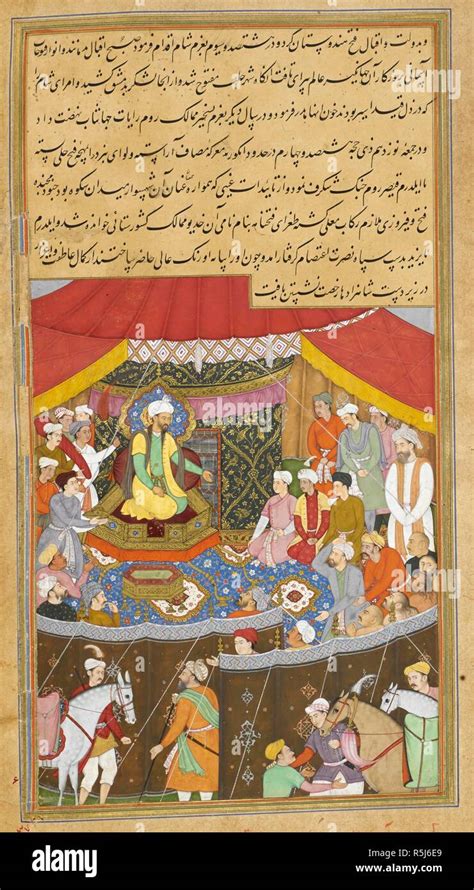
The birth of Timur showing astrologers on the right, drawing up his horoscope. From an imperial copy of Abu l-Fażl’s Akbarnāma, c. 1602.
This blog will show how astrologers acted not only as the psychiatrists but also as the spin doctors of the Mughal Empire.
The Significance of Horoscopes
A horoscope is a diagram showing the sky over a given place at a given time. It consists of:
- The zodiac
- The houses, a second zodiac constructed with the ascendant (the rising point) as the starting point
- The planets at their places for that particular time
A horoscope contains approximately 250 interrelated data points. The astrologer's task is to select the right influences and interpret them appropriately, which is subjective, even if the planets had influences.
Read also: Understanding Lucifer's Role
Abu l‑Fażl's Interest in Astrology
Abu l‑Fażl ibn Mubārak, Akbar’s mentor and chronicler, had a genuine interest in astrology and regarded it as a fully-fledged science. He created four different horoscopes for Akbar and discussed their differences (Akbarnama, pp. 119-123). Eva Orthmann proved that the horoscopes are based on genuine calculations and not fabricated by Abu l‑Fażl.
Differences in Astrological Systems
Abu l‑Fażl writes that an Indian and a Western horoscope were cast at Akbar’s birth in 1542 by Jyotik Rai and Maulānā Chānd. The results differed due to the varying definitions of zodiacal signs in Vedic and Western astrology. Indian astrology defines the zodiac as the constellations in the sky, while Western astrology defines it as the ecliptic divided into twelve equal parts from the spring equinox.
Abu l‑Fażl discusses this difference, effectively discrediting the Indian astrologers (pp. 119-122). Thus, Akbar’s ascendant fell in Leo according to the Indians, which suited an emperor, but in the Western horoscope, it fell in Virgo.
Fatḥullāh Shīrāzī's Contribution
When the scientist and physician Fatḥullāh Shīrāzī joined Akbar’s court in 1583, Abu l-Fażl asked him to correct the two horoscopes. Fatḥullāh cast his own, using old “star tables of the Greeks and Persians” from around 830 AD instead of Ulugh Beg's newer tables. He determined that the ascendant fell at the very end of Leo (28°36’) instead of 7° Virgo. Abu l-Fazl called this “the most reliable horoscope” (p. 123).
Combining the right influences from the vast data, Fatḥullāh Shīrāzī sings Akbar’s praises (p. 123) and even (p. 124).
Read also: The Meaning of Aries Zodiac Flowers
The Mughal Empire and Historical Reputation: Crash Course World History #217
Horoscopes as Propaganda
Overall, the horoscopes emphasize Akbar’s success in conquest, wealth acquisition, administration, and supreme reason in guiding the state and settling disputes. Maulānā Chand argued that Akbar was greater than Timur because Akbar’s Mars was stronger (p. 79).
Abu l‑Fażl concludes that any contradictions in the horoscopes are superficial, claiming that God hides Akbar’s greatness from the undeserving (p. 80).
Abu l‑Fażl considered Akbar’s father, Humāyūn, an accomplished astrologer. Abu l-Fażl says Humāyūn danced with joy when he read the horoscope. In this way, he tries to make his readers believe that if they see nothing but contradiction, this is because they do not see well enough.
Controversies Surrounding Akbar's Birth Details
There are some 'myths' associated with Mughal Emperor Akbar:
- Akbar's DOB has been deliberately kept under shades.
- Akbar was not a 'title' given to Jalal-ud-din Mohammed.
Akbar's DOB is stated as, 5 Raj-'ab 949, that is, 15 October 1542. The day is said to be Sunday. But, in the private records of Humayun, Tez-kirah-al-Waqiat of Jauhar, Vol.1, Page-45/46 (M.C. Akbar's DOB is stated as 14 Sha'ban 949, that is, 23 November 1542. The day is said to be Thursday. So, why this discrepancy.?.
Read also: Criminal Minds: Unmasking the Zodiac Killer's Legacy.
Akbar was born on 23 November 1542. That was a full moon day. Hence, he was named as Badruddin, that time . Badr means Full Moon. means Faith.
Since, the DOB was 'changed' . changed to Jalal-ud-din. means Faith. son would be born to him soon, whom he should name as Jalal-ud-din. So, after regaining his kingdom, in 1546, this name was FINALLY given to Akbar. DOB.
After describing the issue of Akbar's DOB, here is another disclosure.
Akbar was not a 'title' given to Jalal-ud-din Mohammed. It was a part of his ACTUAL name since birth.
The name of Hamida Bano Begum's father was Mir Ali 'Akbar' .
In his book Notable horoscopes, Late B.V. Raman gave 23rd or 24th November 1542. Sri K.N. Rao presented it as 15th October 1542, while Pt. K.N. Rao writes: “Not understanding this, English and Indian historians debated whether Akbar was born in October or November of 1542.
K.N. Rao was right about the date but 15th October is in the Julian calendar and not the Gregorian.
The Akbarnamah which translates to Book of Akbar, is the official chronicle of the reign of Akbar, commissioned by Akbar himself by his court historian and biographer, Abulfazl who was one of the nine jewels in Akbar’s court.
Sadly, many copies dropped or left the horoscopes blank! Even the luxury manuscripts of the British Museum don’t have horoscopes.
Some other Persian copies also present unclear or even wrong figures.
Hopefully, the text explains the necessary information to recast the charts, and putting it all together can give us a correct chart.
Key Astrologers in Akbar's Court
Several astrologers played a crucial role in casting and interpreting Akbar's horoscopes:
- Mawlana Chand: Known for his accuracy in calculation, he found Akbar's tropical Ascendant as 6º13 Virgo.
- Jutgrai (Jyotikrai): Considered the best among Indian astrologers, possibly Neelakantha, the author of Tajik Neelakanthi and Prasna Tantra.
- Amir Fathullah Shirazi: A Persian-Indian polymath who served as a jurist, finance minister, mechanical engineer, inventor, mathematician, astronomer, philosopher, and artist. He was titled “The arm of the empire” and played a role in transmitting Iranian knowledge to India.
- Mawlana Ilyas Ardebili: Accompanied Humayun upon his return from Iran and was one of the best astronomers and astrologers of his time.
Akbar's Birth Details
Abulfazl starts from early events before his birth. In brief, Abulfazl writes several pages about the dreams of relatives and the signs which were promising the pregnancy of the queen and describes him as a promised child. He keeps telling the stories until the morning of the birthday.
From the morning when the queen knew that she would deliver the baby soon, all astrologers and ministers were discussing the time of birth.
“Few hours before the birth time, Mawlana Chand, the astrologer, and astronomer of the court was anxious because he found the time to be inauspicious and he was full of pity that in the next few hours, a time comes which never repeats in thousands of years”, Abolfazl writes.
Then an ugly midwife comes to help the queen and the appearance of that midwife shocks the queen and causes the delay of birth.
Akbarnamah gives detailed information about the date, time, and place of birth.
Here we get that he was born on the 6th day of the Hindu Calendar which is the 5th Day of the Arabic lunar calendar because Arabs wait to find the moon out of sun’s beam.
Also, the month of Aban sun is in tropical Scorpio.
Jalali Calendar starts on March 21st and Aban is the 8th month, therefore, Sun is in tropical Scorpio.
You might also find a controversy in the first two dates, of which the former is Saturday and the latter is Sunday!
In most calendars, the day was commencing from sunrise, but in Arabic calendars, the night comes first!
It means after sunset is Sunday night and the next sunrise is the start of Sunday!
If we simply use online converters to convert any of the given dates, we probably fail!
Here I shortly mention that Sri K.N. Rao presented the correct date and the dates presented by B.V. Place of Birth is mentioned as Amrkut (Umerkot) Which is in the Sindh Province of contemporary Pakistan.
The text mentions the location in Latitude 25º and Longitude 105º from Khaledat Islands.
Before Greenwich, Khaledat Islands as the most western place in the known world was the base of measuring the locations.
Although Sri K.N. Rao was right about the date, he made a mistake about the time.
The text says 4 hours and 22 minutes after sunset but Sri K.N. Rao took it as 4:22 am.
There is a small error of 2 minutes which is due to ignoring the seconds of birth, sunrise, or sunset.
The only other item we can consider to verify the time is the altitude of Procyon.
At 1:42 am, the Altitude of Procyon was 37º55.
We can be convinced by accepting 2 degrees of difference between the modern calculation and local calculation of that time but if we want to go into more detail we can do more modeling.
Here we have a problem because at 01:36 am the ascendant in the tropical zodiac changes from Leo to Virgo.
We cannot easily decide which one of the sunset times or altitude of Procyon should be trusted.
As already said, it was a big problem among the four astrologers of the court.