Look up into the sky. What do you see? A million, billion, insurmountable amount of shimmering stars. Since the dawn of humanity, we have always been fascinated by this ever-changing and always beautiful tapestry of the heavens. When astrology was created, it wasn’t just a system that people used to make random guesses about what was happening or what was to come. No, astrology has been researched and documented throughout time.
But how did they do that? Well, of course they watched the movement of the planets, luminaries, and stars…but there’s more to it than just that. Enter: planetary aspects. Let’s do a quick Q & A about planetary aspects so you have a handy-dandy astrology 101 tutorial, regardless if you’re a newbie or a long-time student!
Astrological aspects are illustrated in the center of this natal chart.
If you’ve ever looked at a birth chart, you’ve likely seen lines crisscrossing the circle, connecting planets. These lines represent aspects, a key concept in astrology. Aspects are an essential part of astrology-an age-old tradition that goes back to the ancient Greeks. They indicate how the planets are interacting with each other. Depending on the aspect, that could mean ease or challenge. Let’s dive into the wonderful world of astrological aspects!
What are aspects in astrology?
First and foremost, aspects in astrology are the “conversations” that are happening in the sky. When we’re looking at a 360-degree view of the sky, we divide the circle into 12 houses. Planets move through different houses and zodiac signs, and as they move, they send messages to each other when they link at certain mathematical angles. These angles are what we call planetary aspects.
Read also: Learn about Rick Levine and his contributions to astrology.
When a luminary or planet forms an angle with another celestial object, they carry a specific energetic signature. For example, a trine is like the Sun (ruling our life force) is smiling and waving to Jupiter (planet of luck), bringing bring happy news, positive energy, and expansion to each of us and the world at large. By charting aspects, we have a clearer vision of the “astro-weather.” Remember: astrology is essentially the research and understanding of the flow of energy, whether that’s through the entire world, a lunar cycle, or an individual’s birth chart!
What do aspects tell us?
Aspects are super important. Like, they give us an in-depth understanding of how energy is moving at any given time. While major aspects between the planets or luminaries can have a longer effect-especially if an outer planet or Mars is involved-the Moon can make a ton of aspects in a single day.
The Moon and Mercury make the most aspects because they move so quickly, and by extension we can learn more about the emotional atmosphere and our daily lives from their insight. When it comes to outer planets, aspects can build, crystallize, or release energy over longer periods of time. For example, let’s say Jupiter and Uranus are making an aspect. The energy can be felt very powerfully over weeks and months, but if they continue to aspect one another, this can also echo over years! These kinds of situations often bring powerful generational and collective evolution.
Aspects in your birth chart
Now, when it comes to a birth chart, aspects give us even further insight about an individual and specific parts of their lives. They add a tremendous amount of nuance to an individual and one’s personality. For instance, if your Venus makes an aspect to Jupiter, that will blend their energies together and echo out into your life. However, if your Venus makes an aspect to Saturn, that will also bring a very different and distinct color to all Venusian topics in your life, like love, romance, beauty, and money.
This is how someone may have different layers to one of their Big Three-like a Sun sign, Moon sign, or Rising sign. For example, someone could be a Leo Sun or Leo Rising, and you’d think this person loves to be the center of attention and in the limelight 24/7. But if Saturn is opposing, square, or conjunct their Leo Sun or Leo Rising, they may prefer to avoid attention.
Read also: The Secrets of Astrology and Numerology
If you’ve ever looked at a birth chart, you’ve seen the beautiful, complex web of lines in the middle of the wheel. Those lines are not just for decoration; they represent the secret language of your chart. Think of your birth chart as a play: the planets are the actors and the zodiac signs are the roles they play. The astrological aspects explained here are the script-they describe how these actors interact. In simple terms, aspects are specific angles between planets in the zodiac wheel. These angles create an energetic connection, determining whether the planets work together harmoniously, create tension and conflict, or have a more complex relationship.
Aspects in compatibility
When it comes to compatibility, it’s always important to look at how two birth charts overlay and interact with one another. While most people like to look at how their Sun signs, Moon signs, or Rising signs match, looking at aspects between planets fills in the nuance and gaps of how a relationship exists and evolves. In this regard, you can see how the energy flows between two people. For instance, let’s say two people’s Moon signs aren’t in “compatible” elements, but they have a strong aspect to each other. This will bring a powerful rapport regardless. By understanding the complex web of synastry-which is built upon aspects-you’ll have many *Mind blown!* moments that reach far beyond just looking at basic compatibility.
Aspects in Astrology
“Soft” aspects vs. “hard” aspects
There's a difference between “soft” and “hard” aspects in astrology. On a general level, soft aspects occur when two celestial bodies are in a positive or beneficial alignment. These often promote harmony, growth, or an easy ~flow~. Hard aspects, however, occur when two celestial bodies are in a sharper angle. This reveals that the energetic flow between them will be challenging, require adjustment, or even have a blockage.
It is important to note that the idea of “good” or “bad” aspects is a bit outdated-you can’t hope for “soft” aspects 24/7! Soft aspects can certainly promote happiness, but they can also create laziness or boredom because sometimes things just feel “too easy.” Hard aspects force us to pivot, stand up, and persevere, even if we are faced with hardship, challenges, and opposition. This is why sometimes people who have a ton of hard aspects happening in their lives-or were born with them in their birth charts-end up becoming tremendously successful.
The major aspects
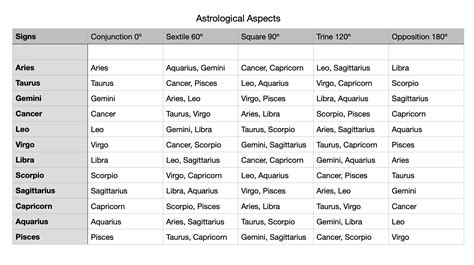
There are five major aspects you need to know, all defined by Ptolemy, an ancient Greek mathematician. All are divisible by 10 and evenly divided in relation to a 360° circle.
Read also: Leo Celebrities and Their Charts
- Conjunction: 0˚
- Sextile: 60˚
- Square: 90˚
- Trine: 120˚
- Opposition: 180
These are not the only aspects, but they are the most important. Before we explore each aspect further, it’s essential to consider orbs.
What Is An Orb?
An orb is the degree of exactness of the aspect. In other words, how close in degrees the planets are. The closer the orb, the more intense the influence will be felt. For example, if your natal Sun is 12º Taurus and your natal Venus 13º Taurus, that would be a conjunction with only a 1º difference. In other words, it would be as close to exact as you could get. Let’s say the Sun is 5º Pisces and Venus is 25º Pisces. That is a 20º orb, which means the planets are pretty far apart, even though they are in the same sign. The energy would be subtle or barely noticeable. Therefore, you’ll want to focus on tighter orbs, no more than 5º. (Some astrologers feel you could go as far as 10º difference, but I find it’s better to be as close to exact as possible.)
Conjunction
When two planets are close to each other in the sky (within a couple of degrees, usually in the same zodiac sign), this means they form a conjunction and their energy is blended in unison. This can create a perfect alliance or bring intensity. In transiting astrology (“astro weather”), we can expect this day to be especially potent.
Conjunctions in transiting astrology mark new beginnings too: For instance, when the Sun and Moon form a conjunction, it creates a New Moon. If you have your Sun and Moon conjunct in your natal chart, it not only means you were born on a New Moon (or in some cases, a solar eclipse) but also that you will have an easy time synergizing your conscious and subconscious in the pursuit of your goals throughout your entire life.
The planets are 0º apart. In other words, they are the same sign, the same degree. For example, if your natal Mercury is at 12º Scorpio and your natal Mars is also at 12º Scorpio, they are conjunct. A conjunction intensifies the energy between the two planets, for good or ill. In this example, Mercury and Mars are aligned, which could produce a sharp mind or an argumentative nature. Remember, aspects show the energy. You still have a choice in how you decide to manifest that vibe.
When a conjunction is exact with the Sun, it’s called “cazimi,” which means “in the heart.” This gives the planet power. However, it must be managed because it can run hot and create trouble, like in the Greek myth where Icarus fell to the earth when he flew too close to the Sun.
Sextile
If two planets are separated by two zodiac signs and are roughly 60 degrees apart, we get one of the sweetest aspects of all-the sextile. Since these planets are in compatible elements two zodiac signs apart (earth + water or fire + air), they support one another and flow easily. Sextiles are often happy and chill, bringing good moods and camaraderie. An opportunity may present itself if we seize the day to take action and uncover it.
For instance, let’s say Venus and Neptune are sextile. If it’s taking place in your birth chart, you are blessed with creativity and a romantic demeanor. If the planets are linked in a sextile on a random day, we will be more openhearted at this time, likely pulled toward beauty, romance, or art. I’m getting butterflies just thinking about it!
The planets are 60º apart. This is a favorable aspect that shows ease and opportunity. The planets are vibing well, like good friends. Using our Mercury-Mars example, a sextile would indicate a positive, dynamic mindset.
Square
Yikes! One step further than a sextile is a square: Two planets are separated by three zodiac signs, meaning they are roughly 90 degrees apart. Get ready for a battle as each planet steps into the center of the ring to trade blows! When two planets are in a square, they share an astrological quality-they’re both cardinal, fixed, or mutable signs-but don’t have much else in common!
Squares often bring tension, struggles, and conflict, with each planet not seeing eye to eye. The best way to navigate this awk energy is to do your best to compromise. As an example, let’s say you have Mars square Saturn in your natal chart. Welp, that means you will often feel blocked and criticized by the world-especially around how you express yourself and pursue your passions. In transiting astrology, the days that Mars is square to Saturn will bring frustrations and obstacles to you as you’re pursuing your goals. Ick.
However, challenges in astrology can also bring the greatest rewards because they teach you to find your strength and create solutions.
The planets are 90º apart. In my opinion, squares are the most difficult of all the aspects. This indicates difficulty. The planets are not cooperating. Once again, using the Mercury-Mars example, if they were in a square aspect, it might indicate temper tantrums, sarcastic speech, and a tendency to get into arguments. If you have this aspect, you must learn to calm down and think before you speak. (By the way, I have this aspect and admit to having a volcanic temper! I’ve had to learn to manage it.) Do not assume you’re in trouble if you have a bunch of square aspects in your chart. Some of the most successful people in the world have astrological charts filled with squares! While this aspect can be difficult, it can also be a catalyst for bold ambition.
Trine
Get ready for good vibes, bb! Next on our list is when two planets are four zodiac signs apart, or roughly 120 degrees. This aspect is called a trine, which means that the planets will be in the same element-fire, earth, air, or water. Trines bring luck, harmony, and opportunity. We can move forward easily, often with something presenting itself with very little effort.
Howevs, since trines are just ~so fab~, they can also make us lazy-as opposed to squares, which make us put in a ton of effort to get what we want. In a birth chart, let’s say Mercury and Uranus are in a trine-that means you’re blessed with a brilliant mind with a progressive view of the world. And if these two planets are frolicking through the heavens on a random day and meet in a trine, you can expect that exciting news is going to pop up for you suddenly, pushing you to form new ideas and open your mind.
The planets are 120º apart. Another favorable aspect, a trine indicates harmony, talent, ease, and opportunity. This is where you have gifts and good fortune. Once again, using Mercury and Mars as an example, a trine between these two might indicate a sharp, decisive mind. It could also mean you’re a strategic planner. But while the energy is positive, it can sometimes lead to laziness. After all, if you don’t have challenges, why bother?
Opposition
Whoa, tense much? These two planets are directly across the sky from each other and separated by six zodiac signs, meaning they’re about 180 degrees apart. (Quick guide to the opposites: Aries-Libra, Taurus-Scorpio, Gemini-Sagittarius, Cancer-Capricorn, Leo-Aquarius, and Virgo-Pisces.) On one hand, this can bring balance and union through compromise, almost like the planets fit together like two opposite puzzle pieces. But on the other hand, this aspect can bring obstacles.
The planets will be in congenial elements (fire + air or earth + water), which on one hand can show that they can work together well when they try, but they also share an astrological quality (cardinal, fixed, or mutable), meaning they are pretty set in their ways and won’t really want to budge.
For example, let’s say you have the Sun opposite Pluto in your natal chart-like your Sun is in Taurus and your Pluto is in Scorpio. This means you’ll face many personal crises in life, likely around relationships, that will help to transform you repeatedly. In transiting astrology, the days that the Sun stands opposite Pluto will bring a major change, likely triggering a crisis moment that can help you evolve for the better.
The planets are 180º apart. In other words, they are in opposite signs. Although the saying goes that “opposites attract,” in this case, it’s complicated. The planets are at odds, which has the feeling of being antagonistic. Sometimes, outer events can be a catalyst for drama. If you want to manage the energy, you must find the middle ground. If you’re able to do that, it can be a productive aspect. If we use Mercury and Mars as our example, this creates a “contrarian” personality. It’s the “devil’s advocate” who chooses the opposing viewpoint in order to stir the pot.
The minor aspects
Yes, there’s more! Once you’ve mastered the more dynamic energies of major aspects, you can take a further dive into the energetic patterns of minor aspects. Minor aspects are less pronounced and more nuanced than major aspects but can still bring a lot of insight into someone’s natal chart as well as the celestial vibes of day-to-day life. These aspects often affect us in a more nuanced emotional, mental, or spiritual way.
| Aspect | Angle | Description |
|---|---|---|
| Inconjunct (Quincunx) | 150° | Uneasy pressure, requires adjustment |
| Quintile | 72° | Tapping into heightened senses and talents |
| Semi-sextile | 30° | Friction and unease, requires effort |
| Semi-square | 45° | Tension, subtle but grinding |
| Sesquiquadrate (Sesquisquare) | 135° | Cranky energy, tension beneath the radar |
| Bi-quintile | 144° | Opportunity to unearth talents, inventive solutions |
| Septile | ~51.43° | Mystical aspect, hidden flow of energy |
| Octile (Semisquare) | 45° | Stimulating or challenging energy |
| Novile | 40° | Subtle shifts and fine-tuning |
| Undecile (Elftile) | ~32.73° | Subtle shifts and fine-tuning |
| Semioctile (Sexdecile) | 22.5° | Triggers challenge, version of the Semisquare |
Inconjunct, or quincunx
Uh-oh, are you feeling that ~uneasy~ pressure? Could be an inconjunct aspect (which also goes by the fancy name of quincunx). This is considered the most important of the minor astrological aspects. An inconjunction occurs when two planets are separated by 150 degrees. This angle means they just can’t see eye to eye and they make each other uncomfortable-ick! Inevitably, one planet’s energy is going to dominate the other’s. The best way to work with this energy is to use self-reflection to find a way to better balance the two-even though it’s immensely hard to integrate both energies fluidly. I mean, can’t we all just get along?
Another way of considering the inconjunct is to look at it as a time or situation where you need to adjust your tactics to reach your goal. Another important note to make is when two planets are inconjunct, they are different in modality, polarity, and element-basically, they share no common ground.
Quintile
Are you feeling those soft, subtle good vibes? Say hello to the quintile. This energetic flow is all about tapping into your heightened senses and talents-but it’s something you must take action toward to make happen. Quintiles occur when two planets are 72 degrees apart, which looks like a five-pointed star inside a circle. Often, quintiles boost ambition, creating an area of opportunity to express yourself and create an impact. Quintiles also give us a special opportunity to look at things from a unique perspective in ways other people may not perceive.
Semi-sextile
Oh, look, another shady aspect? The semi-sextile occurs when two planets link at 30 degrees, creating a sense of friction and unease. The energetic flow between them is attractive, as if they’re making each other curious, but requires effort in order to incorporate the other planet’s vibe and information. When two planets are semi-sextile, they are in neighboring zodiac signs. And by their very nature, zodiac signs that are before or after one are super different, as they do not share a modality, element, or polarity. While the planets may feel alien to each other because they can’t really “see each other clearly,” there is something to be gained from semi-sextiles. Look at this as an opportunity to learn to work in tandem to realize the full potential of a situation. Remember, just because there’s the potential for understanding, it doesn’t guarantee it’ll happen-but it’s good to be aware so you can avoid miscommunication.
Semi-square
The semi-square is giving you a literal side-eye! This aspect takes place when two planets are linked at 45 degrees in two adjacent signs or houses. Tension? Mm-hmm. The friction here isn’t as tough as it is a square and it’s certainly subtler, but it will still grind your nerves. Remain calm, balanced, and grounded to navigate this annoying energy. Be extra aware of how you respond to tension and conflict, so you can make proper choices to make things run as smoothly as they can.
Sesquiquadrate or sesquisquare
Yes, this aspect is impossible to spell. A sesquiquadrate occurs when two planets are 135 degrees apart; this is also sometimes called the sesquisquare. This aspect has cranky energy: Neither planet is interested in working together, which yet again brings some tension beneath the radar. The best way to deal with this vibe is to face it honestly and practice moderation and control rather than giving into conflict. It’s best to work through this trash energy than just forever being stubborn.
Bi-quintile
Phew! We can have a breath of fresh air. The bi-quintile is double the quintile-or two fifths of a circle. This is a super-subtle, chillaxed alignment. It occurs when two planets are separated by 144 degrees. This aspect gives you the opportunity to unearth important talents and creative abilities, but you have to work on this-not just sit back and wait for it to happen. The bi-quintile also gives you the chance to be original and inventive in finding constructive solutions to irksome problems. Think outside the box!
Septile
Then last-but not least-is the septile. This aspect is impossible to spell.