Call of Cthulhu is possibly one of the most beloved tabletop RPGs of all time, renowned for its versatility and immersive storytelling. Chaosium recently released a new edition as part of its 40th Anniversary celebration of the legendary horror game.
If you're up for spine-tingling suspense and eldritch horrors, this one's a must-try… In a nutshell, the Call of Cthulhu Starter Set is a riveting plunge into cosmic horror. It could be argued that more people have been introduced to the Cthulhu Mythos through Call of Cthulhu the RPG than the original stories.
This review delves into the Call of Cthulhu Starter Set, examining its contents, rules, adventures, and how it effectively brings Lovecraftian horror to the tabletop.
Call of Cthulhu Starter Set Unboxing and Overview
What's Inside the Box?
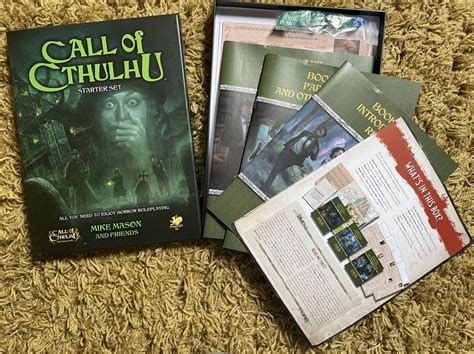
The Call of Cthulhu Starter Set is designed to get you playing quickly, without sacrificing the tone or depth that makes the game special. It contains three books, handouts, investigator sheets (some pre-generated, some blank), and a set of dice - with an extra tens d10 for bonus dice rolls.
The starter set includes everything you need to get your feet wet: a beautifully put together, carefully thought out collection that allows people () to learn the game easily and relatively quickly.
Read also: Call of Cthulhu: A Must-Play for Horror Fans?
The set comes with a set of dice, and contains three books.
- Book One: Alone Against the Flame
- Book Two: Introductory Rules
- Book Three: Paper Chase and Other Adventures
Book One: Alone Against the Flame
Book One: Alone Against the Flame is a solo adventure, kind of like the old Choose Your Own Adventure books, that not only gives you a taste of the setting, but also teaches you the basic rules of the game, and helps you build a character. It’s a fantastic idea for an introductory box set, and I really think it should be an industry standard.
The structure of the adventure reminded me of a video game tutorial level. Players build their characters and test their skills in the story of someone taking the worst bus ride ever to start their new life in Arkham, Massachusetts.
Book Two: Introductory Rules
Book Two: Introductory Rules is pretty self explanatory. It’s a clear breakdown of the mechanics of 7th edition. At 23 pages, including art and charts, it’s a nice reminder that one of the reasons I’ve always loved Basic Role-Playing and its various incarnations is that the rules are just not that complicated.
What’s great is to see them condense what appears as a traditional “hardback book” game with plenty of rules into a slim pamphlet with just the important ones. This is an excellent resource for the one-shot GM.
Read also: Descent into Madness
Book Three: Paper Chase and Other Adventures
Book Three: Paper Chase and Other Adventures is the final book, and contains three adventures intended for new Keepers. Throughout the third book there are paragraphs of advice to new Keepers on how to do various scenes or work in various concepts.
There are also several blank character sheets, some pre-generated character sheets, and a booklet reproducing various handouts from the adventures, so you can easily make photocopies for your players. That’s a really nice touch, and I wish that was more common, too.
The scenario book included props that can be scanned, photocopied or printed, but all of them are provided as individual handouts. I’m very happy to see Chaosium understand that documents are a strength of this game and even just a paper with a picture of the newspaper article on it elicit exciting feelings from the group.
The last book contains three classic adventures.
- “Paper Chase” is a small one player one Keeper experience that feels more spooky than frightening as a toe dip into the world of cosmic horror.
- “Edge of Darkness” is much more of what one might expect of a typical case featuring some family secrets, dives into diaries and newspaper archives and a showdown at the end with an unnatural being.
- “Dead Man Stomp” is the third choice and remains my favorite introduction to the game. It blends the elements I love most about Call of Cthulhu perfectly: real history, pulp action and terrifying scenes.
Some fans have lamented the lack of “The Haunting” in this box as it’s been used as a starting scenario for many editions but I think these are stronger choices. Besides, it’s available as part of the free quick-start PDF.
Read also: Detailed Weapon Analysis
Core Game Mechanics
In six previous editions, there have been few changes to the rules of the game. Mostly it’s been variations on the amount of content in the book or layout. The core game mechanics, used in various forms for many games put out by Chaosium, are the Basic Role-Playing rules.
Games like Dungeons & Dragons are ‘level based,’ meaning your characters improve by building up enough experience points (typically through killing stuff), they reach a new level and are suddenly better at a lot of stuff, stronger, faster, etc. Call of Cthulhu, however, is ‘skill based,’ meaning your character gets better at the skills they actually use. Want to get better at climbing? You’ve got to climb. Want to get better at shooting? You’ve got to shoot. Works for me.
The biggest change in the new edition is in basic statistics (Strength, Intelligence, etc.). In previous editions, your stats were on a 3 to 18 scale, with 3 being almost unable to lift your arm and 18 being height of human achievement. A 3 strength means you likely can’t support your own weight, while an 18 means you’re The Rock after pounding a bovine steroid laced protein shake.
The 3 to 18 range was pretty common in a lot of early games, because everyone was using six sided dice (D6) in various ways. However, it did always seem a bit weird for Call of Cthulhu, since nearly everything else used percentile dice (D100), and in fact, many things needed you to multiply your stat by 5 to achieve proper percentile targets. 7th Ed. has done away with the old 3D6 range and replaced it with a D100 range instead, cutting out some clunky steps.
The only other major changes I noticed were the addition of Luck as a more active, player controlled way of effecting outcomes and the addition of half & fifth values to characteristics. The latter is something I think a lot of Keepers (Game Masters) already used in some way or another. I used to give PCs slight modifications to their skills in certain circumstances. Like, “roll Spot Hidden, but take off 10% because of the drug’s effects,” or something.
The game uses a percentile system, where you roll a d100 die and have to hit under the target skill number found on your character sheet. Much of the difficulty adjustments are through bonus/penalty dice (roll extra tens dice, then take the better result (bonus) or take the worse result (penalty).
Quality and Components
I think it's overall better quality. The pre-generated investigators are a lifesaver for inexperienced players. They each feel like a living, breathing character: a curious reporter, a bookish professor, a grizzled private eye.
My only serious complaint with the box set is the quality of the three books. Visually they’re excellent, with great layout, lots of art, etc. But the outside covers are so flimsy I was worried they wouldn’t survive my first reading of them, much less future use during sessions, being handed around to players, etc.
A few of the big problems with the previous 7E starter set was that the paper stock was substandard and that the handouts were included in the booklet rather than free-standing handouts. So you'd have to either cut up your booklet or photocopy, scan, or otherwise to get the handouts to be actual...you know...handouts. This review explicitly mentions the handouts are free-standing bits of paper which eliminates that concern.
I’m sure that part of how the box was kept at a very value-friendly price was the lesser-grade paper, so maybe I shouldn’t complain.
Just for anybody wondering what the difference between this 40th Anniversary Starter Set and the previous one is, it's just some new art for the most part and some very minor text corrections. So, if you have the previous don't feel the need to rush out and grab this.
Final Thoughts
I really can not recommend the Call of Cthulhu Starter Set highly enough. You could get this box and play for years. I guess you might want a creature book or something. But honestly, with the Mythos, I often don’t stat a lot of creatures, because why bother? They’re so far beyond the abilities of Humans to hurt that if you don’t investigate & role-play your way out of situations, you’re probably gonna die anyway, so who cares what X monster’s Dexterity is? Often cultists are the only threat my PCs stand a chance against, and you make them just like a PC, so again, this box set has you covered.
Translating Lovecraftian horror into a game is a delicate balancing act. In a novel you can build terror in slow, steady increments, but in a game players can, and will, test the outer edges of that horror looking for weaknesses. The Starter Set ultimately works best because it leaves the rules lean, preventing any possibility of interrupting the story with gameplay.
So, seriously. Get this box set. Give this box set to friends you think might like Tabletop RPGs.
The Call of Cthulhu Starter Set is much more than an introduction to a rules system: it’s the gateway to one of the most long-lasting, atmospheric RPGs to have ever been created.
| Aspect | Details |
|---|---|
| Contents | 3 Books, Dice, Handouts, Character Sheets |
| Solo Adventure | "Alone Against The Flames" |
| Group Adventures | "Paper Chase", "Edge of Darkness", "Dead Man Stomp" |
| Rules | Streamlined, Percentile-Based System |
| Quality | Visually Excellent, Flimsy Book Covers |
| Recommendation | Highly Recommended for New Players |