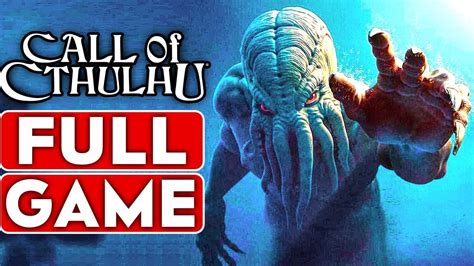
Call of Cthulhu, the official videogame inspired by Chaosium's classic pen and paper RPG, brings you deep into a world of creeping madness and shrouded Old Gods within Lovecraft's iconic universe.
Even if you haven't read any of H.P. Lovecraft's literary works, you likely possess a passing understanding of why he is broadly recognized as one of the most significant horror writers of the 20th century. His ideas of unspeakable, unknowable terrors driving men (and it is almost always men) to madness, and his creation of the Cthulhu mythos with its pantheon of ancient gods utterly indifferent to the lives of men, have influenced countless novels, films, pen-and-paper and video games in the years since.
This game plays out like a single-player arc of a Call of Cthulhu RPG (the pen-and-paper one) campaign.
In this article, we'll explore the various aspects of the game, from its narrative and RPG mechanics to its strengths and weaknesses, to help you decide if it's worth delving into this world of cosmic horror.
Call of Cthulhu is a video game published by Focus Home Interactive and developed by Cyanide SA.
Read also: Descent into Madness
Story and Setting
1924. Private Investigator Pierce is sent to look into the tragic death of the Hawkins family on the isolated Darkwater Island. Soon enough, Pierce is pulled into a terrifying world of conspiracies, cultists, and cosmic horrors. Nothing is as it seems.
This latest effort, from French studio Cyanide, spins a familiar tale of artistic obsession, unnatural experimentation and the frailties of the human mind into a mostly successful--if not exactly revelatory--exploration of Lovecraft's core thematic concerns.
Edward Pierce is a private investigator in Boston who seems to specialize in underwhelming his employer, the Wentworth Detective Agency, and self-medicating the trauma he suffered during World War I with alcohol and sleeping pills. Still shaken after waking from yet another nightmare, he agrees to look into the death of Sarah Hawkins, her husband, and their son three months prior in a house fire on the tiny island and former whaling port of Darkwater.
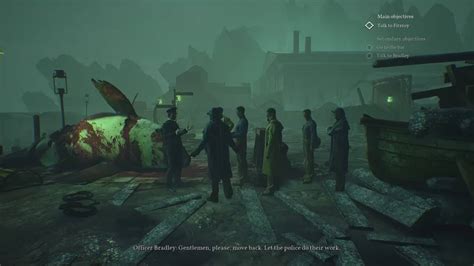
The rhythm of Pierce's detective work, and thus the bulk of the game, is established as soon as he disembarks at the fog-drenched and permanently midnight Darkwater docks. You can explore, in first-person, a small location, talk to the various locals and examine certain items of interest.
Read also: Detailed Weapon Analysis
Sarah's father seeks out Pierce after taking posthumous receipt of one of his daughter's paintings, a rather heavy-handed depiction of a woman cowering before some kind of demon. Pierce, summoning all his investigative acumen, suggests Sarah was trying to send a message via her art.
The voice performances here is entirely serviceable, and not nearly as hammy as one might fear given the setting, though the writing itself suffers from some jarring tonal shifts as you navigate the branches of dialogue and countless unfortunate typos in the subtitles.
Gameplay Mechanics
Taking cues from the Cthulhu pen-and-paper RPG, you can earn and assign points to a collection of stats that, in theory, let you tailor Pierce's detective expertise towards Investigation, Psychology, Eloquence and so on. These stats affect both the dialogue options--a high level in Eloquence might enable Pierce to choose a more persuasive line of questioning--and the ways you can interact with the environment, i.e. Pierce can draw upon his knowledge of Medicine to reveal something about a corpse.
The rpg mechanics keep me thinking "if only I had just put my point in this skill instead of the other".
Yet these moments rarely, if at all, feel significant; they mostly seem like minor excursions en route to the same outcome. In general, the RPG nature of the game feels undernourished.
Read also: Call of Cthulhu Investigator Guide
The idea of these stats is, I assume, to let you know you're applying specific techniques of investigation; in some instances, it succeeds, most notably in the few occasions when Pierce is able to solve puzzles in multiple ways. But much of the time the differences between having leveled up your Strength stat instead of your Investigation stat feel ambiguous at best and trivial at worst.
Conversations are presented with a dialogue wheel offering multiple topics, some of which are only unlocked if Pierce has learned relevant information while occasionally others are delivered as binary choices--pick one and you can't go back to pursue other spokes on the wheel.
Much of Pierce's detective work is routine. You scour each location for hotspots with which to interact, pocketing clues and the odd useful object. Progress is typically a case of diligence--find enough hotspots and Pierce will work out what to do next. Sometimes, however, he's able to "reconstruct" past events that occurred at the present location, but while these tend to be interesting in terms of plot revelations they, again, only require you to find the relevant hotspots and click on them.
There's a kind of grim pleasure to be had here, I suppose, a measure of compulsive enjoyment gleaned from tracking down every last hotspot that some players will find gratifying. It's rote work, though.
Sanity and Atmosphere
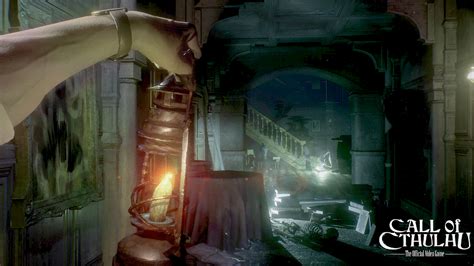
Sanity is an irregular bedfellow, all too often replaced by whisperings in the dark. Strange creatures, weird science, and sinister cults dominate the Cthulhu Mythos, intent on realizing their mad schemes to bring about the end of everything.
The sanity mechanics make me fear for my safety in certain situations, especially if im hiding. Your mind will suffer - between sanity and psychosis, your senses will be disrupted until you question the reality of everything around you. Trust no one.
The mood really made me feel scared and eairily uncomfortable at times. The unease of the unknown is VERY well done.
Combat and Stealth
A common complaint is the lack of combat, but if you've ever played CoC RPG session you would know that experience of combat is...
In contrast, the low points arrive when you're forced into the game's handful of action sequences. In one, you're hiding from a monster that will kill you instantly if it gets too close. You eventually realize you have to find a particular item--one, it should be said, out of a dozen near-identical items scattered throughout the adjacent rooms--and use it in a particular spot. The only clue you're given is a comment Pierce makes when he picks up the correct item, noting that this one "seems different somehow."
In another, Pierce is equipped with a handgun for the only time in the game and has to make his way across an area populated with slow, shuffling enemies. On my first playthrough, I died while experimenting with what happens when you get caught and, when the game reloaded, found myself without a gun. The only way I could proceed was by running around the area, luring enemies into chasing me around until eventually, a gap opened between them that was wide enough for me to dart through. It turned what was probably meant to be a dramatic, seat-of-the-pants dash for safety into a comical farce.
Dwelling on these few low points may seem overly harsh--they account for no more than a small portion of the whole game, after all. But they are not merely poor moments in an otherwise solid game; they're awful pieces of game design utterly inconsistent with the rest of the game.
Choices and Consequences
When you make certain choices or perform certain actions the message, "This will affect your destiny," pops up in the top left corner in a manner similar to a Telltale adventure game. What's never clear, however, is how your destiny has been affected.
There's no end of chapter screen that recaps the crucial choices you made and little sense, by the game's conclusion, of how those decisions lead to the choice Pierce has to confront in the very final scene. On my first playthrough I was faced with two possible endings, while on my second, after making a bunch of different choices throughout, I had unlocked a further two without any real understanding of how I'd been given the chance to alter Pierce's destiny.
Call of Cthulhu, and Lovecraft himself, revels in the inexplicable, the ineffable, the fallibility of human perception and its limited capacity to understand the world. Over the course of the game, Pierce finds himself grappling to make sense of what he's seen--or what he thinks he's seen. As his grip on reality, already tenuous to begin with, further loosens, it becomes difficult, if not impossible, to reason out cause and effect.
On a narrative level, this serves the story well, maintaining suspense and hitting you with well-timed twists. But on a more mechanical level, as you select each choice with a shrug of ignorance, it feels weirdly distancing and ultimately unsatisfying.
Positives
Many things stand out to me after i beat it. Especially how well handled the endings are.... wow i was so happy with the ending.
The scare parts were just right, not too jump scary.
I have finished it and I must say that from my perspective it is very well worked. I have enjoyed it very much.
I'm thoroughly enjoying it so far, It feels like i'm about midway through and i've gotten fairly scared at a good couple points.
Negatives
But its achievements in narrative and mood-setting are regularly undermined by some lackluster sleuthing, run-of-the-mill adventure game puzzles and a handful of truly terrible pseudo-action sequences.
It's real â¥â¥â¥â¥, terrible game. stilted voice work, terrible facial work, no action, barely any "Investigation" the music is really silent most of the time.
Overall Impression
Much of Call of Cthulhu is a perfectly competent adventure game built on firm, if uninspired, point-and-click traditions. And while it won't dazzle you with ambitious, creative puzzle-solving, its central story is as haunting and consuming as you want a good Lovecraft tale to be.
It isn't going to win greatest game of all time awards, but it also isn't just an unimaginative and uninteresting game or even an average game. It is a good game with a neat story and if you're into Lovecraftian insanity horror, it is a definite buy.
If we're talking 0 to 10, with 5 being true average, not 9.5 being average, I'd give it a 7 or 7.5. It isn't a bad game or even an average game with all the dribble on Steam these days, but it also isn't a groundbreaking game that changes games forever.
If you like Lovecraft this is probably the best game on market besides Bloodborne and last door season 2