The term "cherub" (plural: cherubim) is derived from the Hebrew word "כְּרוּב" (kerub). In biblical literature, cherubim are celestial beings associated with the presence and majesty of God. They are often depicted as guardians of sacred spaces and are integral to the imagery of divine worship and protection.
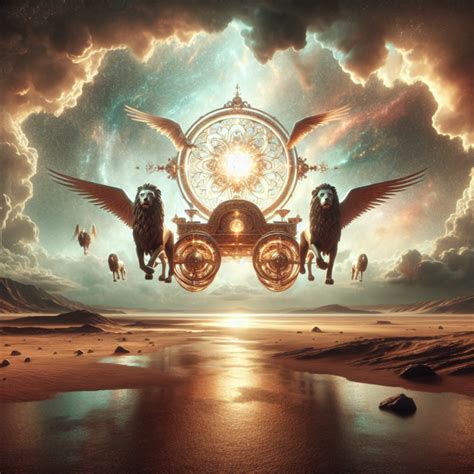
Ezekiel's "chariot vision" with the tetramorph (living creatures), engraving after an illustration by Matthäus Merian, Icones Biblicae (c. 1625-30)
Biblical References and Descriptions
Cherubim are mentioned numerous times throughout the Bible, often in contexts that emphasize their role as protectors and attendants of God's glory. They are first introduced in Genesis 3:24, where God places cherubim at the east of the Garden of Eden, along with a flaming sword, to guard the way to the tree of life: "So He drove out the man and stationed cherubim on the east side of the Garden of Eden, along with a whirling sword of flame to guard the way to the tree of life".
In the construction of the Tabernacle and later the Temple, cherubim are prominently featured. Exodus 25:18-22 describes the design of the Ark of the Covenant, which includes two cherubim made of gold: "And make two cherubim of hammered gold at the ends of the mercy seat. Make one cherub at one end and the second cherub at the other end; make the cherubim of one piece with the mercy seat at its two ends". These cherubim are depicted as having wings that overshadow the mercy seat, symbolizing God's throne and His presence among His people.
The prophet Ezekiel provides a vivid description of cherubim in his visions. In Ezekiel 1:5-11, they are described as having four faces and four wings, with the likeness of a man. Their appearance is both awe-inspiring and complex, reflecting their role as bearers of God's glory and executors of His will.
Read also: Understanding anemia spiritually
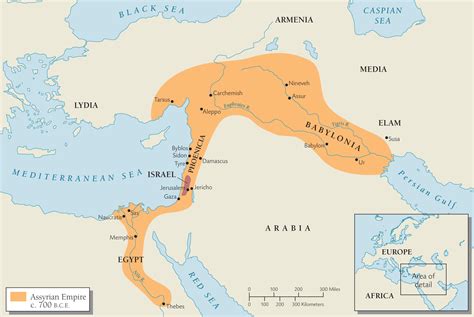
"Cherub" on a Neo-Assyrian Empire seal, c. 8th century BCE
Symbolism and Theological Significance
Cherubim are often associated with the holiness and unapproachable majesty of God. Their presence in the Holy of Holies, the innermost sanctuary of the Tabernacle and Temple, underscores the sacredness of the space where God chose to dwell among His people. The imagery of cherubim in the Bible serves to remind believers of the transcendence and immanence of God, who is both above all creation and intimately involved with His covenant people.
In Christian theology, cherubim are sometimes seen as symbols of divine wisdom and knowledge. Their multiple faces and wings suggest a capacity to perceive and move in ways beyond human understanding, reflecting the omniscience and omnipresence of God.
In Isaiah 37:16, Hezekiah prays, addressing God as Hebrew: יֹשֵׁ֥ב כְּ֝רוּבִ֗ים, lit. 'enthroned above the cherubim', referring to the mercy seat. In regard to this same phrase, which also appears in 2 Kings 19, Eichler renders it "who dwells among the cherubim".
Cherubim feature at some length in Ezekiel. While they first appear in Ezekiel 1, in which they are transporting the throne of God by the Kebar (or Chebar, which was near Tel Abib in Nippur), they are not called "cherubim" until Ezekiel 10. In Ezekiel 1:5-11 they are described as having the likeness of a man and having four faces: that of a man, a lion (on the right side), and ox (on the left side), and an eagle. These faces peer out from the center of an array of four wings; these wings are joined to each other, two of which are stretched upward, and the other two cover their bodies. Under their wings are human hands; their legs are described as straight, and their feet like those of a calf, shining like polished brass. Between the creatures, glowing coals that moved between them could be seen; their fire "went up and down", and lightning burst forth from it.
Read also: Light Blue: Calmness and Healing
In Ezekiel 10, another detailed description of the cherubim appears, with slight variations in the details. Three of the four faces are the same - man, lion and eagle - but where chapter one has the face of an ox, Ezekiel 10:14 says "face of a cherub".
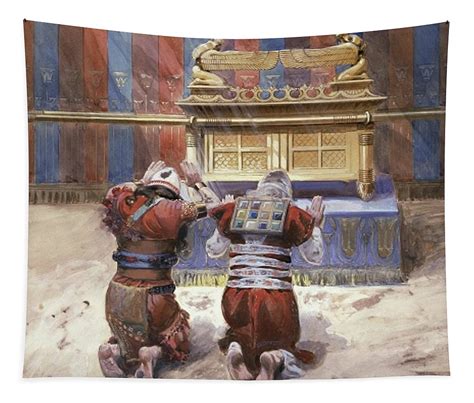
Moses and Joshua bowing before the Ark by James Tissot (c. 1896-1902)
Many forms of Judaism include a belief in the existence of angels, including cherubim within the Jewish angelic hierarchy. The existence of angels is generally accepted within traditional rabbinic Judaism. In Kabbalah there has long been a strong belief in cherubim, the cherubim and other angels regarded as having mystical roles.
Cherubim are discussed within the midrash literature. In early Jewish tradition there existed the notion that cherubim had youthful, human features, due to the etymologization of the name by Abbahu (3rd century). Before this, some early midrashic literature conceived of the cherubim as non-corporeal.
In Medieval theology, following the writings of Pseudo-Dionysius, the cherubim are the second highest rank in the angelic hierarchy, following the seraphim and preceding the Thrones. Cherubim are regarded in traditional Christian angelology as angels of the second highest order of the ninefold celestial hierarchy.
Read also: Explained: Spiritual Blessings
In Western art, cherubim became associated with the putto and the Greco-Roman god Cupid/Eros, with depictions as small, plump, winged boys. Artistic representations of cherubim in Early Christian and Byzantine art sometimes diverged from scriptural descriptions. The earliest known depiction of the tetramorph cherubim is the 5th-6th century apse mosaic found in the Thessalonian Church of Hosios David.
According to the Quran, Al-Karubiyyin are identified as a class of al-muqarrabin, and are a class of angels near the presence of God. The Quran mentions the Muqarrabin in An-Nisa verse 172, angels who worship God and are not proud. Further, cherubim appear in Miraj literature and the Qisas al-Anbiya. The cherubim around the throne are continuously praising God with the tasbih: "Glory to God!" They are described as bright as no one of the lower angels can envision them. Cherubim as angels of mercy, created by the tears of Michael, are not identified with the angels in God's presence, but of lower rank.
Artistic Depictions
Throughout history, cherubim have been depicted in various forms of Christian art, often as angelic beings with wings. In Western art, they are sometimes portrayed as chubby, childlike figures, though this representation diverges from the more formidable and majestic descriptions found in Scripture.
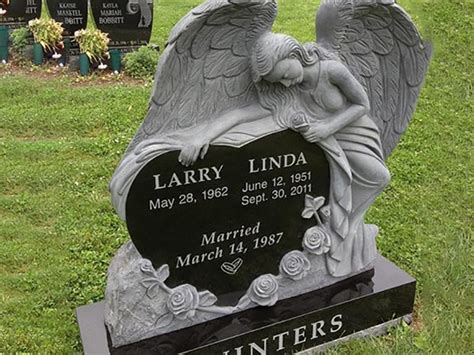
Weeping cherub headstone, St John the Evangelist, Margate
The word ‘cherub’ is derived from the Hebrew word ‘Kěrub’ which means ‘to draw near’ or ‘to bless’ as divine messengers drawing near to humans to deliver blessings or divine messages. In the Bible cherubs are seen as powerful figures that guard sacred spaces such as the Ark of the Covenant in the Old Testament. In the Book of Ezekiel 10:14, they are described as angelic beings with four faces; a human, a lion, an eagle and a human. These derives from ancient Mesopotamian and Assyrian art which depicted winged creatures with multiple faces which often guarded temples or palaces. These influenced early Christian artist who used them in their images of cherubim.
In fact the Italian word ‘putto’ derives from the Latin word ‘putus’ meaning boy or child. Today in Italy, ‘putto’ means ‘toddler winged angel’ and there are similar words or meanings in other languages. Putti were believed to influence human lives in the ancient classical world and in the 2nd century they could be found dancing and playing amongst other activities on child sarcophagi. Their role as messengers were emphasised by them being seen as between the realms of the human and divine by being Roman spirit guardians or the Greek daimon.
During the Renaissance they were revived due to the painter Donatello. Now putti are largely decorative and feature extensively on Victorian and Edwardian buildings - just look up and you’re bound to see one at least. They could be interpreted as weeping angels which immediately brought to mind one of Dr Who’s most brilliant and intimidating villains - the Weeping Angels -don’t blink!
But why are there weeping cherubs? It’s a very poignant symbol in that a small child is seen openly weeping. These were the heads of what appeared to be children with wings around them that emphasised a rebirth of the soul in heaven which was a kinder view of death.
Elizabeth Drake monument in full view.
Cherubs are supposedly found on children's graves and a walk through any churchyard or cemetery would confirm this. But cherubs can be confused with putti which is the Italian word for cherub but they are very different.
Cherubim: The Angels With Four Faces... and It Gets Weirder | Christian Mythology Explained
The Covering Cherub: A Story of Transformation
The concept of cherub comes from the Bible and is not a rosy-faced kid-like, multi-winged angel you see in a lot of Baroque art with divine overtones and on cupid cards at Valentine’s. That amongst these sons of God was a cherub.
Ezekiel 28:12-18 describes a lamentation upon the king of Tyrus, stating, "You were perfect in your ways from the day that you were created, till iniquity was found in you." In verse 14, the Cherub that covers refers to Exodus 25:20, where 2 Cherubim are associated with God’s throne and their outstretched wings that cover it. This Cherub is ‘anointed’ meaning, set aside for a special task associated with the very holy mountain of God. In other words, not just anywhere, we will see this is a reference to the place where He reigns from, today we’d call it headquarters; this is a scene from Third Heaven.
Especially notice that God created this Cherub, putting him in the category sons of God. Cherubim are amongst the highest-ranking created spirit beings. The conclusion we can draw is that God had a significant role for this Cherub to play in whatever His universal plan is. God had specially prepared this Cherub. Indeed it had been equipped with a brim-full pitcher of wisdom and beauty (vs. 12) so much so that he was ‘perfect in all his ways’ (vs. 15).
The ‘fade out’ in verse 18 reverts back to the King of Tyre but also refers to the Cherub: heart lifted up, corrupt wisdom, a multitude of iniquities and iniquity of your traffic, referring to his fraudulent economic practices in general. This perfect spirit being, a son of God, by creation, has completed the total evil makeover. Yes, excellence identified it, but, as verse 15 confirms, till iniquity was found in you. At a given point in spiritual time (yes, there is such a thing: consider that eternal involves time immemorial), wickedness slowly began to invade and characterize this Cherub. Your heart was lifted up because of your beauty, you have corrupted your wisdom by reason of your brightness (vs. 17). Here is the original vanity, the prototype of pride. This Cherub’s majestic grandeur went to its head, and it floundered. A different, grotesque and hideous nature reared its ugly head.
There’s an important result of the Cherub’s iniquity and sin: “therefore I [God] will cast you as profane out of the mountain of God: and I will destroy you. I will cast you to the ground, I will lay you before kings. I bring forth a fire from the midst of you, it shall devour you, and I will bring you to ashes upon the earth…” (vs 16-18). Profane means the Cherub is not holy anymore, God demotes it, strips it of its role and it loses all its privileges.
When this Cherub reached the point of no return, God took an ultimate action, stripping the Cherub of its role and ousting it from His entourage.
The prophecy in Ezekiel 28:19 says that it would remain this way. Indeed, the supposedly invincible island part of Tyre was demolished by Alexander the Great in 332 BC. He scraped it off, down to the bedrock, and it lies buried in a watery grave to this day.
The king and the Cherub, because of their iniquity, were the cause of their respective demises.
Ezekiel 26:17 Your heart [Cherub] was lifted up because of your beauty, you have corrupted your wisdom by reason of your brightness: I will cast you to the ground, I will lay you before kings, that they may behold you. Check the word ground in Hebrew (H776 erets). You’ll see that it also means Earth. God cast the Cherub out of the Third Heaven to Earth.
The New Testament also depicts this scenario, look at Revelations 12:7-9 “…the great dragon was cast out, that old serpent, called the Devil, and Satan, which deceiveth the whole world: he was cast out into the earth, and his angels were cast out with him.”