Understanding compatible numbers is a crucial skill for students learning to estimate and simplify calculations. This article provides a comprehensive guide to using compatible numbers, complete with examples and resources to help students master this essential math concept.
Compatible numbers are 'friendly' numbers that are easy to work with mentally, making estimation much simpler. They are particularly useful when dealing with division, addition, and subtraction problems where an exact answer isn't necessary. By using compatible numbers, students can develop their number sense and mental math skills.
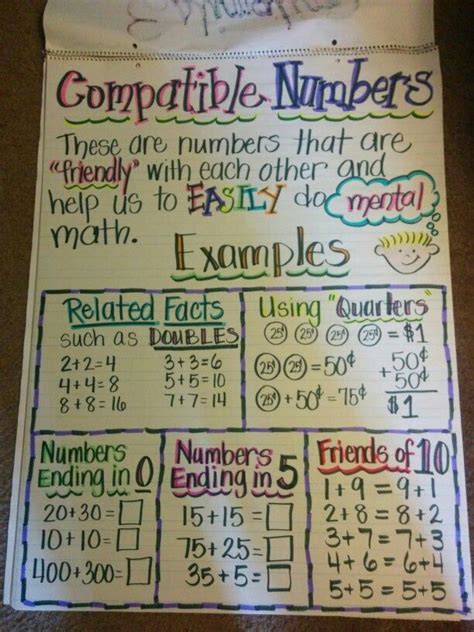
What are Compatible Numbers?
Compatible numbers are numbers that are easy to compute mentally. They often end in 0 or 5, making them easier to add, subtract, multiply, or divide.
Estimation Strategies
There are two key estimation strategies that utilize compatible numbers:
- Rounding: Rounding numbers to the nearest ten, hundred, or thousand to make them easier to work with.
- Compatible Numbers: Replacing numbers with those that are close in value but easier to calculate mentally.
For example, to estimate the sum of 42 + 37, you might round 42 to 40 and 37 to 40, making the estimated sum 80. Alternatively, you could use compatible numbers like 40 and 35, resulting in an estimated sum of 75.
Read also: Detailed Review of Arccos Golf
Anchor Charts for Teaching Compatible Numbers
Anchor charts are a fantastic visual aid for students. They provide a quick reference point for key concepts and strategies. Here are some ways to use anchor charts to teach compatible numbers:
- Display: Hang the anchor chart in the classroom as a constant reminder of how to round numbers and find estimated sums or differences.
- Interactive Notebooks: Print smaller versions for students to keep in their math notebooks.
- Guided Math Lessons: Use the anchor chart as a visual aid during guided math lessons.
Using Compatible Numbers in Different Operations
Addition and Subtraction
When estimating sums and differences, look for numbers that can be easily rounded or adjusted to create compatible pairs. For instance, when adding 29 + 53, consider using 30 + 50 to get an estimate of 80.
Multiplication
Compatible numbers are also useful in multiplication. For example, to estimate 27 x 4, you can round 27 to 25, making the problem 25 x 4, which is easily calculated as 100.
Division
In division, compatible numbers help simplify the process of estimating quotients. To estimate 123 ÷ 4, use compatible numbers like 120 ÷ 4, which equals 30.
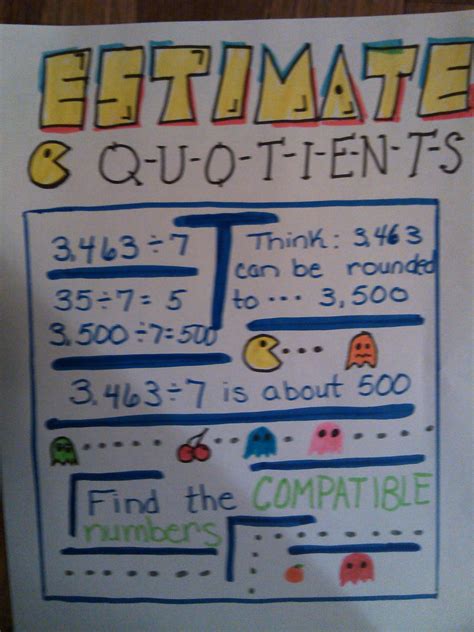
Examples of Compatible Numbers
Here are some examples of compatible numbers in different operations:
Read also: Apps for Oura Ring Users
- Addition: 12 + 18 (compatible numbers: 10 + 20 = 30)
- Subtraction: 47 - 19 (compatible numbers: 50 - 20 = 30)
- Multiplication: 8 x 26 (compatible numbers: 8 x 25 = 200)
- Division: 153 ÷ 3 (compatible numbers: 150 ÷ 3 = 50)
Benefits of Using Compatible Numbers
Using compatible numbers offers several advantages:
- Improved Mental Math Skills: Encourages students to perform calculations mentally.
- Enhanced Number Sense: Helps students develop a better understanding of number relationships.
- Simplified Estimation: Makes estimation easier and more accessible.
- Increased Confidence: Builds confidence in math abilities by providing a straightforward approach to problem-solving.
Compatible numbers are essential for finding divisibility of numbers to check on a fraction that may need to be simplified.
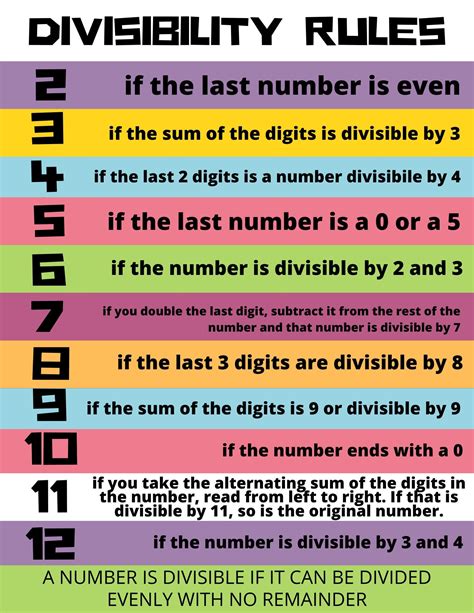
Resources for Teaching Compatible Numbers
Several resources can help teachers and parents effectively teach compatible numbers:
- Worksheets: Use rounding to estimate worksheet sets to sharpen number sense and mental math skills.
- Games: Explore rounding games 3rd grade and 4th grade students will love, like this “Rounding Match-Up” activity!
- Teaching Slides: Teach rounding with a number line using this set of teaching slides featuring numbers up the hundred thousands.
- Online Games: Invite your students to play this rounding large numbers game to review rounding whole numbers up to the hundred thousands place.
- Interactive Activities: Share this create-your-own rounding whole numbers game with your students to give them practice rounding numbers up to the hundred thousands place.
- Number Line Worksheets: Use our rounding on a number line worksheet set to give your students practice using a number line to round numbers up to the hundred thousands place.
- Posters: Display this rounding poster of the “Rounding Rock” in your classroom to encourage your students to rock out rounding!
- Estimation Worksheets: Supercharge your students’ math skills with our estimation worksheets!
Conclusion
By incorporating compatible numbers into math lessons, educators can empower students to estimate with confidence and improve their overall number sense. Using anchor charts, interactive activities, and targeted practice, students can master this valuable skill and apply it to a wide range of mathematical problems.
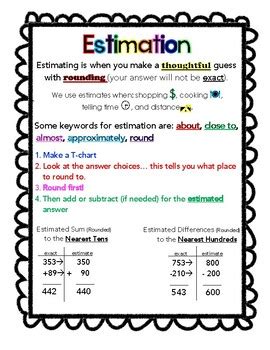
ROUNDING TO ESTIMATE THE SUM / 3rd Grade COMMON CORE MATH
Read also: What is S3-Compatible Storage?
tags: #compatible #numbers #anchor #chart