Newly published tarot and oracle decks arrive on Amazon, Etsy, crowd-funding platforms, and in bookstores every month. Today there are literally thousands of decks to choose from, including out-of-print decks as well as published ones. Blending the divinatory power of the Rider-Waite-Smith Tarot with the visionary writings of Edgar Allan Poe, this deck offers deep spiritual insight into who you are and what you might become.
The Edgar Allan Poe Tarot is for those who, like Poe, dream even when they’re awake, see beauty in darkness, and are unafraid to face the shadows of everyday life. Whether you’re brand new to tarot or are an experienced reader, The Edgar Allan Poe Tarot will be your guide on your spiritual journey.
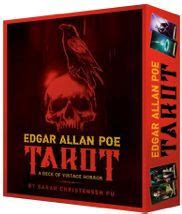
What to Expect from the Edgar Allan Poe Tarot
Each card has two sections: Into the Maelström, which provides divinatory meaning, and Tell-Tale Heart, which explores its connection to one of Poe’s works. The Edgar Allan Poe Tarot includes tips for reading reversals, working with repeating questions, and choosing an appropriate spread for a reading. Author Rose Wright explores significator cards, clarifiers, and numerology to help develop a personal reading style that works for you.
The Edgar Allan Poe Tarot stands on its own in comparison to modern classics like the Rider Waite Smith. The traditional representatives for each suit have been changed. Eyes replace the Wands; Ravens replace the Cups; Hearts replace the Swords, and Graves replace the Pentacles. Otherwise, the meanings follow the Rider Waite system.
The deck comes in a sturdy box and is accompanied by a delightfully detailed companion book that includes a full-page color reproduction of each card and card descriptions divided into two sections: Tell-Tale Heart provides the backstory for each card image and explains how the image relates to Poe’s body of work, and Into the Maelstrom gives the divinatory meaning for each card. This guidebook is absolutely essential; some of the imagery in the deck deviates from familiar RWS imagery, but in looking through the LWB, it becomes clear that each image is carefully selected for a very specific reason.
Read also: Heartbreak and the Three of Swords
When we deck creators sit down to write the companion guidebook, we have to first decide whether the guidebook’s purpose is to be a beginner’s primer on how to read tarot cards or to explain the deck’s concept, sources of inspiration, and to deep-dive into the artist’s and creator’s intentions. This deck comes as a full package with a 288-page companion book inside a beautiful fold-out box. It’s sturdy and feels like it’s meant to last.
The Artwork and Imagery
The artwork for this deck is it’s best feature, the colors are strong and rich. But it’s Eugene Smith’s illustrations that set this deck apart. Overall, the colour and tone of the deck is dramatic, detailed, and moody - just what one would expect given Poe’s writings. Smith’s illustrations don’t disappoint. The artwork is thought-provoking and clear.
However, the visual accessibility of the deck is very limited, without the explanations in the booklet it would be impossible to discern meanings solely from the images, especially the minor arcana where the creator elected to use pips for many (but not all) of the cards, instead of characters and scenes. This design forces the reader to rely on the accompanying booklet for interpretation.
Looking through this deck is like a scavenger hunt, trying to find every connection to Poe and identify which bits of his work show up on which cards. Depending on your familiarity with Poe, this may prove easy or quite difficult. Some of the connections are obvious and brilliant: “The Pit and the Pendulum” as the Hanged Man, “The Fall of the House of Usher” as the Tower, the heart from “The Tell-Tale Heart” as the Three of Swords.
The connection to Poe really permeates this deck, and it’s obvious how much time and care Wright and Smith put into making this a deck that breathed Poe, rather than just taking a RWS clone and smacking a couple of ravens on it. You get a strong sense of creativity and discernment from the artist.
Read also: The Meaning of Tarot Suits
This has both advantages and drawbacks. On the one hand, it means you really get what you paid for: A true Edgar Allan Poe Tarot. On the other hand, it means the deck can be somewhat less accessible for novice readers or for those who are accustomed to relying on standard RWS-style imagery, unless they rely heavily on the guidebook in their readings. Likewise, the question of accessibility extends to clients. I would definitely use this deck when reading at a Halloween party (or some other intentionally spooky venue) or for a client who I know loves Poe, but I probably wouldn’t break it out for everyday client readings.
For example, the Fool card doesn’t give us a figure standing on the edge of a cliff like we’re used to seeing. Poe himself is depicted as the Emperor. In the guidebook, Wright explains that, “His authority in writing and his empathy for the human condition made him a true leader of his craft.” This is another example of the detail, thought and construction that’s gone into this deck.
Poe himself is set as the main character, The Fool in The Fool’s Journey, journeying through subconscious realms. Poe, as a character, interacts with characters from his most famous works. As you follow the quest, you yourself unveil the mysteries. Reading with this deck is like flipping through the pages of an illustrated Victorian book of poems. Shufelt’s art style here is timeless.
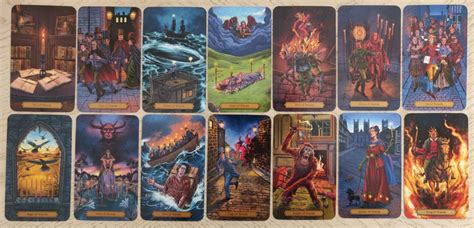
Card Examples and Meanings
The Empress is a strong maternal, feminine power, a card that bodes well for fertility, family, and wealth. This card reflects fruitful and bountiful creative endeavors.
The Knight of Hearts is a card that represents heroism but also great risk.
Read also: The Symbolism of Bad Bunny's Super Bowl Stage
The Three of Graves signifies the mastery of a craft or art, as the gravedigger has achieved perfection in his trade.
Key 11: Justice, one of Shufelt’s favorite cards in the deck to create, departs from what you might normally think of as the iconography for Justice, and instead, we have the idea of a blindfolded Poe inside the mouth of a skull swinging a pendulum of justice.
Key 8: Strength featuring Pluto the Black Cat. Quote from “MS.
That Three of Swords really is perfect, huh? Especially if you know the story of “The Tell-Tale Heart.” It is perhaps unsurprising given the source material but where this deck really shines is in the cards that deal with suffering and loss. The Three of Swords and the Hanged Man are probably my favorite cards in the whole deck. The suit of Swords-everyone’s least favorite cards to get in a reading-really holds the heart (pun not originally intended but absolutely left there on purpose once I noticed it) and soul of this deck.
Who Will Enjoy This Deck?
I think that broadly speaking, the three categories of people who will get the most out of this deck are collectors, Poe enthusiasts, and readers who prefer to use “dark” decks. Collectors will find joy just in the beautiful artwork and novel theme. People who already love Edgar Allan Poe will find that this is a deck specifically tailored to their interests, rich with symbolism that they can pick up on and use as they’re learning how to read the cards. And finally, experienced Tarot readers with a penchant for the dark will find that the world of Edgar Allan Poe perfectly lends itself to their reading, in line with other decks that focus on dark themes.
There’s a reason that Poe is known as the master of horror: His work is full of sorrow, death, plague, and tragedy, and these themes shine through in the deck.
So you can imagine my delight when I received my copy of the Edgar Allan Poe Tarot, new from deck creator Rose Wright and illustrator Eugene Smith. For anyone who loves Poe, or who wants something new and spooky, or who just wants a beautifully illustrated new deck for their collection, I wholeheartedly recommend this deck.
Potential Drawbacks
Printed on thin card stock, these cards have a gloss finish with rounded corners and are easy to riffle shuffle, even if you have small hands. The cards flex easily because the card stock is on the thinner side; pleasantly, they do not stick together when they first come out of the box. The card stock is thin, so the deck will not last if heavily used use. The shiny red edging does wear down with even mild use, but I’ve never gotten too bothered over that. The card backs have reversible high-gloss embossed ravens set on cardstock in a standard finish.
There is an error in the booklet, the Three of Ravens and the Three of Hearts have the same text. The deck is not particularly good for beginners, but is a nice novelty deck. The creator did a good job connecting the works and life story of Poe to the cards.
At this point, it’s probably worth making a brief note about racial diversity. There’s not a lot of it in this deck. Personally, I see that more as an indictment of Poe than of the deck creators. Poe’s work was, at times, horrifically racist, and where non-white characters do appear in his stories, they are often racial stereotypes, villains, and orientalist caricatures. This deck does not feature diverse characters, because every card is taken so closely from source material where racial representation is simply nowhere to be found.
Final Thoughts
The meanings in the booklet are well-written, and extremely insightful when connecting a card with Poe’s story. The artwork is very suitable for the theme of the deck, and by far it’s best feature. Its intention seems to be to work as any other tarot deck does. But this deck feels like it deserves a special role in a tarot reader’s collection.
I was a huge Poe kid growing up. “The Masque of the Red Death” and “The Cask of Amontillado” were used in my 7th-grade English class as my introduction to the world of literary analysis. “The Raven” (and Poe’s accompanying essay “The Philosophy of Composition”) was the subject of a project I did on Roland Barthes and the death of the author. To this day, “Annabel Lee” is one of my favorite poems of all time.
I love this deck. I love the Poe of it all. It takes me back to my childhood, which is perhaps a grim thing to say since this is a deck so full of sorrow and death, but it’s true. More than anything else, this Tarot deck has made me remember how much I loved Edgar Allan Poe as a kid, and each card brought a smile to my face as I remembered reading the story it’s based on, and as I noticed small details like the “pallid bust of Pallas” perched on the mantel in the Magician.
Reviewing a deck is a subjective judgement intended to help readers determine if they want to own the deck. The critical review of a deck for AskAstrology involves looking at the quality and size of the cards, visual accessibility of the art, quality of the companion book or booklet, and potential usefulness in professional practice.