The Tarot deck consists of 78 cards divided into two main sections: the Major Arcana and the Minor Arcana. The Major Arcana cards are the first 22 cards in a Tarot deck that represent significant life events, archetypes, and spiritual themes. Each of these cards has a unique meaning and can be interpreted in a variety of ways. The Major Arcana cards can be very powerful tools for personal growth, spiritual development, and gaining insight into one’s own life journey.
The Minor Arcana consists of four suits, each with 14 cards, which are similar to the suits in a deck of standard playing cards. By understanding the meanings or correspondences associated with each suit, a tarot reader can provide guidance and advice on how to navigate the challenges and opportunities being presented. In a tarot reading, the suits can provide significant insight into different areas of a person’s life.
In this article, we will cover suit correspondences and what is and isn’t included when you use playing cards, tips to make it easier (or more difficult!) to use and why you may wish to use them.
Why Use Playing Cards for Tarot Readings?
Before diving into the meanings of the suits, let’s address the question: Why would anyone use a playing deck of cards to read the Tarot, instead of a Tarot deck?
- Accessibility: Not everyone has access to a Tarot deck. In some parts of the world they’re very difficult to get your hands on, yes, even in the USA! Playing cards on the other hand, are easily found everywhere, with little to no stigma attached to them.
- Safety: There is a stigma attached to using the Tarot and unfortunately a lot of fear too. If you’re in the broom closet playing cards can be an excellent option for you, that won’t get you into any hot water. On the flipside here, if you’re an ex-christian holding onto the fears of the tarot, playing cards can be a great first step.
- Tradition: Some people see playing cards as a more traditional form of Tarot. This may or may not be accurate but playing cards have been used for fortune telling for a very long time. The Tarot itself began as a card game, which didn’t develop into the divination tool we see it as today until the 1800s!
- Familiarity: Playing Cards are more familiar and common to most people. They do not come off as “scary” like a Tarot Card deck might.
Suit Correspondences
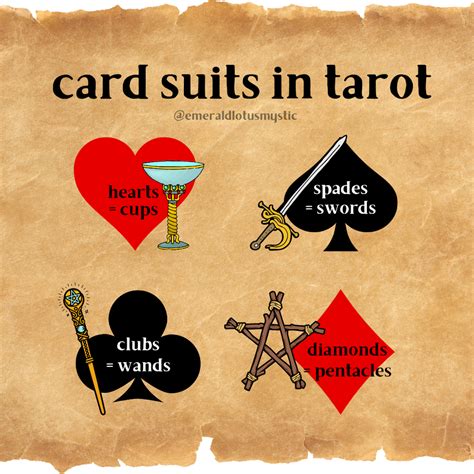
A deck of playing cards has four suits: Hearts, Spades, Diamonds and Clubs. When using a playing deck of cards for the Tarot the suit conversion is as follows:
Read also: Heartbreak and the Three of Swords
- The suit of Hearts are Cups
- The suit of Spades are Swords
- The suit of Diamonds are Pentacles
- The suit of Clubs are Wands
When using a playing deck of cards for the Tarot the court card conversion is as follows:
- Kings are Kings
- Queens are Queens
- Jacks are a Knight/Page combo
Differences between Playing Cards and the Tarot
One major difference between playing cards and the Tarot is the absence of the Major Arcana in a standard deck of playing cards.
There are ways around this though:
- Use the number sequence of the cards, starting with 0 to 21!
- Lay out several cards and see that number they add up to. For example, say the cards you lay out equals 13. You can interpret the overall reading as if it were the Death card. The Death Card is number 13 in the Tarot Deck.
Or you can be a rebel and ignore the majors all together. Sure it’s not a ‘true’ Tarot deck, but I promise you the Tarot police are not out to get anyone.
The 56 Minor Arcana Cards
The 56 Minor Arcana cards reflect the trials and tribulations that we experience on a daily basis. Even though the Minor Arcana cards are called ‘minor', it doesn't mean that these Tarot cards won't have a significant impact in your life.
Read also: The Symbolism of Bad Bunny's Super Bowl Stage
Each Suit contains 10 numbered cards and 4 Court Cards (Page, Knight, Queen and King). In a Tarot reading, a Minor Arcana card will show you what's happening in your daily life and how it is affecting you. These practical cards represent the interactions, experiences, thoughts and emotions you encounter as you go about your life.
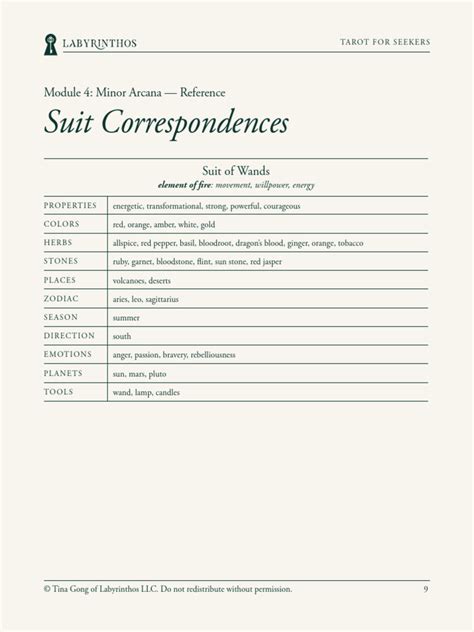
Suit of Wands
The suit of Wands (drawn here as sticks, pencils, arrows, paint brushes, etc.) is associated with fire and deals with passion, desire, activism, and ideas. If this suit were personified, it would be the muse: full of potential, inspiring ideas, and moments of creative epiphany. This is the suit of the spirit, primal energy, and the essential self.
Suit of Cups
The suit of Cups is associated with water, relationships, and connection. Cups are romantic and vibrant. They deal with the full range of emotion-the good and the bad, the intentional and the chaotic.
Suit of Swords
The suit of Swords is associated with air and the mind. This suit is driven by thought and deals with decision-making, intellectual pursuits, planning, and analyzing. The individual swords on these cards can be seen as glyphs for thoughts: powerful tools when wielded properly, but too many thoughts can overwhelm or drive you to conflict.
Suit of Pentacles
The suit of Pentacles (drawn here as coins) is associated with earth, and covers the material aspects of life: career, money, and possessions. This suit talks about our bodies, and all the joy and hard work that comes with physicality. I think of Pentacles as depicting the results of the other suits. In other words, emotion (Cups), thought (Swords), and spirit (Wands) bring about the physical manifestations of reality that we see in the Pentacles.
Read also: Learn about Spirit Guide Tarot
SUIT OF PENTACLES: MEANINGS OF ALL 14 CARDS
Understanding the Numbered Cards
The numbers! Use your knowledge of the suits and weave this with the number meanings when reading. This will help without the need to rely on a pictural reference as with traditional Tarot cards. Each number has a numerological meaning. So, the meaning of the card as a whole results from the intersection of the suit’s themes and the numerological significance of the individual card.
- 1 - (Aces): Beginnings, potential, opportunity. The core energy of the suit.
- 2: Duality and dichotomy. Twos show how things come together, urging us to find balance.
- 3: Threes are about interaction, communication with others, and community.
- 4: Fours indicate (or suggest) a period of rest, structure, and stability.
- 5: Fives are about adversity, change, and conflict. These cards are obstacles.
- 6: Sixes are about growth: sometimes painful and sometimes joyful.
- 7: Sevens are about reflecting on your situation. They often involve conflict.
- 8: Eights are about getting where you need to go and taking a realistic look at your trajectory.
- 9: Nines are about fruition.
For example, the number meaning of a 10 is completion, perfection or the end of a cycle. Pair that with the suit of Hearts (or Cups) and it could mean the completion of relationships, emotions or perfection, happy endings, or a happy family life.
Another example, use the Ace of Spades (or Swords). This could mean new ideas, insight or focus. Renewed energy in mental health. Or take the Ace of Clubs (or Wands) - you could have a new project to get you fired up and feeling creative.
The Court Cards
Court cards depict individuals, each embodying the energy of their suit from a slightly different aspect or at a different stage of development. Many readers see court cards as signifiers either for the subject or for other people in the subject’s life, like characters in the story of the reading.
- Pages: Pages represent youth, students, and the beginnings of things. Pages are at the start of their journey through the suit, and they are very enthusiastic about it. Though they are not masters of what their suit has to teach them, they are committed to figuring it out.
- Knights: Knights are about action! More worldly than Pages, Knights still don’t have a lifetime of experience, and tend to be a bit extreme or impulsive.
- Queens: Queens represent the internal ideals of their suit. In the highly gendered language of tarot, the feminine is introspective, gentle, and caring. Queens have all the life experience of the suit, and use it to better themselves.
- Kings: Kings represent the external ideals of their suit. Kings are stable, solid people who draw upon the various aspects of their suit to build things, lead, and improve upon the world around them. Kings and Queens are equally mature and self-actualized; Kings simply choose to manifest this energy outwardly, rather than inwardly.
Reversed Cards
In a Tarot reading, a reversed card is a card that appears upside-down. Reversals in tarot are not terribly unusual, and can happen during the shuffling or laying out of the cards.
- Reversed meaning: Sometimes, a reversed card will simply indicate the opposite meaning of its upright counterpart.
- Blocked energy: A reversed card can indicate a blockage in the energy or situation represented by the card.
- Inner conflict: A reversed card may indicate an inner conflict or struggle that the querent is facing.
- Delays or setbacks: A reversed card can indicate delays or setbacks in the area of life represented by the card.
It’s important to note that reversed cards do not always have negative meanings. For instance, reversals can indicate a need for more introspection or a shift in perspective. A skilled Tarot reader will use their intuition and knowledge of the cards to interpret the meaning of reversed cards in a way that is meaningful and helpful to the querent. And, you do not have to read reversals if you don’t want to!
Mining the Minor Arcana
Look through your own decks and note the names of the suit, particularly the non-traditional names. Do they help or hinder your understanding of the suits’ energy? Go further, and think about what you would name the suits to provide the deepest understanding.
Study the Aces of your decks, compare them with each other; how do the Aces of a deck provide a window into how the rest of the suit will be presented in a particular deck? What do they tell you about the energies of their suits?
Lay out your Court Cards for a particular suit, and then assign each of the numbered cards in the suit to a Court Card. For example, you might give the 8 of Wands to the Knight of Wands and the 2 of Swords to the Queen of Swords, and so on. This helps you both get to know the different facets of a particular suit by also getting to know the suit’s ‘people’.
As you study the suits, think about how those numerological associations I mentioned earlier work with the energies of the particular suit.