The third-generation Ford Taurus, marketed from 1996 to 1999, represented a significant redesign, being the first complete exterior overhaul since its 1986 introduction. As a mid-size car, it was positioned between the compact Ford Contour and the full-size Ford Crown Victoria in Ford's North American lineup. The third-generation Taurus was available as a four-door sedan and a five-door station wagon, sold alongside the Mercury Sable.
Exterior Design
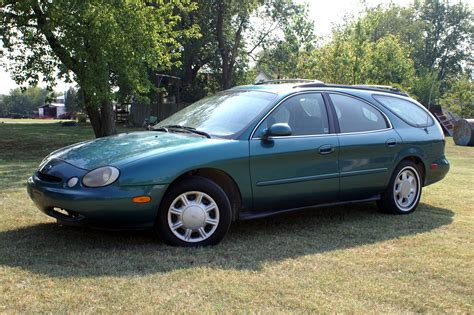
The exterior of the third-generation Taurus was completely redesigned for 1996, using a controversial new shape. Chief designer Jack Telnack claimed that this shape was penned to make the Taurus stand out to sedan buyers, comparing the current Taurus to the likeness of a pair of slippers. This shape was based upon that of an oval, which was perhaps inspired by that of Ford's own logo. While the previous Taurus used a flat, streamlined shape, this Taurus used a rounded shape similar to that of the Chrysler Concorde. The heavily-contoured sides took their cue from the Lincoln Mark VIII. Station wagons also got new sheet metal, although from the firewall back, the Taurus and Mercury Sable wagons again shared the same panels, with all station wagon doors being the same as those used on the Sable sedans.
In 1998, the exterior of the Taurus received a slight redesign to make the shape more mainstream, in order to appeal to a wider customer base. The front bumper was redesigned to have a full-length opening, as well as moving the Ford logo down onto a chrome bar mounted in the grille, similar to that of the third-generation Taurus SHO. These years were also fitted with different front turn signal lenses, featuring completely clear lenses and a multi-reflector surface in the rear of the housing, around the bulb.
Interior Design and Features
The interior was also completely redesigned for the 1996 model year. Like that of the previous two generations, the interior was designed to be user-friendly. The gauges were placed in an oval pod while the dashboard wrapped slightly around the driver; all of the main controls were placed within easy reach, and were designed to be recognizable by touch and to be operated by drivers without taking their eyes off the road.
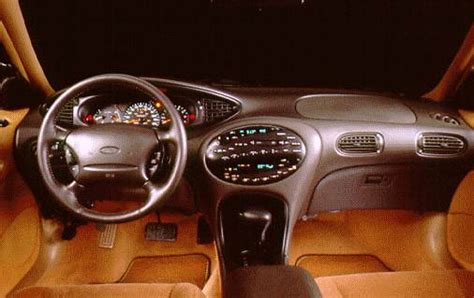
The dashboard's design originated from a large number of complaints from customers that the previous Taurus' radio and climate control modules were cluttered with many small and similar feeling buttons, as well as small graphics, which caused the driver to have to look away from the road to be able to operate them properly. As a result, a large portion of the third generation's dash was devoted to the radio and climate control, with each button on these modules containing a unique design, making it easier for the driver to operate the radio and climate control without taking their eyes off the road.
Read also: Comprehensive Guide: 2006 Ford Taurus Catalytic Converter
Another innovation was the "Flip-Fold" center console on cars not equipped with a standard floor console. It was a seat in between the bucket seats that could be transformed into a console, reducing the seating count by one. The seat cushion folded out into a console with a lockable storage bin and cupholders, resting against the dashboard.
Seating Configurations
The Ford Taurus has many seating options, ranging from five people to eight people. On wagons and sedans equipped with the floor mounted shifter, it seated five people standard, and wagons could seat up to seven people, with a bench in the third row. Also, models equipped with the flip fold console could seat either six or eight people, depending on whether the wagons had a third row bench or not.
This generation's interior was not as configurable as that of the first two generations. The G and GL models were only available with steering column-mounted shifter, along with a cloth front bench seat and the "Flip-Fold" center console. The LX, on the other hand, came standard with bucket seats that could be ordered with either cloth or leather upholstery, along with a center console and floor-mounted shifter. However, a column-mounted shifter and a cloth front bench was available as a no-cost option.
In 1999, the interior was again available in three configurations, like that of the first-generation Taurus; a front bench seat with a column-mounted shifter, front bucket seats with a center console and floor-mounted shifter, or front bucket seats with a center console and a column-mounted shifter.
Trim Levels and Engine Options
To close the price gap between the Taurus and the Ford Contour, as well as to increase sales, an entry-level G model was added midway into the 1996 model year, as essentially a slightly de-contented GL. For the 1998 model year, the models of Taurus were completely changed. The G and GL were dropped, and the LX became the entry-level/value model. The SE model from 1995 was revived, and it became the top-tier model.
Read also: Exploring the Last Taurus
The 1996 model year was the first time that the Taurus did not have an optional engine. The base G and GL had the 3.0 L Vulcan V6, which was a carryover from the previous model. The top-of-the-line LX, however, got the new 3.0 L DOHC Duratec 30 V6, which produced 200 hp (150 kW) and was developed specifically for this model. When Ford rearranged the Taurus models for 1998, the Vulcan became the standard engine, and the Duratec became optional on all models. However, it was only available on the SE for 1999.
Vulcan-equipped models came with the four-speed AX4S automatic transmission, while Duratec equipped models got the four-speed AX4N transmission. However, some Vulcan-equipped models randomly received the AX4N transmission for no apparent reason.
Dimensions
The 1996 Taurus had a wheelbase of 108.5 inches, which was 2.5 inches longer than the previous generation. At 73.1 inches, the '96 Taurus was 1.9 inches wider than its '95 version. Inside the sedan, front passenger room was significantly enhanced, with a 0.9-inch increase in both head- and legroom and 0.6 inch more hiproom, though shoulder room falls 0.1 inch. Rear passengers, on the other hand, lose as much as they gain: While minimum legroom is up 1.1 inches and there's 1.5 inches more hiproom, headroom drops a significant 1.4 inches, and there's 1.0 inch less shoulder room. Trunk volume decreased by 2.5 cubic feet.
Throwback Thursday: The 1996 Ford Taurus LX
Reception
Reception to the new Taurus by automotive publications was generally positive. Road & Track gave the Taurus a good review upon its release, and found its handling and refinement impressive. Motor Trend also gave the Taurus a positive review, although they found the oval styling awkward at first glance. Consumer reaction was mixed, however. Detractors of the new design pejoratively refer to this generation as the "Bubble" Taurus or "Submarine" Taurus based on the window shaping and broad curves used in the front end being seen as a negative.
While the design of the Taurus was polarizing, the more conservative design of the Sable was praised; Automobile Magazine selected the Sable as its 1996 design of the year. Unlike the Taurus, sales of the Sable stayed steady with the previous model, and styling revisions for 1998 were limited to a new grille and headlamps.
Read also: Engine Details: 2003 Taurus
Mercury Sable
The Mercury Sable, a sister model of the Taurus aimed at a more upscale audience, was also redesigned for the 1996 model year. As with previous generations, the Sable used the same mechanical parts as the Taurus with a unique body. However, the 1996 Sable ditched the unique styling cues of the previous generations, specifically the front light bar, wrap-around rear glass and skirted rear fender, in favor of a design theme that more closely resembled that of the Taurus. For the first time, the Sable did not get a unique interior design, instead sharing all of its interior components with the Taurus with the exception of branded parts and unique woodgrain trim.
Trim levels were carried over from the previous generation: A base model GS and high-end LS, with a base G model briefly offered during the second half of the 1996 model year. The Sable had the same powertrains and most features as the Taurus, though no counterpart to the high performance SHO was offered.