The pentagram, often referred to as a pentalpha, pentangle, or star pentagon, is a regular five-pointed star polygon formed from the diagonal line segments of a convex regular pentagon. When a circle is drawn around the five points, it creates a similar symbol known as the pentacle. This symbol is widely used by Wiccans and in paganism, often as a sign of life and connections.
An easy way to remember the difference between a pentagram and pentacle is that a pentaCle is surrounded by a Circle.
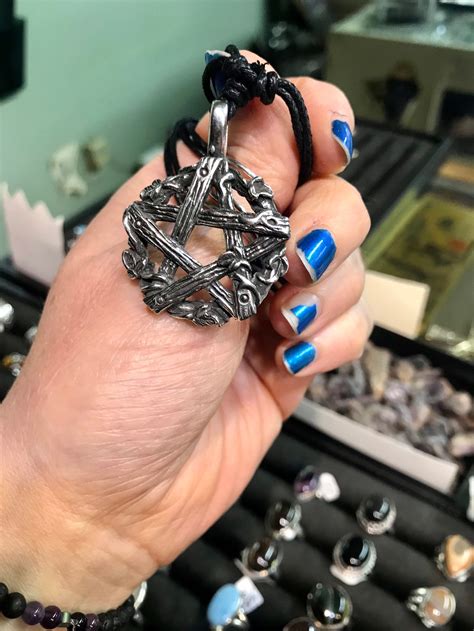
Greenwitch Pentacle
The pentagram is deeply rooted in history, going as far back as 3000 BCE. It has been found on artifacts from Mesopotamia, was the subject of fascination in Ancient Greece, and was used for religious practice by ancient Babylonians. It was also present in early Christianity for over 500 years, where the five points represented the five wounds of Christ, as well as the Beginning and the End ( or the Alpha and the Omega) since it could be drawn in one continuous stroke. In Judaism, the pentagram was the official seal of Jerusalem at around 300-150 BCE.
The five-pointed star is a symbol of the Serer religion and the Serer people of West Africa. In the Serer religion and the Serer creation myth, the pentagram, called Yooniir (also spelled Yoonir) in the Serer language, is the symbol of the Universe. The Serer religion posits that the peak of the five-pointed star represents the Serer creator deity, Roog. The other four points represent the cardinal points of the Universe. The crossing of the lines pinpoints the axis of the Universe, through which all energies pass.
Read also: The History of Spirituals
Early Symbolism and Usage
The pentagram was used in Christendom during the Middle Ages as a symbol for the five senses and of the Five Holy Wounds of Jesus of Nazareth. The north-facing rose of Amiens Cathedral-built in the 13th century-exhibits a pentagram-based motif.
The pentagram is featured with a symbolic role in the 14th-century English poem Sir Gawain and the Green Knight, in which the symbol decorates the shield of the hero, Gawain.
The pentagram is actually much older than you might think. It was used as a symbol to represent a corner or a nook in early Sumerian cuneiform. Pentemychos, meaning “five corners” or “five recesses” was what Pherecydes of Syros called his cosmogony, referring to the seeds of Chronos placed within the Earth in order for the cosmos to appear.
It was a sacred symbol to Pythagoras. Well, he wasn’t exactly a mathematician or a physicist as we would currently understand it: he was philosopher and a sacred geometrist. It’s hard to know exactly what he did invent because he had a cult of followers who were inclined to credit him with supernatural powers and some relation to Apollo and/or Hermes and he apparently never wrote anything down.
So now we know the pentagram has been around for thousands of years, but what does it represent? In the Jewish kabbalistic tradition, the pentagram represents justice, mercy, wisdom, understanding, and transcendent splendor. For the Sumerians, it represented the “vault of Heaven”, which was Jupiter, Mars, Mercury, Saturn, and Venus. According to the Greek mathematician and philosopher Pythagoras, the pentagram represents the elements: Earth, Air, Fire and Water, with Spirit placed on the top. His followers, the Pythagoreans, saw it as mathematical perfection, which would later come to be known as the Golden ratio.
Read also: Differences Between Pentagram and Pentacle
All major Greek architecture and some significant Egyptian architecture is fashioned according to this proportion; think of the Parthenon or the Great Pyramid of Giza. And the most pleasing art makes use of this principle to establish composition. This is what we recognize as perfect natural symmetry, and as philosopher and psychologist Adolf Zeising observed in the 19th century, much of nature is constructed according to this ratio: including trees, leaves, animal skeletal systems, nervous systems, flowers, molecular compounds, crystaline structures, astronomical systems (from solar systems to galaxies to the structure of the universe) and the structure of the human body. The pentagram is constructed entirely by the Golden Ratio.
Each intersection of edges sections the edges in the golden ratio: the ratio of the length of the edge to the longer segment is , as is the length of the longer segment to the shorter. Also, the ratio of the length of the shorter segment to the segment bounded by the two intersecting edges (a side of the pentagon in the pentagram's center) is . The pentagram includes ten isosceles triangles: five acute and five obtuse isosceles triangles. In all of them, the ratio of the longer side to the shorter side is . The acute triangles are golden triangles.
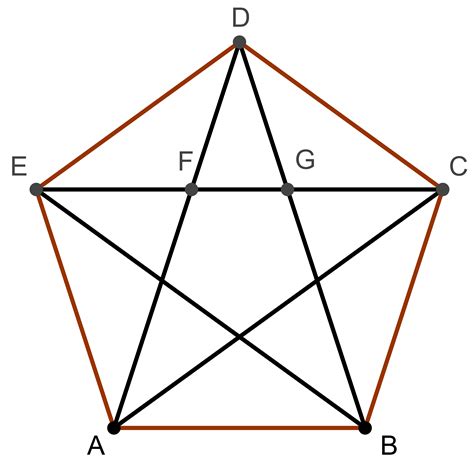
Pentagram and the Golden Ratio
The pentagram of Venus is the apparent path of the planet Venus as observed from Earth. Because Venus’ orbit is almost perfectly circular, and because Earth orbits the sun at a a rate of every 1.6 Venetian years (at a ratio of 13 times to our eight,) Venus draws an interesting Spirograph pattern in the sky. Because this ratio is extremely close to the Golden Ratio, from our perspective, it traces a pentacle in the Heavens every eight years. This pattern is known as the Pentagram of Venus.
Renaissance and Occult Interpretations
Heinrich Cornelius Agrippa and others perpetuated the pentagram's popularity as a magic symbol, attributing the five neoplatonic elements to its five points, in typical Renaissance fashion.
Read also: Pentacle Ring Symbolism
Based on Renaissance-era occultism, the pentagram entered the symbolism of modern occultists. By the mid-19th century, a further distinction had developed amongst occultists regarding the pentagram's orientation. With a single point upward, it depicted the spirit presiding over the four elements of matter and was essentially "good". "A reversed pentagram, with two points projecting upwards, is a symbol of evil and attracts sinister forces because it overturns the proper order of things and demonstrates the triumph of matter over spirit.
Éliphas Lévi, a pivotal figure in 19th-century French occultism, reinterpreted the pentagram, infusing it with deep esoteric significance. Lévi incorporated Hebrew letters and alchemical symbols within this pentagram, including representations of "Adam" and "Eve," to highlight humanity's intrinsic connection to the cosmos.
“The flaming star, which, when turned upside down, is the hierolgyphic [sic] sign of the goat of black magic, whose head may be drawn in the star, the two horns at the top, the ears to the right and left, the beard at the bottom. It is a sign of antagonism and fatality.
In ritual magick and some traditions of Wicca, pentagrams are drawn in different ways to invoke the powers of the four classical elements. Because the bottom right corner of the pentagram represents the classical element of earth, starting your pentagram in that corner, then continuing up to the top and forming the rest of the pentagram from there indicates that you are driving away things that affect the physical world; hence, the “Earth Banishing Pentagram.” Conversely, if you start your pentagram in the top, drawing a line to the bottom left corner, you are calling in Spirit to affect the physical world and create change there; hence, the “Earth Invoking Pentagram.”
If the fifth point on the pentagram represents the spiritual aspect of creation, then the direction in which a pentagram is facing has a bearing on it symbolism.
Today, the pentagram is used mostly in witchcraft for ritual practice, and for protection. Pythagoras’ attribution to Nature’s elements and the Spirit is still accepted, and shows them working together in harmony.
Here’s a table summarizing the elemental associations:
| Element | Corner of Pentagram | Action |
|---|---|---|
| Earth | Bottom Right | Driving away things affecting the physical world |
| Spirit | Top | Calling in Spirit to affect the physical world |
What Does the Pentagram and the Pentacle REALLY Mean?
Modern Usage and Misconceptions
The five-pointed star is a symbol of the Baháʼí Faith. In the Baháʼí Faith, the star is known as the Haykal (Arabic: "temple"), and it was initiated and established by the Báb.
The Church of Jesus Christ of Latter-day Saints is theorized to have begun using both upright and inverted five-pointed stars in Temple architecture, dating from the Nauvoo Illinois Temple dedicated on 30 April 1846. Other temples decorated with five-pointed stars in both orientations include the Salt Lake Temple and the Logan Utah Temple.
The encircled pentagram (referred to as a pentacle by the plaintiffs) was added to the list of 38 approved religious symbols to be placed on the tombstones of fallen service members at Arlington National Cemetery on 24 April 2007. The decision was made following ten applications from families of fallen soldiers who practiced Wicca.
The Order of the Eastern Star, an organization (established 1850) associated with Freemasonry, uses a pentagram as its symbol, with the five isosceles triangles of the points colored blue, yellow, white, green, and red. In most Grand Chapters, the pentagram is used pointing down, but in a few, it points up.
Sometimes the inverted figure of the pentagram, with two points facing upward and one facing down, is associated with negative or “black” magic and devil worship. Indeed, the inverted pentagram figures in the sigil of Baphomet, one of the main symbols of the Church of Satan, an atheistic organization that evokes in its imagery the Devil as viewed in Christianity but does not worship any god or being or require that its members perform any rituals, magical or otherwise. The sigil of Baphomet depicts a goat with its horns in the upturned points of the star.
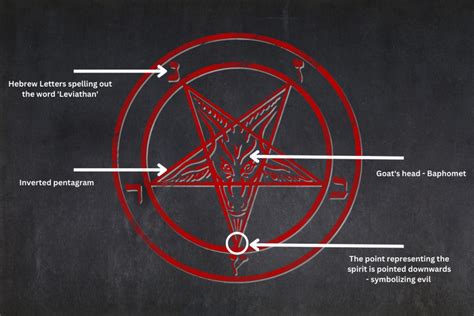
Sigil of Baphomet
The inverted pentagram is broadly used in Satanism, sometimes depicted with the goat's head of Baphomet, as popularized by the Church of Satan since 1968. LaVeyan Satanists pair the goat head with Hebrew letters at the five points of the pentagram to form the Sigil of Baphomet. The Baphomet sigil was adapted for the Joy of Satan Ministries logo, using cuneiform characters at the five points of the pentagram, reflecting the shape's earliest use in Sumeria. The inverted pentagram also appears in The Satanic Temple logo, with an alternative depiction of Baphomet's head.
The association of the pentagram with evil is sprinkled at various parts of history, though its starting point may be likely be at the start of the Inquisitions of the Catholic Church in its attempt to remove heresy from the masses. It was in 1855 where the pentagram was solidified with evil connotations.
In his book, Alphonse wrote that, “a reversed pentagram, with two points projecting upwards, is a symbol of evil and attracts sinister forces…” This was the first time it was documented that the pentagram was connected with evil forces.
In 1966, things came to a head when American author musician and occultist, Anton Lavey, established the church of satan. Ironically, this church isn’t full of actual satan worshipers, but atheists who attributed the word for satan with the original, Hebrew word satan, meaning “adversary”. They do not believe in the entity of satan, and instead painted the perception of satan as an archetype for pride, individualism, and rebellion to Abrahamic faiths.
The final component that assorted the pentagram with evil was the attention it got (and still receives) from the media. In the 1970s and 80s, there was a mutual rise highly publicized serial killings and interests with occultism. The media released numerous articles and news reports attributing killings to satanic groups, referencing the pentagram as their symbol (thanks to the events in 1968). Since then, the pentagram has been used in movies, TV shows, and books as a mark for satanism or dark witchcraft.
Now, the historical context of the upside-down pentagram (and even the right-side up pentagram) has changed, much like the upside down cross-which is actually the symbol of Peter the Apostle. They are seen as rejections of the good power that’s believed to come from their right-side-up counterparts.
The inverted pentagram or pentacle, representing Spirit descending into matter, is used in many ways in modern occultism as well. It is the symbol of modern Satanism; not really as a perversion of the pentagram, as is commonly believed; but more to symbolize that Matter is more important than Spirit. Aleister Crowley made use of the inverted pentagram for this purpose in Thelema.