The question of whether we are alone in the universe has captivated humanity for centuries. While concrete evidence remains elusive, numerous reports and theories propose the existence of various alien species. Simultaneously, scientists are working to estimate the potential number of intelligent civilizations in our galaxy.
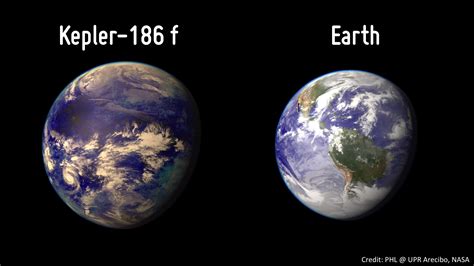
Artist's conception of exoplanet Kepler-186f, a potential habitable world.
Commonly Reported Alien Types
Over the years, certain types of aliens have appeared repeatedly in abduction stories, sightings, and popular culture:
- Grey Aliens: These are perhaps the most iconic alien type, characterized by grey (or sometimes green) skin, a height of around 1 meter (3.3 feet), hairless bodies, large heads, black almond-shaped eyes, nostrils without a nose, slits for mouths, no ears, and 3-4 fingers including a thumb. The '[G]ray' is about four feet high, with a slender body and neck, a large head, and huge, black, slanted, almond-shaped eyes. Grays usually have no hair and often only three fingers on each hand.
- Little Green Men: Despite their prevalence in popular imagination, few abduction reports describe aliens fitting this description.
- Tall, Scaly Humanoids: These include reptilian humanoid beings, with depictions dating back to Ancient Egypt, such as the crocodile-headed river god Sobek.
In addition to these, some claim that cryptozoological animals, including those from folklore, religion (e.g. golem), mythology, and allegedly real creatures from Fortean archives, are actually of extraterrestrial or mixed origin. Sometimes these creatures are associated with the occult or with esotericism, or linked with supernatural or paranormal phenomena. Others dismiss these explanations in favor of skepticism, cultural tracking, or the psychosocial hypothesis such as in cases of mass hysteria. Elongated visual artifacts appearing in photos and video recordings, sometimes claimed to be extraterrestrial beings.
The Drake Equation - How Many Aliens Are Out There?
Read also: Unveiling the Mystery of Space Aliens
The Drake Equation: A Framework for Estimation
The Drake Equation, devised by astronomer Frank Drake in 1961, provides a framework for estimating the number of detectable civilizations in the Milky Way. It considers factors such as:
- The average rate of star formation per year in the galaxy
- The fraction of those stars with planets
- The fraction of those planets that could potentially support an ecosystem
- The fraction of life-bearing planets that give rise to intelligent life
- The fraction of intelligent extraterrestrial life that develops communication detectable from space
- The average length of time that communicating alien civilizations last
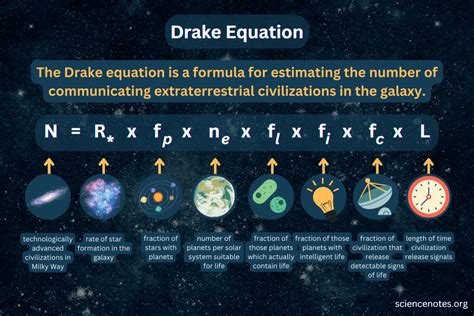
The Drake Equation, a probabilistic argument used to estimate the number of active, communicative extraterrestrial civilizations in the Milky Way galaxy.
While some variables in the Drake Equation remain unknown, recent astronomical discoveries have helped refine our understanding of others. For instance, data from NASA’s Kepler spacecraft and the European Space Agency’s Gaia spacecraft have allowed scientists to estimate the number of Earth-size planets orbiting sunlike stars in the Milky Way.
Recent Estimates of Communicating Civilizations
A recent study published in The Astrophysical Journal by Christopher Conselice and his colleagues at the University of Nottingham, used new data about star formation and exoplanets to estimate the number of communicating intelligent alien civilizations in the Milky Way. The team calculated the age distribution of stars in the Milky Way, looking for those at least 5 billion years old and presumably old enough to host a humanlike civilization. They found that 97% of stars in the Milky Way are older than 5 billion years.
The researchers then calculated the number of those stars that are dense enough and stable enough to host planetary systems. A third of the stars older than 5 billion years qualified. Next, using what astronomers now know about the distribution of exoplanets, the researchers estimated the number of rocky planets within the habitable zones of those stars. They also calculated which stars are metal-rich enough to have orbiting rocky planets with the kind of elements you might need to construct, say, a radio transmitter. Finally, they set a lower limit of the life span of a communicating civilization at 100 years, based on Earth's timeline with radio technology so far.
Read also: Pop Culture Aliens
Based on these calculations, the researchers estimated that there could be approximately 36 intelligent, communicating extraterrestrial civilizations in the Milky Way today, assuming that life on other planets follows a similar trajectory to that on Earth. There is uncertainty in this estimate, with a range from four other civilizations up to 211. If alien civilizations are likely to be distributed evenly throughout the Milky Way, our nearest neighbor would likely be 17,000 light-years away.
It took more than half a century for scientists to start pinning down how many planets could feasibly host life. In 1961, astronomers knew of no worlds orbiting stars other than the sun-and although planetary formation theories suggested exoplanets should be common, we had no observational evidence that they existed. But over the past decade, it’s become clear that planets are extremely common, outnumbering stars in the Milky Way. On average, nearly every star is home to at least one orbiting world.
Challenges and Considerations
Astronomers are tantalizingly close to figuring out the next factor in the equation: the fraction of habitable worlds on which life evolves. As we continue to explore our solar system, we’re finding that the list of habitable niches is long and diverse. Worlds such as Mars or Jupiter’s icy moon Europa could host microbial life, and even the toxic clouds above Venus could possibly harbor lifeforms. “If it happened more than once in the solar system,” Wright says,” that gives you that number pretty quick.”
Solving the Drake equation isn't possible, because the values of most of the variables are unknown. But University of Nottingham astrophysicist Christopher Conselice and his colleagues were interested in taking a stab at it with new data about star formation and the existence of exoplanets, or planets that circle other stars outside our own solar system. They published their findings June 15 in The Astrophysical Journal.
However, these estimates rely on several assumptions that are subject to debate. For example, the assumption that intelligent life reliably shows up about 4.5 billion years later is not necessarily true. Had a chance asteroid not knocked Earth around 66 million years ago, killing off the dinosaurs, the timeline of the evolution of intelligent life on Earth could look quite different, after all. Perhaps the most limiting variable, Shostak said, is the assumption that a communicating civilization only transmits signals for a century. That seems pessimistic even for human civilization, which has its struggles but seems unlikely to stop using radio waves in the next couple of months, he said.
Read also: History of the Anunnaki
Despite these challenges, the search for extraterrestrial intelligence remains a vital endeavor. Finding just one example of life beyond Earth would demonstrate that biology is not a cosmic fluke but rather a probable outcome, given the right ingredients. It could also provide valuable insights into the potential longevity of our own civilization.
| Factor | Description | Estimated Value |
|---|---|---|
| Rate of Star Formation | Average rate of star formation in the Milky Way | Variable |
| Fraction of Stars with Planets | Proportion of stars that have planets | Nearly every star |
| Habitable Planets per System | Number of planets suitable for life per star system | 0.37 to 0.88 per sunlike star |
| Fraction that Develop Life | Proportion of habitable planets where life evolves | Unknown |
| Fraction that Develop Intelligence | Proportion of life-bearing planets that develop intelligent life | Unknown |
| Fraction that Communicate | Proportion of intelligent civilizations that develop detectable communication | Unknown |
| Civilization Lifespan | Average length of time a communicating civilization lasts | 100 to 3,060 years |