The vast expanse of science fiction is populated with a myriad of alien species, each with unique characteristics and varying heights. From towering giants to diminutive beings, these extraterrestrial life forms capture our imagination and challenge our understanding of biology and evolution.
Here, we delve into the average height of some notable alien species from popular culture, exploring their origins, physical attributes, and societal roles.
Xenomorph COMPLETE Breakdown | creation, biology, variants, etc.
Xenomorphs
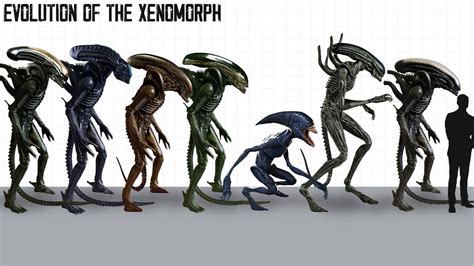
The Xenomorph, a creature of pure hostility and structural perfection, presents a terrifying example of alien life. Known to be extremely deadly and hostile, these creatures require a host organism in order to reproduce.
A Xenomorph's physical appearance can vary widely depending on its life stage, hive, caste, age, and host. A typical Xenomorph begins its life cycle as an egg-like creature (known as an ovomorph or simply egg) which, when detecting the presence of a potential host, opens up to release the second stage: a small arachnid-like life form (named the facehugger) which launches itself onto the host's face and impregnates it with an endoparasitoid larva.
Adult Xenomorphs tend to share some common traits: a invertebrate-like body, including a protective dark exoskeleton, a long flexible tail, an elongated domed head and a toothed mouth hiding a secondary, extendable, proboscis-like inner maw.
Read also: Contact with Extraterrestrials
The appearance of the Xenomorph can vary depending on the host in which the embryo is implanted. The Human phenotype is generally around 7-9 feet (~ 2.13 - 2.74 meters) in height and roughly 181.43 to 272.15 kilograms (400-600 pounds) in weight, with a long, muscular tail and large, curved, oblong head.
Key Features of Xenomorphs:
- Height: 7-9 feet (Human phenotype)
- Weight: 400-600 pounds (Human phenotype)
- Notable Traits: Dark exoskeleton, elongated head, inner mouth, acidic blood
Little is known about their biology, but it is known that they eat with their inner or secondary mouths, not their outer mouths. This mouth is somewhat similar to the pharyngeal jaw of a moray eel. They also bleed an unknown and extremely corrosive fluid.
While the extremely corrosive fluids and tremendous resilience displayed by the creature might suggest an exotic kind of biochemistry, the fact that the Xenomorph not only feeds on Humans, but actually develops inside them, strongly suggests that its biology is carbon-based. The ability to inherit traits from its hosts also suggests that it incorporates genetic material from them, implying that the Xenomorph either has DNA, or is able to read and convert DNA into whatever means it uses to store genetic information. There is evidence that the genetic exchange is mutual (i.e. Xenomorphs operate in hives made of a resin they produce, mixed up with their saliva fluids. Judging from the condition that any Xenomorphs can potentially 'molt' and grow into a Praetorian and then a Queen, the Xenomorph species is likely all unisexual and reproduces asexually by a process called parthenogenesis: a reproductive method practiced by many species on Earth and other planets. Alternatively, it's also possible that the aliens are either hermaphrodites or practice sequential hermaphroditism, i.e.
Most Xenomorphs appear to possess an intelligence level equivalent to that of a typical primate. It's well within their capabilities to learn relatively quickly, gathering information and making advantageous use of their environment. Although they do not demonstrate Human and Yautja-level intelligence as a species (such as abstract reasoning, introspection and technological advancement), their Queen appears to possess considerable acumen in her social behavior and manipulation of Human technology, such as cutting the power of the LV-426 colony and operating an elevator. As the adult Xenomorphs are known to inherit physical characteristics from their hosts (for example, when a Yautja was infected, the parasite later developed into a "Predamorph" or "Predalien") it is possible that the intelligence level of the creature may be influenced by its host as well. Xenomorphs have demonstrated little emotion, though they are not completely devoid of fear, such as when they are in the presence of fire, which they are vulnerable to. It has been suggested that Xenomorph nests may operate under a hive mind, or a collective consciousness directed by the Queen, who can call back and give orders to her subjects, both telepathically and vocally with shrieks. In some cases, the Queen Mother Xenomorph communicates telepathically with potential hosts, inducing terrifying dreams and religious visions, which may even lead to the formation of cults with the Xenomorph as a god-like figure, not dissimilar to the cults of Cthulhu and other such entities. The most famous example of this phenomenon might have been Walter Golic, who received supposedly telepathic messages from a captured Xenomorph; which ultimately led him to release it and let it kill him. There is evidence that the Xenomorph hive mind also includes a collective memory that passes along even at a genetic level. Through the tests conducted on Ellen Ripley, it is revealed that the memory passed from Ripley onto the new generation of Xenomorphs allows them to read and understand different languages. Events on the LV-426 colony and the USM Auriga show that the species excels at observational learning. Another case of observational learning can be seen following a Xenomorph escaping its cell. It had learned that the consequences of attacking the observatory glass was a jet of extreme cold (possibly liquid nitrogen), triggered by a large red button on the console. In the rare event that a Xenomorph finds itself under attack or otherwise vulnerable, it might display incredible creativity and cleverness. Xenomorphs are conscious of the effects of their acidic blood, and will use it to their advantage - to break out of Human-constructed confinement, or as a weapon. They show some military tactics (such as retreating when overwhelmed), and can find ways to get around certain problems (such as pushing the red button to freeze a soldier in liquid nitrogen in the afore-mentioned incident). A Xenomorph is equipped to be the perfect killing machine. They possess an exoskeleton much like that of a lobster, impenetrable to everything but the most powerful Human firearms (12-gauge shotguns, Pulse Rifles, and stanchion launchers are quite effective). Ash claims the creature's skin is made from "protein polysaccharides", so this would imply a substance similar to chitin. He also says the creature replaces its surface cells with polarized silicon, which is a very inert, heat resistant, and flexible polymer. This allows these creatures great environmental resistance. However, they are vulnerable to sudden, massive changes in temperature. It's been demonstrated that they can be destroyed by immersion in molten lead followed by sudden cooling with fire sprinklers, causing their silicon shells to shatter. Attached at the ends of both of their arms are a set of long fingers and shiny, black, extremely sharp claws capable of slashing through almost anything within their grasp. Their tail is long and flexible. A Xenomorph's outer mouth is filled with sharp teeth, but their main killing device is the inner jaw that shoots out to penetrate directly into the victim's brain. The inner jaw (also known as an "attack tongue") is a muscular appendage on the inside of the Xenomorph's mouth. All Xenomorphs have this trait, excluding the genetically-engineered Newborn Xenomorph. It consists of a cord of muscle with a small but extremely deadly mouth-like appendage on the end. The plasticity of the Xenomorph phenotype is one of the species' most notable features, and has resulted in physical traits that diverge from individual to individual and from hive to hive. Even among those spawned exclusively from Humans, different Xenomorph hives can produce highly divergent individuals. Some are taller and lankier, with an almost erect posture. Others are shorter and bulkier, and move more quadrupedally. While most have smooth craniums, others have ridges, which may be attributed to their age (i.e. When it comes to their digits, there are at least three different patterns. On at least one occasion, Human-spawned Xenomorphs were observed to have a digitigrade, as opposed to plantigrade posture. Some Xenomorphs have tails that are roughly the same length as the rest of their bodies, equipped with a small, almost surgical stinger-like barb on the end. This stinger can be, and has been, used to perforate victims, and may turn loose from the tail and remain lodged in the victim's body, not unlike a bee stinger. A close-up of a Xenomorph head, revealing what might be interpreted as an eye. The most notable feature of the Xenomorph species is the elongated, banana-shaped head. In terms of eyesight, the Xenomorph appears to be entirely eyeless. Other proposed conjectures include that the eyes might be similar to a desert-burrowing lizard's eyes; meaning that they lay under a thin layer of skin, yet are deep enough that they are not visible from the outside. In that case, their eyes could be hidden behind their black carapace and they see through it, similar to a one-sided mirror (except in this case no one can see in, but the Xenomorph can see out). Some species of Earth fish, such as the Barreleyes, see through a transparent layer of skin; it is possible Xenomorph vision is similar. Eyeless or not, it is widely assumed that a Xenomorph identifies enemies by sensing pheromones. The secondary jaws (also known as the inner mouth, double jaw, or maw) are another disturbing feature of the species. It's assumed that they're powered by extremely strong muscles inside the creature's elongated head, that enable it to be quickly launched and retracted, similar to the tongue of a chameleon. The inner mouth is typically the Xenomorph's close-combat weapon, as opposed to its long-range tail. The Xenomorph lashes it out of its outer mouth, and it destroys anything it hits, being able to put a hole in a thickened Yautja skull and still have enough momentum to plunge another hole through the back as it escapes. The secondary jaw is powered by muscles, as seen when a Yautja rubs a part of the interior (resembling the gills of a crab), a feature that can be seen from the external midsection on each side of the head, ovular in shape. The Yautja-spawned Xenomorph (a.k.a. "Predalien") has the ability to use its inner mouth to implant chestburster embryos directly into a host's throat, like a facehugger. Along the back of most Xenomorphs' bodies are a series of appendages that appear to have no clearly-defined function. It's still in debate what they are used for, with theories ranging from sensory organs to communication organs, to breathing apparatus, to defensive mechanisms, to structures that dissipate heat, to storing substances their bodies need, or to provide structures to carry around the young, underdeveloped chestbursters, the eggs or the facehuggers or as a counter weight to keep them from falling over when running. One theory is that the four back appendages are used as a kind of radar that the alien utilizes to see through extreme environments or detect movements. It is interesting to note that Xenomorph Drones have been observed to bury themselves in the ground, yet their spines are still shown just breaking the surface, implying some use when connected to the environment. The creatures might come from a mainly amphibious planet, and perhaps the spines are a mechanism to swim underwater faster to catch prey. The spines might be spiracles that take in and filter the air around them, while waste is expelled through the mouth. It is widely accepted that they do not have lungs, so this is possible, and yet implausible because Runners (a.k.a. dog-spawned Xenomorphs), don't have them. They might also be traits that the alien acquires by chance when developing inside the facehugger, putting the legs of the facehugger on the back. The spines may allow a facehugger to hook their spider-like legs until a victim is near. The spines may also act as a counter balance, much like a cat's tail, so that the Xenomorph does not fall forward when running. They may be used for breathing, as it's possible that the inner jaws serve only offensive purposes. This also makes sense if one considers that they may have come from a swamp-like planet, where they would lay in wait for prey to wander by. The "Runner", a Xenomorph born from a dog or other quadrupedal host, is notable in that it doesn't have dorsal spines. It is accepted that the tail is an offensive weapon and little more. Though the creature can and will run on all four appendages, it often stands on its two hind legs so it can reach for its prey with its arms. While standing, it has also been seen to impale its victim with its tail, even to the point where it can raise a creature heavier than itself to eye level, possibly in preparation for a face-bite using the secondary jaws. The tail can be used in stealth attacks, since it is flexible enough to attack from a variety of positions, and is hard to notice if it is behind the enemy, or if the area is rather dark. Even when the sharp point is cut off, the tail is still deadly, as the Xenomorph can use the damaged tail to spray its acid blood from the severed tip over a wide area. Xenomorphs are capable swimmers. The adult Xenomorph is a living weapon, noted for their ferocity and deadliness in any condition. Once fully matured, they have great physical strength and agility. They are masters of stealth; a favored method of acquiring prey is to wait in a dormant state until an appropriate victim strays near, and then drop down silently from behind or use their tail to impale whoever walks by. The prey is generally blind to the fact that a Xenomorph is present, due to its propensity to camouflage itself within its nest walls or the surrounding artificial environment, given their biomechanical-like appearance. Xenomorphs are shown to be able to take extreme amounts of physical damage that would kill any earthly life form. An example of this is a Queen that survived a multi-ton exo-suit falling on her from over 30 feet. Adult Xenomorphs are quick and agile, and can clamber along ceilings and walls: a skill they exhibit freely whether they are evading others, attacking, or hunting. They can survive in extreme temperatures, are well-adapted to swimming, can respire in harsh atmospheres, and can survive in vacuum for indeterminate lengths of time. Their movements tend to be silent, and they do not radiate heat as their exoskeletal temperature matches the ambient temperature. They also salivate profusely. This saliva is not acidic, though some Xenomorphs do have the ability to spit acid, which may come from their stomachs, a special gland somewhere in their throats, or acid pouches lining the head. Due to the absence of clearly visible eyes, it is possible that the creature uses echolocation to see its environment, much like bats. It may be for this reason that Xenomorphs hiss almost constantly, though there is evidence that they can detect light and darkness as well. Xenomorphs may be able to find their prey through e...
Engineers
The Engineers, featured in Ridley Scott’s 2012 film Prometheus, are an ancient alien species credited with the creation of Mankind. They are humanoid in appearance, but unlike humans, they are over nine feet tall, hairless and the palest of greys.
They are an incredibly advanced humanoid race and are credited with the creation of Mankind as well as other biological life throughout the galaxy. They are especially skilled in genetic engineering. Not much information is known about their planet of origin, except they live in a culturally advanced society.
Height: 8-9 feet (2.44-2.74 m)

Engineer from Prometheus
Humans
Humans (taxonomically Homo sapiens, 'wise man') are a species of sapient bipedal great apes native to planet Earth. Extraterrestrial species showing this same body plan, or a very similar one, are collectively known as humanoids.
Read also: The Ethics of Contacting Aliens
Humans have an erect posture, with two legs, two arms and a head which comprises the brain and most of the sense organs. Although some humanoid races look almost exactly like humans (due to convergent evolution or another, possibly supernatural factor), as is the case with Vulcans, they are often very different internally. Humans are carbon-based lifeforms, and have an internal skeleton containing calcium phosphate, which gives the bones strength and durability. More than 60% of the Human body is composed of liquid water. Human arms end in hands. Humans balance vertically on their legs, and Human knees bend backwards. Human feet evolved from a second pair of hands, which can bear the Human's weight, but cannot perform any of the actions of the true hands.
Despite having evolved as an opportunistic feeder species (being able to gather, hunt, scavenge, or raise food), Humans are generally considered weak and not well adapted to hunt without the aid of tools. Their fingers and toes have nails, rather than sharp claws. They can, however throw objects with unusual strength and accuracy, and an athletic Human is a tireless runner. A Human following you with a rock is extremely dangerous. Despite having teeth not as sharp like those of their evolutionary relatives, the other Earth primates, their jaws are much stronger and are able to apply the force of over 1,000 Newtons in a single bite. Humanity's greatest strength is their endurance. Being pursuit predators by nature, Humans have several adaptations for such a lifestyle, such as sweat glands, and being mostly bare of hair. Even when compared to other Terran pursuit predators like wolves, a Human's endurance is massive. With this endurance comes hardiness. Injuries such as broken limbs or large lacerations are often death sentences for other species, while Humans often live several years after receiving similar injuries, although thanks to their hyperactive scar tissue, they are left with nasty scars. Another one of humanity’s greatest strengths is adaptation, they can acclimatize to environments with lower oxygen and withstand temperature degrees higher and lower than their homeostasis level. They have amazing pattern recognition ability and can figure out the workings of a new ecosystem through observation in small periods of time.
In science fiction and fantasy settings, Humans may be portrayed as anything from a planetary civilization to an interplanetary, interstellar or even intergalactic one, whether merely a part of a multi-species state, at the helm of a great empire, or subjugated by another species. Sometimes, Humans are portrayed as being extinct, endangered, regressed, or evolved to higher forms. On other occasions, Humans are given a homeworld other than Earth, such as Sera in Gears of War or Coruscant in Star Wars, or Earth is portrayed very differently from the real world, with an alternate history, other native sapient species coexisting with the humanity, a different distribution of land, and more.
Starting in the past, an extremely common trend in science fiction is Humans being the victims of alien invasions, sometimes being destroyed or subjugated while more often than not managing to fight back and destroy the invaders. However, many works portray at least some alien species to be allies of Humanity, sometimes even coming to Earth with gifts or seeking help of some sort.
Hylund Creatures
Hylund is home to a variety of unique creatures, each adapted to its specific environment.
- Garth: This herbivorous creature can reach a length of 10 to 20 meters when fully grown.
- Fragtooth: This large, fast, ferocious and highly intelligent mamallian predator has a great deal in common with Terran Dinosaur-Age Velociraptors.
- Sarg: The Sarg is the largest ocean predator on Hylund. In its ceaseless swim across the ocean, the Sarg eats virtually all animals in its path.
- Hylund Cat: This felinoid predator is slightly larger than the Terran Siberian Cat.

Terran Dragon
Nordic Aliens
Nordic aliens are often described as benevolent or even "magical" beings who want to observe and communicate with humans and are concerned about the Earth's ecology or prospects for world peace. During the 1950s, many people alleging to be contactees, especially those in Europe, claimed encounters with beings fitting this description.
| Species | Average Height | Notable Traits |
|---|---|---|
| Xenomorph (Human phenotype) | 7-9 feet (2.13 - 2.74 meters) | Dark exoskeleton, elongated head, inner mouth, acidic blood |
| Engineers | 8-9 feet (2.44-2.74 m) | Humanoid, hairless, pale grey skin, advanced genetic engineering |
| Garth | 10-20 meters (length) | Herbivorous, wings |