Nostradamus, born Michel de Nostredame on either 14 or 21 December 1503 in Saint-Rémy-de-Provence, France, remains one of the world's most famous authors of prophecies. His claimed birthplace still exists, and he was baptized Michel. He was one of at least nine children of notary Jaume (or Jacques) de Nostredame and Reynière, granddaughter of Pierre de Saint-Rémy who worked as a physician in Saint-Rémy. Jaume's family had originally been Jewish, but his father, Cresquas, a grain and money dealer based in Avignon, had converted to Catholicism around 1459-60, taking the Christian name "Pierre" and the surname "Nostredame" (Our Lady), the saint on whose day his conversion was solemnised.
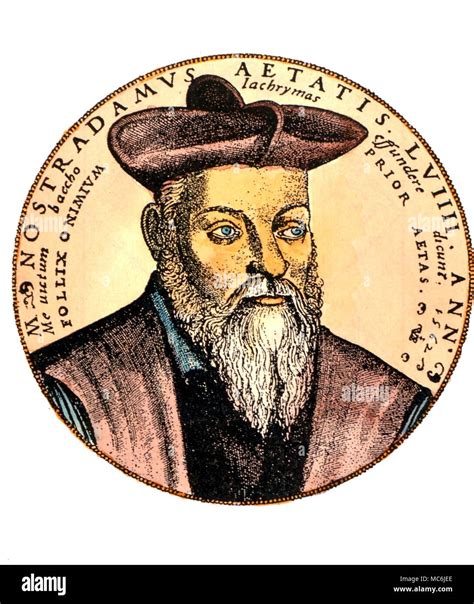
His most renowned work, Les Prophéties, consists of one unrhymed and 941 rhymed quatrains, grouped into nine sets of 100 and one of 42, called "Centuries.”
Early Life and Education
Little else is known about his childhood, although there is a persistent tradition that he was educated by his maternal great-grandfather Jean de St. At the age of 14, Nostradamus entered the University of Avignon to study for his baccalaureate. After little more than a year (when he would have studied the regular trivium of grammar, rhetoric and logic rather than the more advanced quadrivium of geometry, arithmetic, music, and astronomy/astrology), he was forced to leave Avignon when the university closed its doors during an outbreak of the plague.
After leaving Avignon, Nostradamus, by his own account, traveled the countryside for eight years from 1521 researching herbal remedies. In 1529, after some years as an apothecary, he entered the University of Montpellier to study for a doctorate in medicine. He was expelled shortly afterwards by the student procurator, Guillaume Rondelet, when it was discovered that he had been an apothecary, a "manual trade" expressly banned by the university statutes, and had been slandering doctors. The expulsion document, BIU Montpellier, Register S 2 folio 87, still exists in the faculty library. Some of his publishers and correspondents would later call him "Doctor".
Personal Tragedies and Career Shifts
In 1531 Nostradamus was invited by Jules-César Scaliger, a leading Renaissance scholar, to come to Agen. There he married a woman of uncertain name (possibly Henriette d'Encausse), with whom he had two children. In 1534 his wife and children died, presumably from the plague. On his return in 1545, he assisted the prominent physician Louis Serre in his fight against a major plague outbreak in Marseille, and then tackled further outbreaks of disease on his own in Salon-de-Provence and in the regional capital, Aix-en-Provence. After another visit to Italy, Nostradamus began to move away from medicine and toward the "occult".
Read also: Pope Francis and Nostradamus
The Rise of a Prophet
Following popular trends, he wrote an almanac for 1550, for the first time in print Latinising his name to Nostradamus. He was so encouraged by the almanac's success that he decided to write one or more annually. Taken together, they are known to have contained at least 6,338 prophecies, as well as at least eleven annual calendars, all of them starting on 1 January and not, as is sometimes supposed, in March. It was mainly in response to the almanacs that the nobility and other prominent people from far away soon started asking for horoscopes and "psychic" advice from him, though he generally expected his clients to supply the birth charts on which these would be based, rather than calculating them himself as a professional astrologer would have done.
He then began his project of writing a book of one thousand mainly French quatrains, which constitute the largely undated prophecies for which he is most famous today. The quatrains, published in a book titled Les Prophéties (The Prophecies), received a mixed reaction when they were published. Some people thought Nostradamus was a servant of evil, a fake, or insane, while many of the elite evidently thought otherwise. Catherine de' Medici, wife of King Henry II of France, was one of Nostradamus's greatest admirers. After reading his almanacs for 1555, which hinted at unnamed threats to the royal family, she summoned him to Paris to explain them and to draw up horoscopes for her children.
Some accounts of Nostradamus's life state that he was afraid of being persecuted for heresy by the Inquisition, but neither prophecy nor astrology fell in this bracket, and he would have been in danger only if he had practised magic to support them.
The Complete Antichrist Timeline (prophecy explained)
Final Years and Legacy
By 1566, Nostradamus' gout, which had plagued him painfully for many years and made movement very difficult, turned into edema. In late June he summoned his lawyer to draw up an extensive will bequeathing his property plus 3,444 crowns (around US$300,000 today), minus a few debts, to his wife pending her remarriage, in trust for her sons pending their twenty-fifth birthdays and her daughters pending their marriages.
Read also: Nostradamus: Cast and Film Analysis
In The Prophecies Nostradamus compiled his collection of major, long-term predictions. The first installment was published in 1555 and contained 353 quatrains. The third edition, with three hundred new quatrains, was reportedly printed in 1558, but now survives as only part of the omnibus edition that was published after his death in 1568. Given printing practices at the time (which included type-setting from dictation), no two editions turned out to be identical, and it is relatively rare to find even two copies that are exactly the same.
Since his death, only the Prophecies have continued to be popular, but in this case they have been quite extraordinarily so. Over two hundred editions of them have appeared in that time, together with over 2,000 commentaries. Research suggests that much of his prophetic work paraphrases collections of ancient end-of-the-world prophecies (mainly Bible-based), supplemented with references to historical events and anthologies of omen reports, and then projects those into the future in part with the aid of comparative horoscopy. Hence the many predictions involving ancient figures such as Sulla, Gaius Marius, Nero, and others, as well as his descriptions of "battles in the clouds" and "frogs falling from the sky".
His historical sources include easily identifiable passages from Livy, Suetonius' The Twelve Caesars, Plutarch and other classical historians, as well as from medieval chroniclers such as Geoffrey of Villehardouin and Jean Froissart. One of his major prophetic sources was evidently the Mirabilis Liber of 1522, which contained a range of prophecies by Pseudo-Methodius, the Tiburtine Sibyl, Joachim of Fiore, Savonarola and others (his Preface contains 24 biblical quotations, all but two in the order used by Savonarola). This book had enjoyed considerable success in the 1520s, when it went through half a dozen editions, but did not sustain its influence, perhaps owing to its mostly Latin text (mixed with ancient Greek and modern French and Provençal), Gothic script and many difficult abbreviations. Nostradamus was one of the first to re-paraphrase these prophecies in French, which may explain why they are credited to him.
Given this reliance on literary sources, it is unlikely that Nostradamus used any particular methods for entering a trance state, other than contemplation, meditation and incubation. His sole description of this process is contained in 'letter 41' of his collected Latin correspondence. The popular legend that he attempted the ancient methods of flame gazing, water gazing or both simultaneously is based on a naive reading of his first two verses, which merely liken his efforts to those of the Delphic and Branchidic oracles.
Interpretations and Modern Relevance
Most of the quatrains deal with disasters, such as plagues, earthquakes, wars, floods, invasions, murders, droughts, and battles-all undated and based on foreshadowings by the Mirabilis Liber. Some quatrains cover these disasters in overall terms; others concern a single person or small group of people.
Read also: Decoding Nostradamus
Since the 20th century, numerous books have been published interpreting Nostradamus's prophecies. Possibly the first of these books to become popular in English was Henry C. Roberts' The Complete Prophecies of Nostradamus of 1947, reprinted at least seven times during the next forty years, which contained both transcriptions and translations, with brief commentaries. This was followed in 1961 (reprinted in 1982) by Edgar Leoni's Nostradamus and His Prophecies. After that came Erika Cheetham's The Prophecies of Nostradamus, incorporating a reprint of the posthumous 1568 edition, which was reprinted, revised and republished several times from 1973 onwards, latterly as The Final Prophecies of Nostradamus.
Nostradamus's work was even used in propaganda during World War II by both Nazi Germany and the Allies. The Reichsminister of Public Enlightenment and Propaganda, Josef Goebbels, found the predictions intriguing and potentially useful, and tried to find someone to write propaganda based on Nostradamus.
Throughout the prophet's visions of apocalypse the theme of a new religious consciousness occurs again and again. It will flourish, he says, before the end of the 20th century. By clearing predicting the flowering of a new religion, Nostradamus discounts all the familiar established faiths.
Key Prophecies and Interpretations
Some interpreters suggest that Nostradamus's prophecies point to a new spiritual teacher or movement that will emerge. Here are a few interpreted clues:
- The Man from the East: A figure who will come out of his seat, passing across the Apennines to see France. This figure is often associated with an Eastern teacher bringing enlightenment.
- The Outlaw Teacher: A man charged with destroying the temple and altering religions, harming the rocks rather than the living.
- The Mystic Rose: A reference to the fire of awareness and the dawning of inner enlightenment, often associated with Eastern meditation techniques.
- Diana (The Moon) and Dhyan: Allusions to silent rest and images seen, implying the silence and distance from thought experienced in meditation.
Predictions for the Future
Nostradamus has some worrying predictions for 2025. But, with the end of one war, he apparently predicts a war in England beginning. He also appears to predict plague.
“The kingdom will be marked by wars so cruel, foes within and without will arise,” he wrote. “A great pestilence from the past returns, no enemy more deadly under the skies.”
He also appears to predict devastation in the Amazon, and oddly the rise of a “mysterious leader” who would form an “aquatic empire.”
And, according to at least one report, there is an ominous quatrain above all others for 2025.
“From the cosmos, a fireball will rise, a harbinger of fate, the world pleads,” it reads. “Science and fate in a cosmic dance, The fate of the Earth, a second chance.”
Here is how his 2024 predictions shaped up. “Through long war all the army exhausted, so that they do not find money for the soldiers,” predicted Nostradamus. "In England, cruel wars will rage,” wrote Nostradamus. “The ancient plague will be worse than the enemy.” Some speculate that the war in England may not be a literal war, but a war for the throne between Princes William and Harry in the event of King Charles III’s passing.
Many believe this ‘harbinger of fate’ is an asteroid on a collision course with Earth, which could obviously have cataclysmic effects. “From the depths, a ruler will rise, In the midst of floods reaching to the skies,” wrote Nostradamus. Waterworld, here we come! Climate change causing oceans to rise? A new global flood from God?
The Enigma of Nostradamus
Nostradamus is said to have predicted nearly every major global event since his death in the 16th century. And yet as we’ve just seen, his writings are often vague, leaving wiggle room to read whatever you please into his prophecies.
At this point he’s predicted centuries worth of events, and though some have been characteristically vague, others were alarmingly accurate.
Ultimately, the interpretation of Nostradamus's prophecies remains a matter of debate. Whether his visions are accurate predictions or simply reflections of historical and literary influences, they continue to fascinate and intrigue readers around the world.
| Event/Prophecy | Possible Interpretation |
|---|---|
| Man from the East | Emergence of an Eastern spiritual leader |
| Fireball from the cosmos | Potential asteroid impact or significant cosmic event |
| Aquatic Empire | Rise of a leader amidst floods and climate change |
| New Religious Consciousness | Emergence of a new spiritual movement or understanding |
tags: #nostradamus #end #time #prophecy