When I first entered the world of Stranger Things, one of my biggest fears was that it would be a huge bro-fest. The ingredients were all there: a sci-fi show written by a pair of brothers-the Duffers-that centered around a group of nerdy boys. Yes, I know it was the 1980s, but nerdy girls who play Dungeons & Dragons do exist. And, in a way, I was right-the series is mostly about a bunch of boys looking for another boy. But to my surprise, it was the women who ended up stealing the show.
The show’s emotional anchor is chain-smoking Joyce Byers (Winona Ryder), mother of Will Byers, the child whose disappearance in the first episode gets the plot rolling. Joyce is the first to realize that her son has fallen into the clutches of supernatural forces, trapped in an alternative universe known as the “upside-down.”
Throughout the show, she communicates with him through the phone and the light bulbs in her house-one blink for “yes,” two for “no”-and goes so far as to turn her wall into a giant Ouija board.
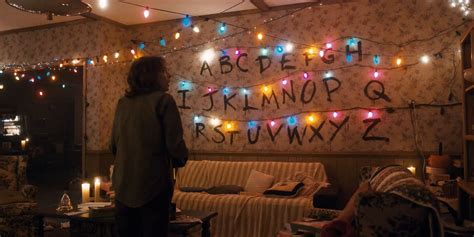
Joyce Byers communicating with Will using Christmas lights in Stranger Things
Like Roy in Close Encounters, Joyce is onto something, and she turns the phone shocks and flickering lights into a conversation between mother and son across different planes of existence, first through simple yes-or-no questions (“Are you alive?” Yes. “Are you safe?” No.), and then through a kind of Ouija board that she paints on her living-room wall.
Read also: The Role of Psychics in Locating Lost Items
And once you paint the alphabet on your living room wall as a multi-colored Ouija board for your child’s electric spirit to warn you about the hell spawn coming to eat you, you’ve chosen, unconsciously or not, to shut the door and enter a new realm altogether.
It’s here that Stranger Things tips into outright horror - unlike the movie Ouija, funnily enough, which never got there - as the reassurance that Will is “R-I-G-H-T H-E-R-E” turns into a frightening directive to get the hell out of the house.
In one scene Joyce even sees Will’s captor, a faceless monster nicknamed the “Demogorgon,” entering through the wall from the parallel dimension. But she is gritty and refuses to abandon her house and her son.
Tenacity is one of Joyce’s defining characteristics. She is unwavering in her conviction that her son is not only alive, but talking to her through electrical appliances. Conviction isn’t quite the right word; it implies faith rather than fact, and Joyce is only following what the evidence tells her.
Hopper, the town’s emo police chief, and Jonathan, her eldest son, try to convince her that her senses are lying to her-that everything she’s experiencing is in her mind. But Joyce stays grounded: She sees some crazy shit and comes to the correct conclusion that, well, crazy shit is going on. “I don’t care if anyone believes me,” Joyce declares. “I won’t stop until I find my boy.”
Read also: Interpreting Dreams About Ear Objects
Whether or not the men in Joyce’s life will believe her is one of Stranger Things’s main tensions. And, unanimously, they do not. At least, not until they confirm her assertions from other sources-Hopper from his own detective work, and Jonathan from his classmate Nancy, another young woman doggedly following the trail of a lost loved one. (Joyce’s ex-husband, meanwhile, also tries to convince her it’s all in her head, but adds creepy greediness to insult by suggesting they could make a lot of money off a wrongful death lawsuit.)
Although the outside world thinks Joyce is crazy, she is the most empirical of the bunch, which makes her frustration all the more palpable. Even in the morgue, it is Jonathan who lets his emotions overwhelm him, running out of the room to throw up when he sees his brother’s body. Joyce-calmly, coldly-asks the coroner to lift up Will’s arm to see if his birthmark is there. She correctly assesses that the body is a fake. (It’s a dummy planted by the secretive government agency whose experiments opened up a gate to the Demogorgon in the first place.) Of course, we aren’t totally sure if she’s right-we can’t be-until Hopper later cuts into the body to reveal it is stuffed with bright white cotton. Even the viewers are wary of trusting her claims.
In clear contrast to Joyce, Hopper’s journey follows the modus operandi of testosterone-fuelled cop-dramas-punch enough people and they’ll eventually lead you to the truth. His snooping takes him all across town, while Joyce has found out almost the same exact information like, a million years ago, without even leaving her house.
We could forgive the other characters for their skepticism; after all, Joyce is claiming she can talk to her son through the walls. But this dynamic-a woman’s frantic claims falling on the deaf ears of men-feels all too familiar, and amounts to a thematic echo of real-world phenomena. Take, to name one example, sexual assault: When women report assault to male cops, they are often met with suspicion. Giving victims of harassment the benefit of the doubt has emerged as a tenet of social liberalism, even seeping into the presidential campaign. There are countless stories about women on college campuses whose claims have been brushed aside, about victims who have been asked, “Are you SURE it was rape? It might have just been a bad hookup.” It’s all the worse if a woman is insistent and clamorous-one study showed that expressing anger decreases women’s social influence, while it actually increases men’s.
Joyce isn’t the only one ignored. Nancy, an older sister of Will’s close friend, is also disregarded when she sees the Demogorgon. She realizes that it has taken her best friend while they were at a party at her boyfriend’s house. When she is interrogated by the police, they focus on the fact that she was sleeping with the boy, rather than the fact that her friend might be in dire straits. “Was this before or after you took your clothes off?” asks a dopey cop.
Read also: The Spiritual Person Defined
Later in the show, Hopper and Joyce visit Terry Ives, a mother who once claimed that the government stole her child at birth. No one believed her, and when we meet her, she is catatonic. The show appears to be asking: What happens when we don’t listen to our wild-eyed women?
As the fearsome, mistrusted mother, Ryder would have completely stolen the spotlight if it weren’t for Millie Bobbie Brown, the 12-year-old actress who plays the character Eleven. At the beginning of the series, her character escapes from the government facility where she was raised and she quickly falls in with Will Byers’s crew of nerdy heroes. When she stops a noisy fan with her mind, we discover that she is telekinetic.
Eleven’s relationship with her new friends is, again, an exercise in trust. She struggles to convince the boys that Will is still alive. Luckily for Eleven, these kids spend a majority of their time in fantasy worlds-the planes of D&D, the pages of X-Men-and belief in the supernatural comes relatively easily. However, for much of Stranger Things Eleven is kept at arm’s length, branded as the crazy “weirdo.” Compounding this wariness-these are pre-pubescent boys we’re talking about-is the simple fact that she is a girl. It’s not hard to see Eleven, insistent and peculiar, as a young Joyce.
It is perhaps no surprise, then, that the most moving moment of Stranger Things is between the show’s two most misunderstood females. After Eleven manages to make contact with Joyce’s son in the “upside-down,” she emerges from a makeshift sensory deprivation tank trembling in fear. Joyce holds her close-a gesture of maternal comfort that Eleven has almost surely never experienced. It is a mother’s instinct to console an orphaned child, yes. But it is also an act of faith between two women.
With “Holly, Jolly,” Stranger Things adds another period-appropriate sci-fi movie to its growing list of influences: Joyce’s attempts to communicate with her missing son mirror the intense obsession of Roy Neary in Close Encounters of the Third Kind. In both cases, there’s an evident madness to the behavior that alienates even those closest to Joyce and Ray, and, in both cases, they’re working toward a crude system for interacting with supernatural beings. Watching Close Encounters again recently, I was struck by the degree to which Roy’s singular obsession spilled into domestic turmoil. He wasn’t just idly slathering together Devil’s Tower out of mashed potatoes; he was operating without respect to anyone around him. The difference with Stranger Things, of course, is that Joyce’s love for her family motivates her search for Will, rather than some mysterious, possessive outside force. Yet there’s a feeling from everyone - her boss at the pharmacy, who sells her stacks of Christmas lights; Mike and Nancy’s mother, Karen, who brings her a casserole; and even her own son, Jonathan, who’s following his own strange impulses - that Joyce has lost her mind. And who could blame her? Her son is missing. She hasn’t slept. Her eyes are bloodshot from grieving and searching for days. Now she’s convinced that Will is talking to her through the lights, which is true, but understandably insane to everyone who see this as a mere missing-person case.
Meanwhile, “Holly, Jolly” inches toward addressing the key questions about the diabolical happenings in Hawkins while leaving them up in the air. Hooper suspects that Will’s disappearance has something to do with Dr. Brenner’s laboratory, but learns nothing specific, other than those possibly fudged surveillance tapes. In flashback, we see that Elle’s psychic powers have been honed under Brenner, who rewards her with the fatherly affection she desperately craves only when she uses her destructive power as ordered. And we still don’t know the creature’s relationship with the laboratory: Is it another experiment that raged out of control? Is it an alien? Is it possible that Dr.
The Christmas-light sequence, reinforced by the episode’s cliffhanger ending, brings Stranger Things into a metaphysical realm. We know from Barb’s struggle with the creature in the pool that wasn’t that the beast is operating on at least two different planes of reality. And that impression is supported by Joyce’s interaction with Will: He’s “R-I-G-H-T T-H-E-R-E” in the house, but his physical form cannot be accessed - if he has any physical form at all anymore. When the authorities later dredge up what seems to be Will’s body from the quarry, does that really mean he’s dead? Does that mean Barb is dead?
With five more episodes to go, Stranger Things can keep teasing out the possibilities, but even an hour as plotty as “Holly, Jolly” still packs in some pleasing grace notes. The sequence where Elle wanders around Mike’s empty house during the day recalls the scene in E.T. that finds the alien doing likewise, poking around as if basic human amenities (a recliner, a television, a phone) were a total curiosity. Nancy’s concern over her best friend’s disappearance pulls her into the larger story, but the show continues to do well in detailing her regrettable dalliance with the popular crowd. “Ms. Perfect,” with a Trapper Keeper and butterfly stickers on her locker, has entered the adult world of sex and death, and she’s reeling from it. As Stranger Things continues to delve into its central mysteries, the big question is whether it’ll be so wrapped up in X-Files-type conspiracies that it loses some of the human and period elements that set it apart.
Dustin wonders whether Elle was born with powers (like X-Men) or acquired them (like Green Lantern). Elle’s psychic powers are reminiscent of Carrie, but without the coming-of-age baggage. They’re not a metaphor for anything.
Stranger Things‘ third episode also treated us to similar shifts in other characters, namely Eleven, who showcased new degrees to her powers and ethical limits alike, and Hopper, who has upped the ante toward finding Will beyond routine police work. Still, the biggest and most poignant catalyst to this trend is Barb. She was a symbol of Nancy’s innocence and an anchor to her adolescent life. Her death wasn’t only a domino drop so that the rest of the story could keep going (although it was definitely that in a big way), but was a slaying of something in Nancy as well. After Mike saw “Will” pulled out of the water, he raced home and cries in his mother’s arms as Nancy watched from another room. One sibling thought his friend was dead when he was only missing, the other thought her friend was missing when she was actually dead.
Everyone in “Holly, Jolly” faced the end of their old lives. Just as Barb’s death was the literal embodiment of Nancy’s former high school life being ripped to shreds, Joyce chose to absorb a brand new reality that looks like insanity to everyone else. She became embedded in a disembodied connection with Will that forced her to buy a new phone and get a two-week advance on her paycheck. And since her son had begun communicating using the power lines, Joyce began to wear her apparent insanity out in public. Threshold thoroughly crossed, she no longer cared about her helmet-haired boss or her casserole-bearing neighbor Karen catching sight of her insanity. All that mattered was her son.
Joyce’s old life was gone. So was Nancy’s.
Are you rewatching with us? It’s kids vs.
The following table summarizes the key characters and their roles in the communication and search for Will:
| Character | Role | Method of Communication/Search |
|---|---|---|
| Joyce Byers | Mother of Will | Christmas lights, Ouija board |
| Eleven | Friend of Mike, Will, Dustin, and Lucas | Telekinetic powers, sensory deprivation tank |
| Hopper | Town Police Chief | Detective work |
| Nancy | Friend of Barb and girlfriend of Steve | Investigates Barb's disappearance |