The Ouija board, a seemingly simple game, has been a source of fascination and controversy for over a century. Is it a harmless party game, a relic of Victorian superstition, or a genuine tool for communicating with the spirit world? This article delves into the history of the Ouija board, exploring its origins, evolution, and the mysteries that continue to surround it.
For more than a century, it’s prompted obsessive debate. Is it just a silly adolescent slumber-party board game, leftover from those superstitious Victorians? Is it truly a tool for connecting to spiritual worlds we don’t understand? Is it harmless, helpful, or dangerous?
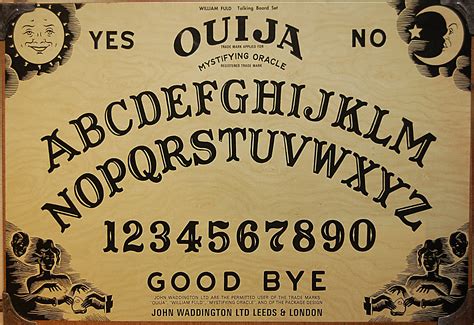
Origins and Evolution
The origins of the modern-day American Ouija board are quite mysterious, though, with many disputed tales about who the actual inventor of the board was, and how he came up with it. However, even before the Victorian craze of mysticism, similar talking boards had been in use much longer, the origins dating back centuries in China.
Other means of talking to ghosts were much more inefficient, requiring taking down notes from Morse Code-like knocks, taps, and rattles of a shaking table. It wasn’t long before crafty inventors came up with devices that let supposed spirits leave alphabetic messages much more readily.
A 1920 article in the New York World Magazine had this piece of folklore about Chestertown, Maryland, cabinet-maker Ernest Charle Reiche inventing the board in 1890: “Mr. Reichie, although not a spiritist, noticed sympathetically that a large table was a heavy thing for a frail spirit to juggle about. His meditations, attuned to cabinetmaking, took a practical form.
Read also: Cultural impact of the Ouija board
Another legend, found in the same article, says the same year, Charles W. Kennard, a Chestertown entrepreneur who had previously started ventures in fertilizers and real estate, “sat idly in the kitchen of his Maryland home. … In this blissful state he reached out and took his wife’s breadboard and placed it on his lap, and then placed a saucer on the bread board. The saucer began to move, as though on its own volition. Mr. Kennard was amused, frightened, interested, impressed, inspired and delighted.
In fall 1890, Kennard went into business with fellow Masons Harry Welles Rusk, William H.A. Maupin, Col. Washington Bowie, and John T. Green as the Kennard Novelty Company in Baltimore.
Kennard went on to patent and manufacture other talking boards, including the Volo (1892) and the Igili (1897), and other knockoffs soon followed.
The Rise of William Fuld and Parker Brothers
talking board patent, registered by Elijah J. Bond, and sold their interest in it to the company. It wasn’t long before Bowie dismissed everyone but Rusk, and put his close pal William Fuld in charge of the renamed Ouija Novelty Company.
Abbott explained to me that Fuld also liked to brag he invented the Ouija. “Fuld also told the tale of the board giving him advice in business dealings,” Abbott says. “I guess it’s all in what you believe. If you believe that Fuld was actually taking instructions from his Ouija board-and not just hyping his product-you might be inclined to think an unfriendly spirit was giving out the orders despite his financial success.
Read also: Enigmatic Ouija Board
Fuld ended up in a long and bitter business dispute with his brother, Isaac, over the production of the Ouija board. Even his 1927 death is shrouded in mystery. One account states, “William Fuld was tragically killed by complications falling from the roof of his three story Harford, Lamont, and Federal Street factory. The iron support he was leaning on gave way, and he tumbled backwards off the roof.” However, some suggested the fall wasn’t an accident at all, and possibly suicide.
After this death, the Fuld family held the patent until they sold it to Parker Brothers in 1966.
The Dark History of the Ouija Board
The Allure for Collectors
For collectors, the game keeps getting better. “The boards I bought 10 years ago have tripled in price,” Abbott says. “It’s a fun part of our history when mystics and séances were all the rage.
Show & Tell regular, Lynda Abbott, known as Vestaswind and a blogger at Appraise Your Junk, piqued our interest when she posted a couple of great vintage “talking boards” from her collection. She explains, “My obsession with Ouija really started in 1999, when Parker Brothers stopped making the old boards and went to the glow-in-the-dark version.
Read also: Spiritualism and the Ouija Board
“At the time, a friend of mine showed me her collection of Ouija boards, and that’s when I realized I had no idea just how many were out there,” she continues. “From that moment on, I knew I had to have them all. Now, I have about 20 boards. I even wrote to Raymond Buckland who wrote ‘Ouija, Yes! Yes!’ and designed his own board. He sent me his book, autographed. For me, the appeal isn’t just the mystery of the board, but the art and the history.
The Legend of Zozo
Zozo, often referred to as the Ouija Board Demon, is a demonic entity reportedly invoked via Ouija boards and spiritual communication methods. Zozo, often referred to as the Ouija Board Demon, symbolizes Christianity's apprehension towards the occult. This entity is a fallen angel, expelled from Heaven by God.
He is a master deceiver which is not surprising as the Devil is claimed to be the Father of All Lies, and Zozo is a powerful Devil in Hell, under Satan.
This entity is known to impersonate the voices of deceased individuals, exploiting human fears and insecurities.
Zozo, in Christian mythology, is a fallen angel expelled from Heaven by God. Known as the Ouija Board Demon, Zozo is associated with possessions, notably that of Roland Doe.
He often delights in telling them they will die soon, and is often brutally misogynystic. He loves to pretend he is other spirits, oftentimes pretending he is three different spirits at once. He can play on psychics, for instance, if a psychic is adamant that there are only two ghosts in the building, Zozo will confuse them by claiming there are nine ghosts instead.
Zozo loves watching his victims squirm with confusion and oftentimes he takes pleasure when one gullible human believes his lies. Zozo is very sadistic and loves watching friends fall out over his lies.
Roland Doe was the boy reportedly possessed by Zozo, a fallen angel banished from Heaven. The possession occurred post his interaction with a Ouija board.
Zozo, often referred to as the Ouija Board Demon, is believed to have possessed Roland Doe, an event documented in 'The Exorcist'. In the book, Zozo is named Pazuzu, a reference to Babylonian culture.
He is rumoured to have been the demon who possessed Roland Doe when the boy used a Ouija board.
Zozo is often said to mimic the voices of the dead who the user of the Ouija board wishes to talk to. He is a cruel, sadistic demon who likes preying on people's insecurities and fears.
Here's a timeline of events involving the Ouija board and the alleged demon Zozo:
| Year | Event |
|---|---|
| 1951 | Roland Doe was a boy who got possessed by Zozo, after using a Ouija board. |
| 2012 | Tombstone, Nevada. A small group of soldiers were off-duty and decided to mess about with a Ouija board just for fun. They made contact with an alleged spirit who told them he had died in Tombstone. |
| 2017 | YouTubers FaZe Rug and Sherman used the Ouija Board in a "secret" room in Rug's known to be haunted home with their cousin, Jesaica. During the game, Jessica took her hand off the planchette. They asked for the spirit's name and it when it was revealed to be Zozo, they immediately said Goodbye to end the game. |
| 2019 | YouTuber Kyle Godfrey attempted to contact Zozo at 3 am on his Ouija board, and made contact with an entity who said it was Zozo. However, Kyle took it further and asked the spirit if there was a specific phone number for Zozo. The entity gave him a number, 4176666666, and when the number was called the lights went out in his room during the phone call and poltergeist activity followed. |
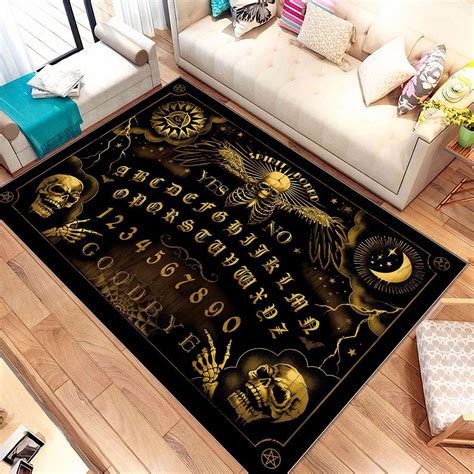
This is the conceptual Ouija board rug and coffee table imagined by Dave Delisle of Dave’s Geek Ideas.