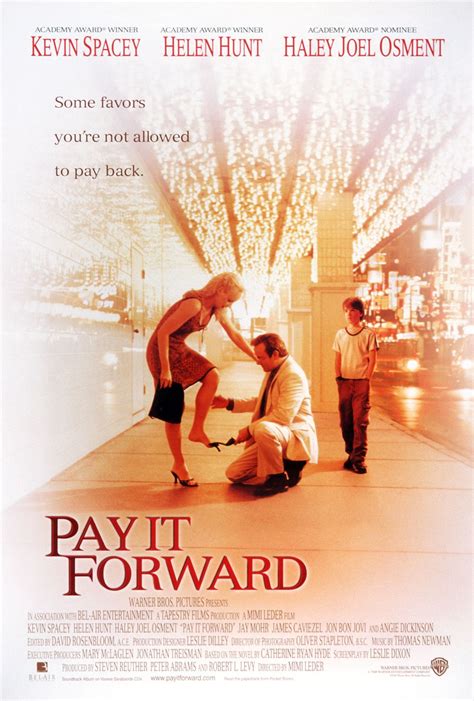
The film "Pay It Forward," directed by Mimi Leder and based on the novel by Catherine Ryan Hyde, is an inspiring and imaginative story that speaks directly to the greatest social problem and character disorder of our times - incivility. It dares to point us in a different direction, boldly revealing that kindness and putting others first are acts of moral beauty.
The Genesis of an Idea
The film centers around Trevor McKinney (Haley Joel Osment), an eleven-year-old boy living in Las Vegas with his working-class mother, Arlene (Helen Hunt), who is a recovering alcoholic. Life is hard for them, with Arlene working two jobs to make ends meet. Trevor is challenged by his Social Studies teacher, Eugene Simonet (Kevin Spacey), to "change the world" as an extra credit assignment.
What does the world expect of an 11-year-old? Absolutely nothing. But Trevor is no ordinary son. He sees the potential he can make in a world that looks like *expletive* (in Trevor’s words). He comes up with a plan to impact the lives of three people. The energetic and idealistic boy decides he will do a good deed for three people, something they can't do for themselves, and then will ask each one of them to "pay it forward" by doing similarly difficult big favors for three others. If they accept, it is their duty to continue the idea of paying it forward (instead of back) by impacting the lives of three others.
Trevor's Missions of Kindness
Trevor begins by helping out a homeless man (James Caviezel), a heroin addict. Trevor's second mission is to bring the lonely Eugene together with his mother. Only trouble is that they both must deal with old tapes of fear, self-doubt, and lack of self-esteem. And to make matters worse, Trevor's physically abusive and alcoholic father (Jon Bon Jovi) returns home.
The Ripple Effect
“Pay It Forward” is told in an interesting present-to-past-to-present storyline by means of an intrusive reporter who is freely given a classy new Jaguar. Meanwhile, a Los Angeles reporter, Chris Chandler (Jay Mohr), is knocked for a loop when a lawyer (Gary Werntz) gives him his Jaguar after seeing that his old Mustang has been totaled. The benevolent Jag owner tells the reporter he is just “paying it forward.” Tracking the rich man down, he learns that his action was part of paying forward the kindness he received from an African American (David Ramsey) in a hospital emergency room. Eventually, Chandler's investigations lead him to Trevor and his innovative "pay it forward" project that has already had more of a positive impact on the world than he had realized. The reporter does an interview with the boy on his twelfth birthday.
Read also: The Dark Side of Witchcraft Movies
It concretely proclaims that each person can make a difference in the world by doing good. And it reveals that although we'll probably never know the effects of our acts of compassion, that's okay. Eventually, Chandler's investigations lead him to Trevor and his innovative "pay it forward" project that has already had more of a positive impact on the world than he had realized. The reporter does an interview with the boy on his twelfth birthday.
This inspiring and imaginative film is based on a novel of the same title by Catherine Ryan Hyde. Mimi Leder (ER, China Beach, Deep Impact) directs from a screenplay by Leslie Dixon. It speaks directly to the greatest social problem and character disorder of our times - incivility. Wherever one looks - in the home, on the street, or at work - everyone is consumed with taking care of number one.
Spiritual Themes and Moral Beauty
The film emphasizes the importance of small acts of kindness, love, and forgiveness. As Meher Baba observed, "They also serve who express their love in little things. A word that gives courage to a broken heart or a smile that brings hope in the midst of gloom is as much service as heroic sacrifice."
It boldly reveals that kindness and putting others first are acts of moral beauty. It concretely proclaims that each person can make a difference in the world by doing good.
Challenges and Roadblocks
The film also acknowledges the challenges and roadblocks that people face when trying to make a positive change. Arlene and Eugene must deal with their own fears and insecurities as they try to build a closer relationship.
Sometimes it's hard to believe that it is possible to turn our lives around and do a new thing. On a scale of one to five, how would you rate your ability to change?
Read also: Deep Dive: Tarot Curse
Not only do we learn that Arlene’s past is riddled with abuse, but burn-scarred Mr.
A Call to Action
If “Pay It Forward” does not challenge Christians to be salt and light in a depraved world, then my suggestion is for those of apathy to reflect deep inside to see if Christ has really changed their heart. To be a Christian who follows the example of Jesus we must be living costly lives, surrendered to Christ and fighting off the lure of ease and comfort. If Trevor, a poor pre-teen with no Christian background, can see the impact he can make for the better, what more should we be doing to reach the lost? Houses are on fire around us, people are asleep inside, and how many Christians are willing to let those in danger know how to escape their eternal destiny and find their way to life everlasting? Jesus Christ already paid the ultimate price two thousand years ago. “Then the righteous will answer Him, ‘Lord, when did we see You hungry, and feed You, or thirsty, and give You something to drink? And when did we see You a stranger, and invite You in, or naked, and clothe You?
One of the major points of this film is that a single person can make a big difference in the quality of life on the planet. Many of the greatest spiritual leaders of our time, including Mother Teresa, Dr. Martin Luther King, Jr., Nelson Mandela, were a force for positive good in the world as active agents of hope.
It dares to point us in a different direction. It boldly reveals that kindness and putting others first are acts of moral beauty. It concretely proclaims that each person can make a difference in the world by doing good.
Inspirational Video - Pay It Forward
Mature Themes and Content
While the film is inspiring, it is important to note that it contains mature elements. It is rated PG-13 for mature elements: substance abuse/recovery, some sexual situations, language and brief violence. Offensive language contains at least 25 “s” words, as well as several uses of God’s name in vain. Hunt’s character dresses life Erin Brockovich in many scenes, including two or so scenes where she is seen in her bra. Trevor works toward setting up his mom with his teacher, and eventually succeeds in this. He is thrilled to know they “had a sleepover” at his house, seeing it as a means to an end of preventing future abuse for the time when his deadbeat dad (played by Jon Bon Jovi) may appear again, not to mention the happiness his mother and teacher experience when in each others company (in one scene of sexuality without nudity). There are a few scenes of violence, though nothing over-the-top.
Read also: Nostradamus: Cast and Film Analysis
Values & Visions Guide
All the world's religious traditions celebrate the supreme worth of the spiritual practices of compassion, forgiveness, hope, kindness, love, and transformation. This guide is one in a series of more than 200 Values & Visions Guides written by Frederic and Mary Ann Brussat.
Here is a table summarizing the key characters and their roles:| Character | Actor | Role |
|---|---|---|
| Trevor McKinney | Haley Joel Osment | The young boy who initiates the "Pay It Forward" project |
| Arlene McKinney | Helen Hunt | Trevor's mother, a recovering alcoholic |
| Eugene Simonet | Kevin Spacey | Trevor's Social Studies teacher |
| Chris Chandler | Jay Mohr | A reporter investigating the "Pay It Forward" phenomenon |