Virgo (♍︎; Ancient Greek: Παρθένος, romanized: Parthénos; Latin for "virgin" or "maiden") is the sixth astrological sign in the zodiac. It spans the 150-180th degree of the zodiac.
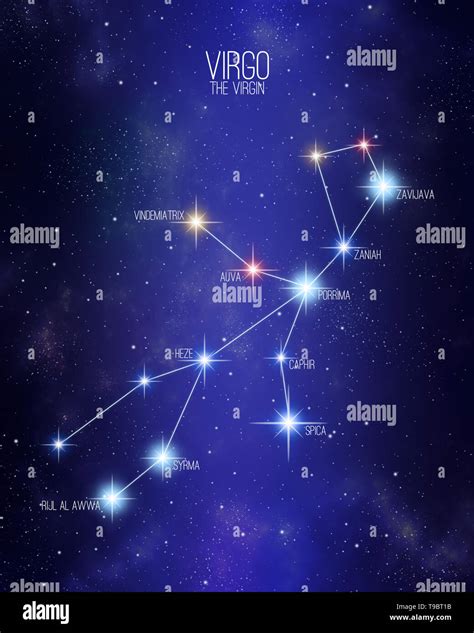
Virgo Constellation Map
Mythological Origins
The constellation Virgo has various origins in different mythologies. The sign is associated with Astraea, a figure from Greek mythology. Another association is with the myth of Parthenos, which explains how the constellation Virgo came to be.
According to this legend, Parthenos is the daughter of Staphylus and Chrysothemis, and sister to Rhoeo and Molpadia. Apollo impregnated Rhoeo, and upon discovering her pregnancy, her father, assuming it was from an unknown suitor, locked her in a box and cast it into a river. Parthenos and Molpadia, fearing their father’s wrath, accidentally allowed a valuable bottle of wine to be broken by one of their swine. In terror, they fled and threw themselves off a nearby cliff. Apollo saved them, placing Molpadia in Castabus, where she became the local goddess Hemithea, and Parthenos in Bubastis, where she was worshipped as a local goddess.
In another Greek myth, Virgo is associated with Erigone, the Athenian maiden and daughter of Icarius. In Egyptian mythology, the Sun’s presence in Virgo marked the beginning of the wheat harvest, thus linking Virgo to the wheat grain. In Christianity, the birth of Jesus to a virgin in Bethlehem is symbolically connected to Virgo.
Read also: UFO Sightings
Most of the fertility and harvest goddesses of the Mediterranean and Middle East are in some way associated with Virgo but there is no one definitive myth that defines this pattern. She is variously identified as a fertility goddess (the Babylonian and Assyrian Ishtar, among others) or the harvest maiden (the Greek Persephone and others). The pattern is pictured as a female, often holding a spike of grain in one hand.
Sometimes Virgo is holding a staff, a caduceus (the snake-entwined staff that symbolizes healing, rebirth, or oracle prophecy), or a scale in her other hand. These other symbols are associated with additional goddesses who symbolize justice or wisdom or prophecy. In other variants, the goddess herself, representing the bountiful Earth, divides her time between the upper world and the underworld, returning above ground in the spring.
Among the goddesses associated with Virgo are the Babylonian Istar, the Egyptian Isis, Sumerian Ishtar, Greek Demeter, Demeter's daughter Persephone, Roman Ceres, Dionysius's daughter Erigone, Greek Dike, Athena, or Artemis - and many others.
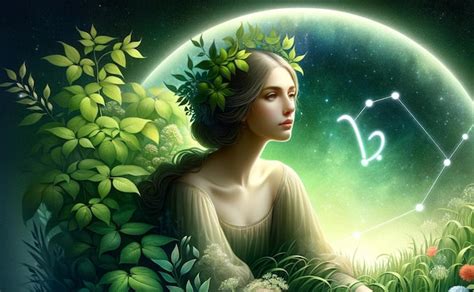
Virgo Illustration
Astronomy and Virgo
Virgo, in astronomy, zodiacal constellation lying in the southern sky between Leo and Libra, at about 13 hours right ascension and 2° south declination. Virgo is the second largest constellation in the sky after Hydra, and the Sun spends a long time within its boundaries. The Sun is still within Virgo at the autumnal equinox, another point significant to ancient harvest and fertility rituals.
Read also: Peridot gemstone guide
The constellation’s brightest star, Spica (Latin for “head of grain,” also called Alpha Virginis), is the 15th brightest star in the sky, with a magnitude of 1.04. Virgo contains the nearest large cluster of galaxies, the Virgo cluster, in which is located the giant elliptical galaxy Virgo A and PSR 1257+12, the pulsar around which the first extrasolar planets were discovered in 1992.
Understanding VIRGO Man || Personality Traits
Astrological Significance
In astrology, Virgo is the sixth sign of the zodiac, considered as governing the period from about August 23 to about September 22. It is represented as a young maiden carrying a sheaf of wheat.
| Aspect | Details |
|---|---|
| Sign | Virgo (♍︎) |
| Dates | August 23 - September 22 (approximately) |
| Symbol | Young maiden carrying a sheaf of wheat |
| Associated Goddesses | Ishtar, Isis, Demeter, Persephone, Ceres, Erigone, Dike, Athena, Artemis |
Read also: Men's Virgo Tattoos