The Rider-Waite Tarot deck stands as one of the most iconic and widely recognized decks in the world of tarot. Its innovative approach to symbolism and imagery has had a profound impact on the tarot community, laying the foundation for many subsequent tarot decks and interpretations. It has permeated Anglo-American tarot and become the paradigm and touchstone through which we think about Tarot.
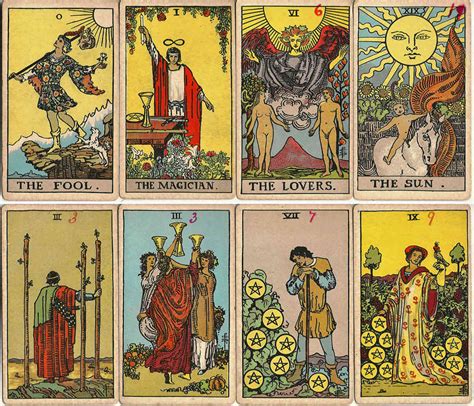
The Judgement card from the Rider-Waite Tarot deck.
The Creators: A.E. Waite and Pamela Colman Smith
The Rider-Waite Tarot deck was first published in 1909 by William Rider & Son in London. It is based on the instructions of academic and mystic A. E. Waite and illustrated by Pamela Colman Smith, both members of the Hermetic Order of the Golden Dawn.
Arthur Edward Waite (A.E. Waite)
A.E. Waite was an English occultist, writer, and scholar deeply interested in mysticism and esoteric studies. A spiritual seeker and mystic, he supported himself with freelance translation and writing. In 1889, under the pseudonym Grand Orient, he published A Handbook of Cartomancy, Fortune-Telling and Occult Divination, one of the first books in English on how to read tarot.
His fascination with the occult scene drew him into membership in the Hermetic Order of the Golden Dawn, but his spirituality gradually evolved away from ceremonial magic and toward Christian mysticism. When the Golden Dawn splintered into factions, he created his own order, the Fellowship of the Rosy Cross.
Read also: Symbolism in Rider-Waite Tarot
Pamela Colman Smith
Pamela Colman Smith, often referred to as Pixie, was a talented artist and illustrator. Born in London to American parents, she spent part of her childhood in Jamaica. She studied art at the Pratt Institute in New York then toured with an English theater company as a costume and set designer. In 1901 she acquired a London studio where she entertained her artistic and literary friends by dressing up in costume and telling Jamaican folk tales with an ethnic accent while using a miniature cardboard theater as a prop. During the high point of her career, from 1890 to 1910, she collaborated with W. B. Yeats and Bram Stoker. In 1909, Waite paid Smith a flat fee for illustrating his Tarot deck. He chose Pamela for the job because of her talent, their common membership in the Golden Dawn, and because he believed her clairvoyant abilities would help her perceive the higher mystical truths he was attempting to convey with his deck.
Recently, the tarot community has been correcting this injustice by referring to the deck as the Rider Waite Smith (RWS) or Waite Smith deck (WS). Although both Waite and Smith had been members of the Golden Dawn, they did not create a Golden Dawn deck.
She not only didn’t benefit financially from the deck, but the publisher’s name was put on the deck instead of hers.
How To Read All 78 Tarot Cards in 30 Minutes!! Easier Than You Think
Key Features of the Rider-Waite Deck
The Rider-Waite tarot deck has 78 cards: 56 Minor Arcana, and 22 Major Arcana. The Minor Arcana generally correspond to the suits of Spanish or Italian playing cards.
A unique feature of the Rider-Waite deck, and one of the principal reasons for its enduring popularity, is that all of the cards, including the Minor Arcana, depict full scenes with figures and symbols. Prior to the Rider-Waite Tarot, the pip cards of almost all tarot decks were marked only with the arrangement of the suit signs -- swords, wands, cups, and coins, or pentacles. The pictorial images on all the cards allow interpretations without the need to repeatedly consult explanatory text.
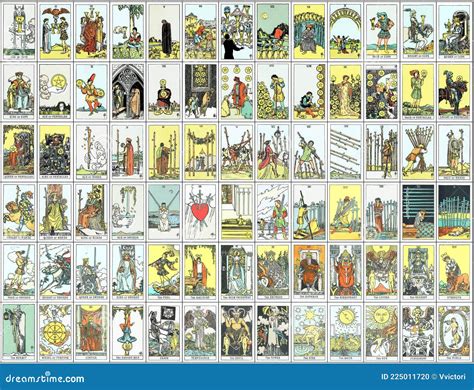
Example of Minor Arcana cards with full scenes.
While the images are simple, the details and backgrounds feature abundant symbolism. Some imagery remains similar to that found in earlier decks, but overall the Waite-Smith card designs are substantially different from their predecessors. Christian imagery was removed from some cards, and added to others. For example, the "Papess" became the "High Priestess" and no longer features a Papal tiara. The "Lovers" card, previously depicting a medieval scene of a clothed man and woman receiving a blessing from a noble or cleric was changed to a depiction of the naked Adam and Eve in the Garden of Eden, and the ace of cups featuring a dove carrying Sacramental bread.
The symbols and imagery used in the deck were influenced by the 19th-century magician and occultist Eliphas Levi, as well as by the teachings of the Hermetic Order of the Golden Dawn. Waite based his Major Arcana imagery on Eliphas Levi’s and Paul Christian’s Egyptianized descriptions of the trumps, as well as Christian symbolism and Golden Dawn astrological attributions. His divinatory meanings draw heavily on Etteilla.
Innovations and Symbolism
In order to accommodate the astrological correspondences taught by the Golden Dawn, Waite introduced several innovations to the deck. The Major Arcana are based on the Tarot de Marseilles with flourishes from Eliphas Levi’s descriptions and Waite’s personal symbolism. The card meanings are drawn partly from the Golden Dawn and partly from Etteilla. Most importantly, Waite does not associate the Hebrew alphabet with the cards, which is the essence of occult Tarot.
Waite utilized symbolism as the key to the Tarot pack. In The Key to the Tarot he writes: “The true Tarot is symbolism; it speaks no other language and offers no other signs.”
Early Editions and Copyright
The cards were first published in December 1909, by the publisher William Rider & Son of London. The first printing was extremely limited and featured card backs with a roses and lilies pattern. In March 1910, a much larger printing featured better quality card stock and a "cracked mud" card back design. This edition, often referred to as the "A" deck, was published from 1910 to 1920.
All of the Rider editions up to 1939 were available with a small guide written by A. E. Waite providing an overview of the traditions and history of the cards, texts about interpretations, and extensive descriptions of their symbols. The first version of this guide was published during 1909 and was titled The Key to the Tarot.
The deck must have been instantly popular since the book and deck were pirated by American publisher DeLaurence in 1916. acquired exclusive rights to the Rider Waite name in 1971. Games 1971 printing is probably the closest to the original that’s available now. Before 1971, University Press was the biggest tarot publisher in the U.S, producing an easily identifiable Rider-Waite deck with an ankh on the card backs. Games deck.
The original version of the Rider-Waite Tarot is in the public domain in all countries that have a copyright term of 70 years or fewer after the death of the last co-author. In the United States, the deck became part of the public domain in 1966 (publication + 28 years + renewed 28 years). Games Systems has a copyright claim on their updated version of the deck published in 1971, but this only applies to new material added to the pre-existing work.
Influence and Legacy
The Rider-Waite-Smith deck has inspired hundreds of imaginative spin-offs like the Morgan Greer, Robin Wood, Hanson Roberts, Hudes, and Aquarian decks. Deck creators feel compelled to pay homage to this deck by modeling their designs on it. Most LWBs (little white books that accompany decks) use RWS card meanings, even when they don’t correspond to the accompanying cards.
The Rider-Waite Tarot deck has not only left an indelible mark on tarot history but has also become a timeless tool for personal growth, divination, and spiritual exploration. The images in the Rider-Waite Tarot deck are designed to evoke emotional and intuitive responses. Some of the Major Arcana cards were renamed to better align with Waite's esoteric interpretations.
Radiant Rider-Waite Tarot
The new Radiant Rider-Waite Tarot is the latest offering in a long line of historically accurate decks from Stuart R. Kaplan based upon the illustrations of Pamela Colman Smith. For this very pretty new deck, the artist Virginijus Poshkus was selected to re-color the drawings. Virginijus Poshkus has successfully undertaken the task of re-colorizing an iconic tarot deck and enhancing the beloved artwork created by Pamela Colman Smith. His carefully chosen palette of vibrant color brings new energy and radiance to the 78 cards of the Rider-Waite® Tarot. The updated look replaces Smith’s thick, black outlines with subtle shading that gives depth to the familiar scenes.
Radiant Rider-Waite’s enhanced brightness highlights the traditional symbolism that readers rely on for insightful readings. The card backs have also been given the fresh new look of a star-filled deep, blue sky. Radiant Rider-Waite® Tarot includes an instruction booklet with an Introduction by Stuart R. Games in the Rider-Waite tradition, which is both helpful and convenient for every purchaser of these cards.
To describe the colouring of these cards as radiant is not an overstatement, as they are indeed shining and glowing, brilliant and luminous, and truly beaming with happiness. The cards have a clean, white border all around the images, with the numbers on the top in Roman numerals for the Major Arcana and spelled out in capital letters on the Minors. The titles and suits are in capital letters, in the same very pleasant typeface, also centered on the bottom of the cards.
The cards themselves have a nice feel, as they are printed on good cardstock, and are plastic-coated and durable. They are easy to handle and shuffle, being sized at 2 3/4" by 4 3/4" overall. The packaging is in a standard size box, printed in complimentary hues of orange and blue to highlight the radiant color values of the cards within, and featuring the Fool and Magician cards from inside.
The Radiant deck, however, features shades that are richer, deeper, and bolder than the softer pastel hues of the Universal Waite version.
I would recommend the Radiant Rider Tarot to anyone who wants to stay with traditional Tarot, but who finds the colors of the traditional Rider-Waite to be too bland or boring for their personal taste. Many have disliked the original Rider-Waite deck as being boring or uninspiring, while others don't mind at all. But now there is another choice to help make tradition more fun, enjoyable, and inspiring.
The Radiant Rider takes the familiar and comforting images of the traditional Rider cards and brings them to life with "radiance." The recolorization serves to illuminate Pamela Colman Smith's original work. If you're not in the mood for the traditional Rider-Waite, which may seem too "plain," or you find that you're also not in the mood for the softer colors of the Universal Waite deck . . . then the bolder colors in the Radiant version may be just what you're looking for.
Just as with the Universal version of these traditional cards, this deck presents itself in a whole new light . . . and so, if you've been one to stay away from the traditional Rider-Waite deck due to the coloring used, the Radiant Rider is a good reason to take another look from a fresh perspective.
It's just a bright, more colorful . . .
Other Editions
Games Systems published a commemorative deck titled "The Smith-Waite Centennial Deck" as part of The Pamela Colman Smith Commemorative Set celebrating the hundredth anniversary of the 1909 deck. This deck notably places Smith's name first and omits the publisher's name (Rider).
Pamela Colman Smith's artwork was pumped up with vibrant colors by Frankie Albano. The deck was originally published in 1968 and went out of print just a few years later. Games Systems re-issued a facsimile deck from the original in 1991 and it has remained a staple for tarot collectors since. The colors are bright with lots of purples and greens, which help readers focus on details they might have otherwise missed.
The Smith-Waite Centennial Tarot Deck is a faithful reproduction of the original deck created by Pamela Colman Smith in 1909 under the direction of Arthur E. Waite. This classic tarot deck features full pictorial scenes in the muted colors chosen by “Pixie” herself. Games Systems as part of the Pamela Colman Smith Commemorative Set. This stand-alone version is for collectors who want to keep their PCS sets pristine and yet do readings with this special deck.
Guides to the Rider-Waite Tarot
Written with thoroughness and clarity, this insightful guide walks you through the meanings of each of the 78 cards and explains how to interpret them in a spread. The Ultimate Guide to the Rider Waite Tarot details the ten most important symbols on each and every card in the deck complete with hundreds of illustrations for easy use. In addition to an explanation of the symbols, each card is given a brief interpretation by topic:
- Primary meaning
- Prognosis or tendency
- Spiritual meaning
- Love and relationship
This complete guide shares the compelling story of the deck's creation, a complete analysis of what each card means, and 78 spreads to help you integrate each card's unique spiritual energy. Discover how artist Pamela Colman Smith and occultist Arthur Waite combined their knowledge of astrology, Kabbalah, metaphysics, mythology, and theater to realize their profound vision.