Picture a deck of tarot cards. What do you see? Maybe the Magician in his rich red robes, right arm raised high above him? Or the skeleton on horseback for Death? The funny thing is that those images don’t hail from some ancient text but from one particular deck of cards, a relatively recent one in the life of this medieval form of entertainment: The Rider (or Rider-Waite-Smith) Tarot.
The Rider-Waite Tarot deck is one of the most iconic and widely recognized decks in the world of tarot. The most famous and popular tarot deck in the world, the first ever printed in English, the Rider-Waite tarot is a product of the intuitive thoughtfulness of an American-born occult scholar in late 19th century London, a British-born creative visual genius who studied art in New York City and lived in Jamaica, and a businessman whose first book was about coal mining techniques who happened upon a set of tarot cards at a toy fair in the late 1960s.
That you can visualize a tarot card at all is likely due to one man, an American business man named Stuart R. Kaplan acquired exclusive rights to the Rider Waite name in 1971.
The Rider-Waite Tarot is a popular deck for tarot card reading, first published by William Rider & Son in 1909, based on the instructions of academic and mystic A. E. Waite and illustrated by Pamela Colman Smith, both members of the Hermetic Order of the Golden Dawn.
With time and practice, the cards may begin to really convey meaning, asking us to look deeper at ourselves and our motives, and nudging us in the correct direction.
Read also: Waite-Rider Tarot
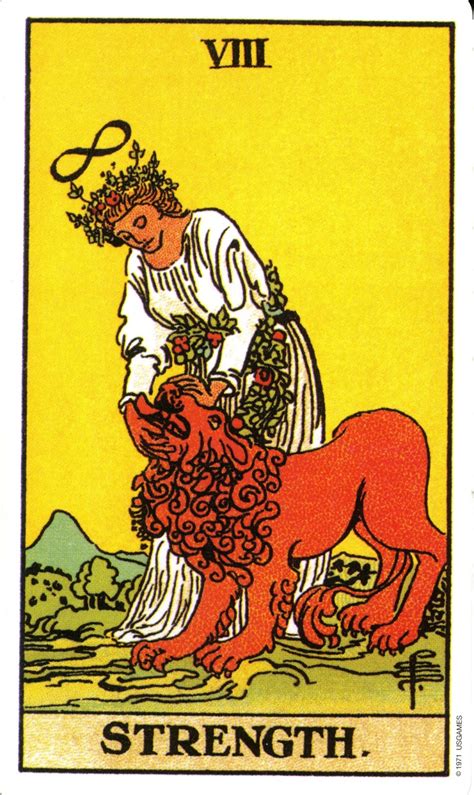
Strength card from the Rider-Waite Tarot deck
The Historical Roots of Tarot
Tarot cards have a long story and a short one. The long one begins in 15th century Europe, where the 78 card deck-four suits (Wands, Cups, Swords, Pentacles) of 10 “pip”cards running from Ace to ten, each with an additional four “face”cards (King, Queen, Knight, and Jack) plus 21 Trump cards known as the Major Arcana, plus the Fool-form the traditional tarot deck.
Without the Major Arcana, the cards of Tarot are roughly aligned with a standard playing card deck, which has its roots in France a few hundred years earlier. The shorter story, however, is how Tarot came to be used in fortune telling. In 1781, when Antoine Court de Gébelin, a French Freemason and Protestant pastor published a book called Le Monde Primitif, tracing the mysticisms of the ancient world and their surviving traces in the modern. Among them, he included the famous French playing card deck, the Tarot de Marseilles, which he connected to the Egyptian deities Isis and Thoth.
Though his musings on the subject haven’t been found to be based on any evidence, tarot’s association with the mystical was now set.
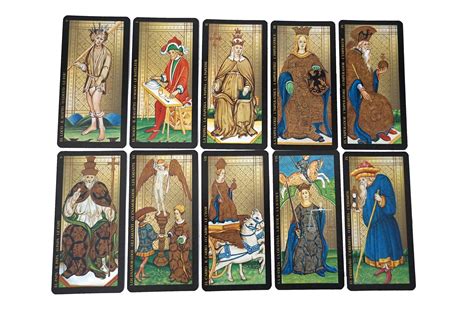
Tarot card from the Visconti-Sforza deck, dating back to the 15th century
The Occult Revival and the Golden Dawn
In 19th century England, however, interest verging on a mania raged for all things occult. Suddenly, worlds of knowledge, coupled with current thinking on the psychology of the human mind opened up, and people of all walks of life became enamored with contacting the spirit world to find out the future or to commune with the dead. Christians began reading the Kabbalah. The Hermetic Order of the Golden Dawn, devoted to study of the occult, and one of the first organizations of its type to fully admit women in addition to men, was founded with its first temple in London in 1888.
Called the Isis-Urania Temple, it was founded by three Freemasons who were also members of the Rosicrucian Society of England, an esoteric Christian order. Early members of the Golden Dawn included William Butler Yeats, Aleister Crowley, and Arthur Edward Waite. Several splinter temples formed over disputes-largely seeming to do with the later famous occultist Aleister Crowley, who was infamous during his lifetime for his experimentation with drugs, his libertine lifestyle, and his outspoken minority opinion for the time that homosexual desires should never be repressed or ignored.
Read also: Understanding Tarot Cards
Arthur Edward Waite: The Scholar
Arthur Edward Waite (A.E. Waite): A.E. Waite was an English occultist, writer, and scholar who was deeply interested in mysticism and esoteric studies. Arthur Edward Waite was born in Brooklyn, New York in 1857 to an American father and a British mother. Arthur’s father died before he was two, leaving his mother a widow. She returned with her family to England, where Arthur spent the rest of his life. He apparently became interested in the occult when his sister died at a young age in 1874.
Eventually, he joined up with the Order of the Golden Dawn, later also becoming a Freemason and then a Rosicrucian. As far as occult topics were concerned, Waite’s interests were varied and far-reaching. He wrote books on topics such as the Kabbalah, mysticism, ceremonial magic, and the Holy Grail, beginning in the late 1880s. One of his books, Book of Black Magic and Pacts (1898) led a very young Aleister Crowley to write to Waite for advice. Eventually, through their associations with the various societies and brotherhoods, the two sparred and became “enemies,”with Crowley attacking Waite in his writings for years.
There is a hint of theatrics to all of this, and the contemplative Waite seems not to have taken the bait for the most part. Dr. Arthur Edward Waite (1857-1942) was a genuine scholar of occultism whose published works include The Holy Kabbalah and The Key to the Tarot first issued in England in 1910. A. E. Waite, the creator of the world’s most influential Tarot deck, was a spiritual seeker and mystic who supported himself with freelance translation and writing.
In 1889, under the pseudonym Grand Orient, he published A Handbook of Cartomancy, Fortune-Telling and Occult Divination, one of the first books in English on how to read tarot. His fascination with the occult scene drew him into membership in the Hermetic Order of the Golden Dawn, but his spirituality gradually evolved away from ceremonial magic and toward Christian mysticism. When the Golden Dawn splintered into factions, he created his own order, the Fellowship of the Rosy Cross.
Waite utilized symbolism as the key to the Tarot pack. In The Key to the Tarot he writes: “The true Tarot is symbolism; it speaks no other language and offers no other signs.”
Read also: Comprehensive Guide to Square Gift Cards
Pamela Colman Smith: The Artist
Pamela Colman Smith: Pamela Colman Smith, often referred to as Pixie, was a talented artist and illustrator. She collaborated with Waite to bring his vision to life, creating the intricate and evocative illustrations that characterize the Rider-Waite Tarot deck. Smith’s story begins in London, where she was born to an American father and a Jamaican mother. Pamela Colman Smith was born in London to American parents and spent part of her childhood in Jamaica.
She travelled between Jamaica, London, and New York as a child, and eventually studied art at the Pratt Institute in New York City under Arthur Wesley Dowell, though she didn’t earn a degree. She studied art at the Pratt Institute in New York then toured with an English theater company as a costume and set designer. She set up shop as a commercial illustrator in London and did the art for a volume of William Butler Yeats verse, several magazines, and eventually illustrated Bram Stoker’s last published work, The Lair of the White Worm, in 1911.
Smith’s art was colorful and unique, and in 1907 Alfred Stieglitz, the photographer (and eventual husband of Georgia O’Keefe) gave Smith her own show at his Photo-Secession Gallery, in his first non-photographic exhibit. Like Waite, Smith’s interests were varied, and she published her own books on Jamaican folklore, as well as (briefly) her own magazine, The Green Sheaf, each issue of which bore the words, “my sheaf is small, but it is green.”
Smith was known in her own time to have a “second sight,”and to paint pictures based on visions she saw while listening to music. She was ushered into the Hermetic Order of the Golden Dawn by Yeats, which she joined in 1901. In 1909, Waite paid Smith a flat fee for illustrating his Tarot deck. He chose her for the job because of her talent, their common membership in the Golden Dawn, and because he believed her clairvoyant abilities would help her perceive the higher mystical truths he was attempting to convey with his deck.
She not only didn’t benefit financially from the deck, but the publisher’s name was put on the deck instead of hers. During the high point of her career, from 1890 to 1910, she collaborated with W.
The Creation of the Rider-Waite Deck
It was, then, through their association with one another that Waite came to commission Smith to create 78 original drawings for the new tarot deck, the first one in English, which he wished to create. Unlike most previous decks, Waite’s tarot would be primarily for divination and so the images would be intentionally laden with meaning. In six months, Smith completed the work, seemingly from written instructions by Waite for the Major Arcana, letting her imagination fully guide the rest of the deck.
In a 1908 article, British artist, illustrator and costume designer Pamela Colman Smith shared how she thought paintings should be viewed. “Learn from everything, see everything, and above all feel everything!
Smith could well have been describing how to use a deck of tarot cards. After all, she was responsible for creating the illustrations used in the world’s most popular tarot card design.
In 1909, Smith and poet and mystic Arthur Waite met through a secret society known as the “Hermetic Order of the Golden Dawn”. Published in 1910, the cards are known today as the “Waite-Smith” or “Rider-Waite-Smith” deck (Smith’s contribution was largely erased from the title and overshadowed by Rider, the name of the original publisher, until the 1990s) but a new edition published by Taschen, ‘The Tarot of A.E. Waite and P.
The cards, created during the summer months of 1909, depict characters, motifs and symbols set against backdrops often associated with the English landscape, such as rolling hills and coastlines.
The Waite-Smith tarot grew out of the late Victorian era with its interest in esoteric and occult matters. involved in the Order of the Golden Dawn since 1891 which became a major part of his life and work. Pamela Colman Smith drew inspiration for the minors from the Sola-Busca Tarot, as well as the paintings of John William Waterhouse (1849-1917). Her own art style is heavily influenced by the Japanese art of that time. cards is her experience as a theatre designer.
Symbolism and Imagery
The Rider-Waite tarot deck has 78 cards: 56 Minor Arcana, and 22 Major Arcana. The Minor Arcana generally correspond to the suits of Spanish or Italian playing cards. While the images are simple, the details and backgrounds feature abundant symbolism. Some imagery remains similar to that found in earlier decks, but overall the Waite-Smith card designs are substantially different from their predecessors. Intuitive Depictions: The images in the Rider-Waite Tarot deck are designed to evoke emotional and intuitive responses.
Christian imagery was removed from some cards, and added to others. For example, the "Papess" became the "High Priestess" and no longer features a Papal tiara. The "Lovers" card, previously depicting a medieval scene of a clothed man and woman receiving a blessing from a noble or cleric was changed to a depiction of the naked Adam and Eve in the Garden of Eden, and the ace of cups featuring a dove carrying Sacramental bread.
The symbols and imagery used in the deck were influenced by the 19th-century magician and occultist Eliphas Levi, as well as by the teachings of the Hermetic Order of the Golden Dawn. In order to accommodate the astrological correspondences taught by the Golden Dawn, Waite introduced several innovations to the deck. Although both Waite and Smith had been members of the Golden Dawn, they did not create a Golden Dawn deck.
Waite based his Major Arcana imagery on Eliphas Levi’s and Paul Christian’s Egyptianized descriptions of the trumps, as well as Christian symbolism and Golden Dawn astrological attributions. His divinatory meanings draw heavily on Etteilla. The Major Arcana are based on the Tarot de Marseilles with flourishes from Eliphas Levi’s descriptions and Waite’s personal symbolism. The card meanings are drawn partly from the Golden Dawn and partly from Etteilla.
Most importantly, Waite does not associate the Hebrew alphabet with the cards, which is the essence of occult Tarot.
Each of Smith’s drawings conjures enough of Waite’s key phrases-the divinatory meanings of the cards-that the pure novice is likely to guess at them on a cursory peek at the image itself. Take the Nine of Swords, for example. The image, on a stark black background, nine swords in parallel behind a figure, sitting up from the covers in bed, head in hands. The image is desolate: something awakens him or her (and so many of Smith’s figures are androgynous) in the dead of night. Is it worry or fear, or is it both?
One looks at the card and sympathizes: we have all had such sleepless nights of pondering, either over the past which cannot be changed, or the present, which is confusing.
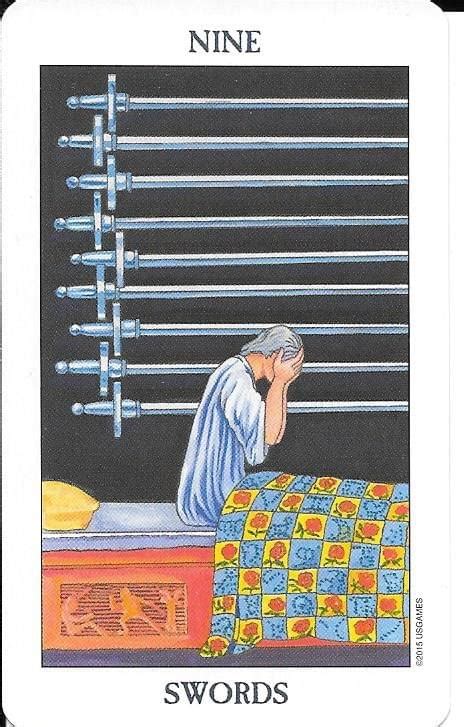
The Nine of Swords card from the Rider-Waite Tarot deck
“Divinatory Meanings: Death, failure, miscarriage, delay, deception, disappointment, despair. A complete newcomer to the tarot, if asked to describe the emotions the card generates might not come up with these exact words, but the meaning is certainly apparent, and obvious. And so goes each and every card, even the ones which describe more abstract thoughts and feelings.
Fiebig says that each card can be interpreted and seen differently depending on the individual. “Tarot is an offer for people. It’s more than just fortune telling,” he said in an interview with CNN. The image itself then is crucial to any journey with tarot, and is a major clue to understanding the enduring popularity of the Waite-Smith deck.
For example, the “Hanged Man” card is not necessarily something to fear, but can be seen as an opportunity to share, and the “Star” may not only represent light and purity, but also narcissism and rigidity. That openness has meant that the Waite-Smith deck has been reinterpreted numerous times, especially during the last decade, alongside an increasing interest in tarot practice. Creators have made decks with characters reflecting their own often-underrepresented communities across race, sexuality, gender, class, disability and more.
For Fiebig, the enduring attraction and appeal of the Waite-Smith deck stems from the cards’ ability to encourage people to encounter their own personal truths -especially in times of crisis.
Publication and Legacy
The Rider-Waite deck, as it came to be known, was published in 1909 by Rider Company in England. The cards were first published in December 1909, by the publisher William Rider & Son of London. The first printing was extremely limited and featured card backs with a roses and lilies pattern. In March 1910, a much larger printing featured better quality card stock and a "cracked mud" card back design. This edition, often referred to as the "A" deck, was published from 1910 to 1920.
All of the Rider editions up to 1939 were available with a small guide written by A. E. Waite providing an overview of the traditions and history of the cards, texts about interpretations, and extensive descriptions of their symbols. The first version of this guide was published during 1909 and was titled The Key to the Tarot.
The Thomson-Leng Tarot Cards were issued by the publishers of women's magazines during the 1930s. The deck must have been instantly popular since the book and deck were pirated by American publisher DeLaurence in 1916. Games 1971 printing is probably the closest to the original that’s available now. Before 1971, University Press was the biggest tarot publisher in the U.S, producing an easily identifiable Rider-Waite deck with an ankh on the card backs. Games deck. The Rider-Waite-Smith deck has inspired hundreds of imaginative spin-offs like the Morgan Greer, Robin Wood, Hanson Roberts, Hudes, and Aquarian decks.
It has permeated Anglo-American tarot and become the paradigm and touchstone through which we think about Tarot. Deck creators feel compelled to pay homage to this deck by modeling their designs on it. Most LWBs (little white books that accompany decks) use RWS card meanings, even when they don’t correspond to the accompanying cards. The Rider-Waite Tarot's innovative approach to symbolism and imagery had a profound impact on the tarot community. It laid the foundation for many subsequent tarot decks and interpretations.
Games Systems published a commemorative deck titled "The Smith-Waite Centennial Deck" as part of The Pamela Colman Smith Commemorative Set celebrating the hundredth anniversary of the 1909 deck. This deck notably places Smith's name first and omits the publisher's name (Rider). The original version of the Rider-Waite Tarot is in the public domain in all countries that have a copyright term of 70 years or fewer after the death of the last co-author. In the United States, the deck became part of the public domain in 1966 (publication + 28 years + renewed 28 years).
When Arthur Waite died in 1942, his obituary, published in the Brooklyn Daily Eagle, called him the author of “many books on occult phenomenon.”There was no mention of his tarot deck.
When Pamela Colman Smith died 16 years later… well, I can find no obituary for Smith.
Enter Stuart R. Kaplan, a graduate of the Wharton School of Business in 1955. “I’m all yours,”he tells me after a few weeks of missed connections on the phone, before launching into his personal history. Kaplan was working in New York City in the late 1960s, managing mines in West Virginia and Pennsylvania when he went to Germany on a business trip in 1968, ending up, out of curiosity, on his free time, at the Nuremberg Toy Fair.
Kaplan didn’t know much of anything about tarot at that point, but cut a deal to import a few thousand of the decks-known as the Swiss 1JJ tarot-to sell in the United States. Kaplan targeted large bookstores such as Brentano’s, and was successful enough in his efforts that he began looking for other tarot decks to import. In the meantime, he wrote the first of his many, many books on tarot: Tarot Cards for Fun and Fortune Telling, published in 1970. In 1971 he began to sell a Marseilles-style tarot deck, and wrote a second, more detailed book, Tarot Classic. This book delved into the history of tarot, and for the first time Kaplan wrote about Arthur Edward Waite.
Soon after, Kaplan negotiated with the British company that held rights to the Rider-Waite deck, which he says wasn’t selling decks at that point. Kaplan wouldn’t import the cards. The Rider-Waite tarot, and tarot generally, had never been widely in circulation. in Stamford, Connecticut. And when he began selling Waite’s deck, there was a slow but sure explosion. “I think the full illustrations of all the cards, including the pips, is the key to the deck’s longevity and popularity,” Kaplan says.
Games, which currently has about 50 decks in print and has published hundreds over the years, prints decks for a few years and then refreshes. “We have prevailed because we have devoted all of our attention to tarot cards,”Kaplan says. “Companies come and go: they’ll print one deck and then be gone. We have never given up,” he goes on, and because of Kaplan and his company, tarot cards are widely available and cheap. “If I see a deck on sale on eBay,” Kaplan, also an avid collector of games, rare tarot cards, and books says, “and it’s $100 or something, that upsets me. If there is a demand for an old deck that’s out of print then we’ll just bring it back.
Kaplan sold parts of his own personal collection of rare tarot artifacts at Christie’s in 2006, with some individual cards selling for thousands of dollars. Games Systems sells new decks for $20. “I think tarot is popular because each deck is an unpaged book,” Kaplan says.
The Rider-Waite Tarot deck has not only left an indelible mark on tarot history but has also become a timeless tool for personal growth, divination, and spiritual exploration.
Key Figures in the Rider-Waite Tarot
| Person | Role | Contribution |
|---|---|---|
| Arthur Edward Waite | Occultist and Scholar | Conceptualized the deck's symbolism and esoteric meanings. |
| Pamela Colman Smith | Artist and Illustrator | Created the visual representations of the cards, bringing Waite's vision to life. |
| Stuart R. Kaplan | Businessman | Popularized and distributed the deck, ensuring its widespread availability. |