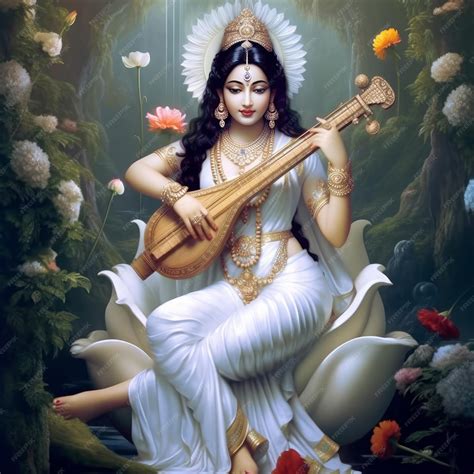
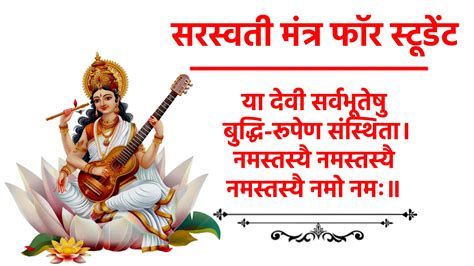
Saraswati Namastubhyam is a prayer often recited in morning prayers, especially in schools. It is a prayer dedicated to Goddess Saraswati, the embodiment of knowledge and wisdom. She is considered a force of nature, deified and believed to be responsible for the work of intelligence.
Small children are often taught this shloka (verse) when they begin their education. While it may not be as common in English medium schools in India, Indian families abroad often teach it in Sunday Schools to preserve their culture and heritage. This highlights the idea that the value of something is often realized when it is no longer readily available.
The Lyrics and Their Meaning
Here are the lyrics in Sanskrit and English, along with their meaning in English:
ऐं ह्रीम् ओम् सरस्वत्यै नमः
ॐ सरस्वति नमस्तुभ्यं वरदे कामरूपिणि ।
Read also: Understanding the Saraswati Mantra
विद्यारम्भं करिष्यामि सिद्धिर्भवतु मे सदा
ॐ श्री सरस्वत्यै नमोनमः
Aim hrīm Om Sarasvatyai Namaḥ
Saraswati Namastubhyam Varade Kaama-Roopini
Vidyaarambham Karishyaami Siddhir-Bhavatu Me Sadaa
Read also: Yoga in Fairfield County
Om Sri Saraswataye Namaha
Translation: Salutations Mother Saraswati, giver of boons, fulfiller of desires. Bless me, so that I begin my studies successfully, may there be accomplishments.
Why is she called Kāmarūpiṇī?
The term Kāmarūpiṇī has several layers of meaning:
- One who has a desirable form (rūpa): Goddess Saraswati is indeed beautiful. However, this adjective is commonly used to praise any deity that a devotee chooses.
- One who takes any form (rūpa) that she desires (kāma): This refers to the Dévī taking various forms to combat dark forces, as described in Dévī-Māhātmya. It also signifies that she takes the form in which you need learning.
Learning comes in many forms. If you focus on her, the solution to your problem will appear. The most important thing for a project is not just resources or money, but the brainpower to back it up. kAma / kāma = desire, roopa /rūpa = form.
People all over the world beseech their chosen form of divinity for blessings and favors, such as wealth and health. However, ultimately, it is we who take action. Knowledge empowers us to achieve our desires. Acquiring relevant knowledge helps us realize the boons we seek. For instance, understanding hygiene, nutrition, and exercise leads to good health, while knowing how to manage money can lead to wealth. The boon of knowledge allows us to fulfill our wishes. Knowing how to cook, for example, ensures that we do not go hungry!
Read also: Review: Jurnal Risa - A Look at the Indonesian Horror
Water flows, and that is its dharma - its defining quality. In fact, the generic term for liquid is the same as for water! Dharma is the defining quality that upholds the identity of an entity. For example, the dharma of a student is to study. Knowledge flows freely, accessible to all. Even if you turn off your TV or radio, the broadcasting waves still exist; you are simply tuned out. Similarly, to learn, you need a receiver and a tuner to tune in. The laws of nature, physics, and gravity have always existed, but Newton was the first to formulate them in the Western world.
Great scientists make discoveries and inventions based on insights that ultimately come from their own minds. Knowledge is freely available. Historically, codes and secret knowledge were used to selectively pass on information, or recipes were kept secret while only the medicine was shared. In Vedic times, the river Sarasvatī (of the Sarasvatī-Sindhu Civilization, also known as the Indus Valley or Harappa Civilization) was a hub of activity, with numerous centers of learning along its banks. Takṣhashilā (Taxila in modern Afghanistan) was home to the world’s first recorded University, complete with boarding dorms, hundreds of teachers, and thousands of students from across the known world.
A simple shloka for starting students has so much deep meaning hidden in it. Hopefully, you found it useful.
Saraswati Namastubhyam Stotra - Tutorial I English IAST I Devanagari
tags: #saraswati #namastubhyam #lyrics