Fire is considered one of the classical elements, alongside earth, air, and water. For thousands of years, fire has sparked fascination among philosophers, scientists, and all humans alike. This led to its widespread use in countless fields, such as agriculture, religion, and the occult. If you’ve ever wondered what place fire holds in history, spirituality, or even in yourself, here's a comprehensive guide to this combustible element.
Fire as a Classical Element
Fire is one of the four classical elements in ancient Greek philosophy and science. It was commonly associated with the qualities of energy, assertiveness, and passion. Fire was one of many archai proposed by the pre-Socratics, most of whom sought to reduce the cosmos, or its creation, to a single substance.
Philosophical Perspectives
Heraclitus (c. 535 BCE - c. 475 BCE) considered fire to be the most fundamental of all elements. He believed fire gave rise to the other three elements: "All things are an interchange for fire, and fire for all things, just like goods for gold and gold for goods." He described how fire gave rise to the other elements as the: "upward-downward path", (ὁδὸς ἄνω κάτω), a "hidden harmony" or series of transformations he called the "turnings of fire", (πυρὸς τροπαὶ), first into sea, and half that sea into earth, and half that earth into rarefied air.
Heraclitus regarded the soul as being a mixture of fire and water, with fire being the more noble part and water the ignoble aspect. However, Empedocles of Akragas (c. 495 - c. 435 BCE), is best known for having selected all elements as his archai and by the time of Plato (427-347 BCE), the four Empedoclian elements were well established. In the Timaeus, Plato's major cosmological dialogue, the Platonic solid he associated with fire was the tetrahedron which is formed from four triangles and contains the least volume with the greatest surface area.
Plato's student Aristotle (384-322 BCE) did not maintain his former teacher's geometric view of the elements, but rather preferred a somewhat more naturalistic explanation for the elements based on their traditional qualities. What we commonly call fire, the hot and dry element, like the other elements, was an abstract principle and not identical with the normal solids, liquids and combustion phenomena we experience.
Read also: Importance of Fire Sprinkler Room Signs
Fire in Ancient Greek Medicine
In ancient Greek medicine, each of the four humours became associated with an element. Yellow bile was the humor identified with fire, since both were hot and dry.
Fire in Alchemy
In alchemy, the chemical element of sulfur was often associated with fire and its alchemical symbol was an upward-pointing triangle.
Fire in Religion and Mythology
Agni is a Hindu and Vedic deity. The word agni is Sanskrit for fire (noun), cognate with Latin ignis (the root of English ignite), Russian огонь (fire), pronounced agon. Agni is one of the most important of the Vedic gods. He is the god of fire and the accepter of sacrifices. The sacrifices made to Agni go to the deities because Agni is a messenger from and to the other gods. He is ever-young, because the fire is re-lit every day, yet he is also immortal.
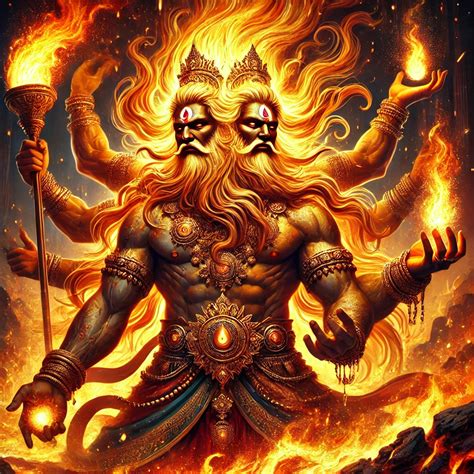
Agni is the God of Fire, channeling the fire of the sun, lightning, and hearths. The deity behind sacrificial fires, Agni was depicted as having flame for hair and two faces- one bad, one good.
In Christianity, fire is mentioned throughout the Bible and is used in rituals. One of the most well-known examples of this is Moses encountering the burning bush in the desert, following God’s voice. The Holy Fire is an Easter ceremony that takes place in Jerusalem. In the Torah, God is represented by fire above any other element.
Read also: Fire, Water, Earth, Air: A Jungian Perspective
The ancient religion of Zoroastrianism also features fire in their doctrine. Native to Iran, this religion hinges on the eternal battle of good versus evil and believes fire to be an agent of purity.
Fire in Esoteric Traditions
Fire and the other Greek classical elements were incorporated into the Hermetic Order of the Golden Dawn's system of ritual magic. Philosophus (4=7) is the elemental grade attributed to fire; this grade is also attributed to the Kabbalistic sefirot Netzach and the planet Venus. The elemental weapon of fire is the Wand. Each of the elements has several associated spiritual beings.
Fire in Tarot
Fire in tarot symbolizes conversion or passion. Many references to fire in tarot are related to the usage of fire in the practice of alchemy, in which the application of fire is a prime method of conversion, and everything that touches fire is changed, often beyond recognition. The symbol of fire was a cue pointing towards transformation, the chemical variant being the symbol delta, which is also the classical symbol for fire.
Conversion symbolized can be good, for example, refining raw ore into gold, as seen in The Devil. In the Minor Arcana, fire is associated with the suit of wands, and as such, represents passion from inspiration.
Mystery of Zodiac Fire Signs in Astrology
Fire in Astrology
In astrology, the fire signs of the zodiac are Aries, Leo, and Sagittarius. The three fire signs are Aries, Leo, and Sagittarius. In general, fire signs are passionate, expressive, generous, and joyful, brightening up any room they’re in.
Read also: Safety Tips to Prevent Fires
- Aries: Personality traits of an Aries include high energy, creativity, and courage. Some downsides include having no filter and an occasionally bad temper.
- Leo: Personality traits of a Leo include being extroverted, charming, and warm. Some downsides include arrogance, possessiveness, and superficiality.
- Sagittarius: Personality traits of a Sagittarius include being opinionated, well-rounded, and friendly. Some downsides include being emotional, overly blunt, and flakey.
The five elements are wood, metal, water, earth, and fire. Those born under fire have a reddish complexion, thin face, and muscular backs. Fire types are the most joyful of the elements. They're extroverted and seek out pleasure. They don't care for material possessions. They are smart and seek beauty in the world.
Highly emotional, fire types love drama and are easily bored. They constantly look for stimulation and often get restless. They need to be surrounded by people in order to feel happy. Since fire governs the heart and stomach in Chinese medicine, fire types are therefore believed to be more prone to certain cardiovascular and digestive issues.
Go outside during the day to recharge your fiery batteries. You can lay out on blanket to catch some rays, go for a walk, have a picnic in the park, or sit al fresco at a coffee shop. If you have access to a fireplace, light a fire and sit by it. The beauty and warmth of the flickering flames can promote a sense of calm and meditation, very necessary for high anxiety fire types.
Fire in Traditional Chinese Medicine (TCM)
In Traditional Chinese Medicine (TCM), the five elements theory forms a fundamental framework for understanding the balance and harmony within the human body and its surroundings. Fire symbolizes transformation, warmth, and vitality. It is associated with the summer season, the most Yang time of year, bringing forth vibrant energy, brightness, and movement.
In TCM philosophy, the Fire element is linked to various aspects of human life, including passion, joy, compassion, and the ability to connect with others. In the Five Element cycle, the Fire phase is the stage of peak power, a celebration of that which has become. In nature, heat speeds things up and promotes activity, making life and growth possible.
The Fire element in TCM is primarily represented by two organs: the Heart and the Small Intestine. The Heart, known as the Emperor of the body, is considered the residence of the spirit and its proper function is essential for emotional well-being. It governs blood circulation, controls sweat, and houses the mind.
The Fire element represents warmth, connection, and the ability to foster relationships and community bonds. It embodies the spirit of enthusiasm, joy, and sociability. Effective communication and expressing emotions are key attributes of the Fire element. It supports heart-to-heart connections and the sharing of feelings and ideas. In fact, the Fire element is often seen in those who inspire and lead others. Community events, celebrations, and gatherings often reflect the Fire element.
Maintaining Balance of the Fire Element
Maintaining the balance of the Fire element is essential for overall health and vitality. During the summer, it is beneficial to consume foods that have a cooling effect on the body and help balance the excess heat. To counterbalance the heat, it is essential to stay properly hydrated. Drink plenty of water, herbal teas, and diluted fruit juices throughout the day.
It is important to take care of your heart health during the summer. Engage in activities that promote relaxation, such as meditation, yoga nidra, deep breathing exercises, gentle yoga, sound bath or massage. Summer is a time of increased energy and activity, but it’s important to find a balance between being active and allowing yourself to rest. Overexertion can deplete your energy reserves and potentially lead to imbalances.
While enjoying outdoor activities in the summer, protect yourself from excessive heat and sun exposure. Use sunscreen, wear light-colored and breathable clothing, and seek shade during the hottest parts of the day.
Fire in Personal Mythology
In personal mythology, Fire represents the untamable life force, the divine spark that animates and inspires. To have Fire as a central element in your mythos is to tell a story of intensity. Your narrative may be one of passion, not of gentle affection; of sudden, blazing epiphanies, not gradual understanding. Life may not be a placid river but a series of bonfires, each marking a significant transformation, a burning away of a former self.
This archetype could suggest a belief that the psyche, like a forest, requires periodic fires to clear out the underbrush of old traumas and outdated beliefs, allowing for new, more resilient growth to emerge. The symbolism of Fire is inherently dual. It is the comforting hearth at the center of the home, a symbol of community, warmth, and security. Yet it is also the wildfire, a terrifying, indiscriminate force of nature.
This polarity may live within the individual. You might see your role as providing a gathering point of light and warmth for your circle, a source of creative energy and inspiration. Simultaneously, you may harbor a deep awareness of your own potential for destructive rage, for words that scorch and actions that consume.
Ultimately, Fire symbolizes a connection to the sacred and the primal. It is the burning bush of revelation, the alchemist’s flame, the phoenix’s nest. Its presence in one’s mythos could point to a life path that is less about accumulating and more about refining: burning away impurities to get to the core of one’s being.
Fire’s Relationships with Other Elements
The relationship between Fire and Water, particularly in its form as the vast and deep Ocean, is one of primal opposition and paradoxical synergy. They are forces that can extinguish one another, a meeting of pure energy and pure mystery. In a personal mythos, this may manifest as a core tension between the impulse to act, to burn, to express (Fire), and the urge to feel, to reflect, to sink into the subconscious depths (Ocean).
A person holding both might feel perpetually caught between a life of passionate engagement with the world and a deep, solitary call to inwardness. Fire’s relationship with the Wind is one of dangerous codependence. Wind can nurture a tiny spark into a roaring blaze or extinguish a mighty flame with a single gust. For the Fire-aligned individual, this could symbolize a profound sensitivity to external forces: to the words of others, to the currents of public opinion, to the winds of fate.
Their inspiration and passion (Fire) may feel powerfully amplified by collaboration and encouragement (the Wind that feeds the flame). Conversely, they might feel snuffed out by criticism or a sudden change in circumstance. Fire and Mountain exist in a dynamic of transformation and endurance. Fire can reshape the surface of a Mountain, burning its forests to the ground, but it cannot destroy the Mountain itself.
The Mountain, in turn, contains the fire, its stone providing a crucible that directs the flame’s path. In a personal narrative, this could represent the interplay between a volatile, transformative personality (Fire) and the unchangeable realities of life or the stable structures they build (Mountain). One might feel a constant urge to change their career, their relationships, their very identity, while simultaneously relying on the immense stability of their home, their core principles, or a lifelong partnership.
The Fire Archetype in Action
When a project feels cold and inert, the Fire archetype suggests not gentle coaxing but a controlled burn. You may need to metaphorically set fire to the first draft, abandoning precious but unworkable ideas to clear the ground for new growth. To end a significant connection through the lens of Fire is to choose a swift, clean break over a slow, painful dissolution. It is the cauterizing of a wound. This approach recognizes that some bonds, when they become unhealthy, must be fully severed to prevent lingering infection.
The Fire archetype in a social context is the spark of revolution or the illuminating flame of truth. It is speaking an incendiary, necessary reality in a room of comfortable falsehoods. It could mean organizing a protest, publishing a provocative piece of art, or simply refusing to be silent about injustice. Fire is the elemental agent of change. It does not merely alter a substance; it transmutes it into something new: wood to ash, sand to glass, ignorance to awareness.
Before it is a force of heat, fire is a source of light. It reveals what is hidden in the darkness, symbolizing knowledge, consciousness, and the sudden flash of insight that can reorient an entire life. Fire’s power is inseparable from its danger. It consumes, it purges, it destroys.
The Fire-Driven Life
When Fire is a dominant force in your personal mythology, your life story is unlikely to be a linear progression. It may read more like a collection of dramatic turning points, each marked by a symbolic fire that consumed a previous identity. The narrative arc is one of reinvention. The move across the country wasn’t just a change of scenery; it was a self-immolation of a past life. The end of that major relationship wasn’t a quiet parting; it was burning a bridge to ensure there was no return.
Your mythos is episodic, favoring the sudden blaze of a new passion or career over the slow, steady build. This mythos is often centered on a core event of transformation, a “first fire” that defined the pattern. Perhaps it was a youthful moment of speaking a terrifying truth, a creative breakthrough born from desperation, or a crisis that burned away all illusions. This event becomes the central chapter in your sacred text, the story you return to in order to understand your own nature.
Subsequent life events are interpreted through this lens: every success is a well-tended flame, every failure a moment of near-extinguishing, every new beginning an act of striking a match in the dark. Your perception of self, if informed by Fire, may be one of a vessel for a powerful, almost alien energy. You might not feel entirely in control of your own passions or inspirations; they seem to arrive in flashes, demanding expression.
This can lead to a self-concept that is both exalted and precarious. On one hand, you may see yourself as a conduit for creativity, a catalyst for change in the lives of others, a source of warmth and light. You might identify with your own intensity, viewing it as the most authentic part of your being. On the other hand, there might be a fear of this internal furnace. You may feel a deep-seated anxiety about your own temper, your impulsivity, or your capacity to hurt others with a sharp, burning honesty.
This could create a bifurcated self-image: the “good” fire of the hearth (creative, warm, communal) and the “bad” fire of the wildfire (destructive, angry, out of control). The journey of self-development becomes about integration: learning that the same energy that fuels a masterpiece can also fuel a devastating argument.
Worldview of the Fire Archetype
A worldview shaped by the Fire archetype is one that sees reality as fundamentally dynamic, fluid, and defined by transformation. The world is not a static set of structures but a crucible of constant change. You may believe that progress, on both a personal and societal level, requires periodic destruction. Old institutions, outdated traditions, and limiting beliefs must be metaphorically burned down to make way for new, more vital forms.
This worldview may also have a cynical or impatient edge. There might be a deep frustration with stasis, with bureaucracy, with anything that feels slow, cold, and resistant to change. You might view stability not as a virtue but as a form of stagnation, a slow death. The world may appear to be divided between those who carry a flame and those who seek to extinguish it.
This can lead to a perception of life as a constant struggle to protect one’s own inner light from the dampening forces of conformity, apathy, and fear. In relationships, the Fire archetype manifests as a desire for intensity, passion, and transformative connection. You are likely not drawn to placid, comfortable partnerships but to those that challenge, energize, and change you.
The process of falling in love might feel like a conflagration, a sudden and total merging of energies that is both thrilling and a little frightening. You may offer immense warmth, encouragement, and a contagious zest for life to your partners, friends, and family, acting as the hearth around which they gather. However, this same intensity can be the source of relational difficulty.
A need for constant high energy can lead to burnout, both for you and for those who cannot match your pace. Your passion can easily tip into drama, and your honesty can feel scorching to more sensitive souls. There may be a pattern of relationships that burn incredibly bright and then flame out just as quickly, leaving behind a sense of emptiness.
If Fire informs your personal mythos, you may perceive your role in life as that of a catalyst. You are not the person who maintains the status quo; you are the one who disrupts it for the sake of progress. Whether in your family, your workplace, or your community, you might subconsciously take on the role of the truth-teller, the one who points out the uncomfortable reality that everyone else is ignoring.
Your purpose feels tied to action, to initiation, to starting the project, the conversation, or the movement. This role can be both a blessing and a burden. It brings a sense of profound purpose: you are here to make things happen, to bring light to darkness, to warm a cold world. However, it can also be an isolating position. Catalysts are often seen as troublemakers, and the truths they tell can make them unpopular.
Dreams of Fire
To dream of fire in a positive context is often to witness your own life force in its purest form. A controlled fire, such as a bright candle in a dark room or a warm, crackling hearth, could symbolize a dawning of consciousness, a potent new idea, or a reconnection with your deepest passions. It may suggest that your creative energies are flowing well and that you are on a path of authentic self-expression. Cooking over a fire in a dream can point to the nourishment you are receiving from your work or relationships, suggesting a healthy transformation of raw potential into something life-sustaining.
Conversely, a fire dream in a negative context speaks of uncontrolled, destructive energy. A dream of your house burning down may not be a literal premonition, but a stark symbol of burnout, overwhelming stress, or a family conflict that is consuming your sense of safety. Being chased by a wildfire could represent a feeling of being overwhelmed by your own rage, or by external circumstances that are spiraling out of your control. If you are the one setting the fire indiscriminately (arson), your subconscious may be warning you about your own destructive impulses, perhaps a desire to burn bridges or sabotage your own success out of anger or fear.
Physiological Needs
When Fire is woven into your mythos, your physiological needs may feel more acute and demanding. There can be a sense that your body is a furnace that requires high-quality fuel to burn brightly. You might have a naturally fast metabolism or feel a deep, almost primal need for foods that are energizing and warming. A lack of this vital energy doesn’t just feel like tiredness; it can feel like a profound coldness, a dampening of the spirit that manifests as physical lethargy and a dulling of the senses.