One of the most important ancient Egyptian symbols in the history of ancient Egyptian civilization is the Egyptian Scarab Beetle, which was featured in ancient Egyptian art, iconography, and ancient Egyptian religion. It represented life, regeneration, and resurrection.
The scarab is known to have deep meaning and rich symbolism that was essential to the society of the ancient Egyptians. It was worshipped by a sun god named Khepri, who was referred to as Ra, the creator of the cosmos. It was the true embodiment of the divine manifestation of the morning sun. Its behavior of emerging from dung balls represents the cycle of life and death.
The scarab beetle was depicted as pushing the sun across the sky with a deep connection to Ra, which symbolizes renewal each day. The symbol became directly associated with the divine manifestation of the sun god Khepri, the assistant of Ra, who rolls the morning sun disk over the eastern horizon at daybreak.
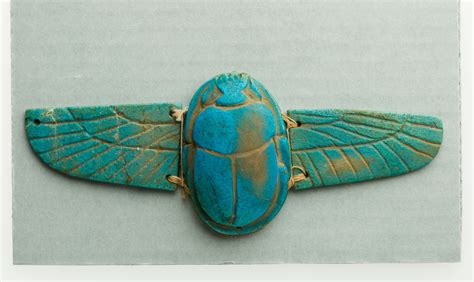
Winged Scarab. Image courtesy of The Walters Art Museum.
Materials and Craftsmanship
The Egyptian Scarab Beetle was carved from stone or molded from Egyptian faience; they would first be carved from glazed blue or green and then fired up. A soft stone called Steatite that hardens when fired is called Steatite. The most common scarabs were the hardstone made from amethyst, green jasper, and carnelian.
Read also: Ancient Egyptian Scarab Symbol
Although all early Egyptian scarabs were crafted in stone, their increased popularity and significance through time yielded more diversity in material and craftsmanship. As they became more popular, scarabs were produced in faience and steatite as well as gemstones including turquoise, amethyst, green and red jasper, lapis lazuli, to name a few.
Uses of the Scarab Beetle
The scarab was found in everything from amulets to hieroglyphs, sculptures, jewelry, amulets, and various works of art. Scarabs served as protective amulets and talismans, which were crafted from various materials and inscribed with blessings or magical spells that were believed to bring good luck, ward off evil, and ensure a safe journey into the afterlife, plus offer a gateway to a new form of existence. It was even placed among mummy wrappings or worn as jewelry, which provided protection and guidance for the deceased.
Scarabs were used as seals, with designs or inscriptions carved on their flat bottoms to create impressions in clay or other materials. These seal impressions were used for administrative, religious, or personal purposes, serving as marks of authenticity or ownership. Scarabs were also employed to commemorate events or convey political and personal statements.
As the scarab evolved, so did its use. While scarabs had begun as seals and amulets, they began to circulate as decorative objects during the Middle and Late Kingdoms. They were often used as charms for items such as necklaces, tiaras, bracelets, rings, and earrings. It was also used as furniture decoration.
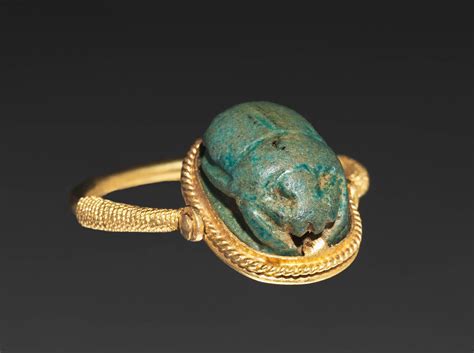
Scarab Ring. Image courtesy of The Walters Art Museum.
Read also: Rebirth in Ancient Egypt
Types of Scarabs
The types of scarabs found in Egypt vary as each type was used for a different purpose across the ancient Egyptian social fabric:
- Heart Scarabs: Placed on the chest during mummification, which replaces the heart and contains spells from the Book of the Dead to aid the deceased in the afterlife.
- Funerary Scarabs: Associated with burial rituals that were placed among mummy wrappings or worn as jewelry, featuring inscriptions about protection and resurrection.
- Amuletic Scarabs: Worn for protection and featured symbols or inscriptions of protective spells. They were carried as charms by individuals seeking the beetle's symbolic protection.
- Administrative Scarabs: Used as seals for documents that bear the owner's name and authenticated administrative or legal paperwork when pressed into clay or other materials.
- Name Scarabs: Personal identifiers featuring the names and titles of individuals, used by officials and elites to mark possessions or as a form of personal branding.
- Transformational Scarabs: Depicted a beetle pushing a solar disk, symbolizing the sun's journey and transformation; these scarabs were associated with the solar aspects of the scarab beetle and linked to the sun god Ra.
Some of the pectoral funerary Egyptian scarabs featured birds’ wings to ensure rebirth of the deceased and peaceful flight into the afterlife. They were also an additional link to Khepri, who was sometimes shown with bird’s wings.
Historical Significance
They were extremely rare, but by the time of Egypt's middle kingdom (1938 1630 BC), they were created in great numbers where they were used as ornaments and an amulet, especially in Egypt's new kingdom (1539-1075 BC) as large Scarab was placed in the bandages of Egyptian mummies to represent the heart of the deceased. The Scarab was shaped like a seal, and there were many clay sealings.
The Egyptian Scarab Beetle was used to describe the titles of officials, places, and even different deities. When combined with a prayer like "With Ra Behind There Is Nothing To Fear" it was considered a sign of a good omen. Most of the names of the Hyksos dynasts have been known due to the recovered collections of Scarabs.
Pharaohs also used scarabs to link themselves with divinities. Most notably, Amenhotep III (1390-1352 BC) produced rich glazed faience scarabs during his reign to commemorate his first year on the throne. He then subsequently released other scarabs in groups for his various achievements. He produced a group of ‘Lion Hunt’ scarabs to represent his strength in lion hunting, and ‘Bull Hunt’ scarabs for bull hunting.
Read also: Understanding anemia spiritually
With increased interaction between ancient Egypt and the surrounding areas of the Mediterranean, scarab manufacturing spread to other civilizations.
Ancient Egyptians believed that when a person died and underwent their final judgement, the gods of the underworld would ask many detailed and intricate questions which had to be answered precisely and ritually, according to the Book of the Dead. Since many ancient Egyptians were illiterate, even placing a copy of this scroll in their coffin would not be enough to protect them from judgment for giving a wrong answer. As a result, the priests would read the questions and their appropriate answers to the beetle, which would then be killed, mummified, and placed in the ear of the deceased.
Amenhotep III (the immediate predecessor of Akhenaten) is famed for having commemorative scarabs manufactured. These were large (mostly between 3.5 cm and 10 cm long) and made of steatite, a grayish-green or brown colored talc. These scarabs were intricately crafted, created under royal supervision, and carried lengthy inscriptions describing one of five important events in his reign (all of which mention his queen, Tiye). More than 200 of these have survived, and the locations in which they have been discovered suggest they were sent out as royal gifts and propaganda in support of Egyptian diplomatic activities. The crafting of these large scarabs was a continuation of an earlier Eighteenth Dynasty tradition of making scarabs to celebrate specific royal achievements, such as the erection of obelisks at major temples during the reign of Thuthmosis III.
Scarabs are often found inscribed with the names of pharaohs and more rarely with the names of their queens and other members of the royal family. Generally, there is a correlation between how long a king or queen ruled and how many scarabs have been found bearing one or more of their names. Famously, a golden scarab of Nefertiti was discovered in the Uluburun ship wreck.
Most scarabs bearing a royal name can reasonably be dated to the period in which the person named lived. However, there are a number of important exceptions. Scarabs have been found bearing the names of pharaohs of the Old Kingdom (particularly of well-known kings such as Khufu, Khafre and Unas).
Scarabs have also been found in vast numbers bearing the throne name of the New Kingdom King Thutmose III (1504-1450 BC) Men Kheper Re. Many of these scarabs date from the long and successful reign of this warrior pharaoh or shortly thereafter, but the majority do not. Like all pharaohs, Thuthmosis was regarded as a god after his death. Unlike most pharaohs, his cult, centered on his mortuary temple, seems to have continued for years, if not centuries. As a result, many scarabs bearing the inscription Men Kheper Re are likely to commemorate Thuthmosis III but may have been produced hundreds of years later.
Later pharaohs adopted the same throne name (including Piye of the Twenty-fifth Dynasty, 747-716 BC) leading to some confusion. The hieroglyphs making Men Kheper Re seem to have become regarded as a protective charm in themselves and were inscribed on scarabs without any specific reference to Thuthmosis III. It can be doubted that in many cases the carver understood the meaning of the inscription but reproduced it blindly. On a lesser scale the same may be true of the throne name of Rameses II (1279-1212 BC) User Maat Re ("the justice of Ra is powerful"), which is commonly found on scarabs which otherwise do not appear to date from his reign.
The significance of a scarab bearing a royal name is unclear and probably changed over time and from scarab to scarab. Many may simply have been made privately in honor of a ruler during or after his lifetime. Some may also have been royal gifts. In some cases, scarabs with royal names may have been official seals or badges of office, perhaps connected with the royal estates or household. Others, although relatively few, may have been personal seals owned by the royal individual named on them.
Anra scarabs are scarab seals dating to the Second Intermediate Period.
Phoenician seal engravers adopted the scarab from the Egyptians in the period of the Achaemenid Empire empire, from the later sixth century BC to the mid-fourth century BC. Phoenician scarabs were carved with not only Egyptian themes, but also Etruscan and western Greek imagery.
Group of Scarabs. Image courtesy of The Metropolitan Museum of Art.
Modern Significance
Although the scarab does not hold religious significance in modern Egypt, it still exists as a cultural symbol. Tourists visiting Egypt flock the markets and souvenir shops to buy modern replicas of scarabs, amulets, and papyrus scrolls. Also popular are jewelry featuring the scarab as a link to antiquity and as a charm for protection and luck.
Scarabs were revered as some of the most powerful symbols in all of ancient Egypt, adorned in necklaces and fine jewellery by both the living and the deceased. To this day, scarab amulets, and necklaces in particular, are universally recognised and considered an emblem of rebirth and regeneration.
Yes, in fact, there is quite a demand for Egyptian scarabs, and they can vary considerably in price, size, and material. The large auction houses, Sotheby’s and Christie’s, and England’s Bonhams are venues that offer Egyptian scarabs in their sales. Like anything else of value, some forgeries reach the market.
Scarabs in Popular Culture
The scarab is also present in modern pop culture.
- In Dungeons and Dragons, there is a magic item called the Scarab of Protection. It protects its wearer against deathly curses and similar effects, usually caused by undead monsters and necromancy.
- Scarabs appear in droves in Tomb Raider: The Last Revelation.