The Hierophant is the fifth card of the Major Arcana, representing tradition, spiritual teaching, community wisdom, and the bridge between the sacred and the everyday.
If the Hierophant appears in a Tarot spread as a person, that means that this person is a guide or mentor, embodying traditional values and established beliefs. They are often seen as a bridge between the spiritual and the mundane, offering wisdom and guidance based on long-held traditions and practices.
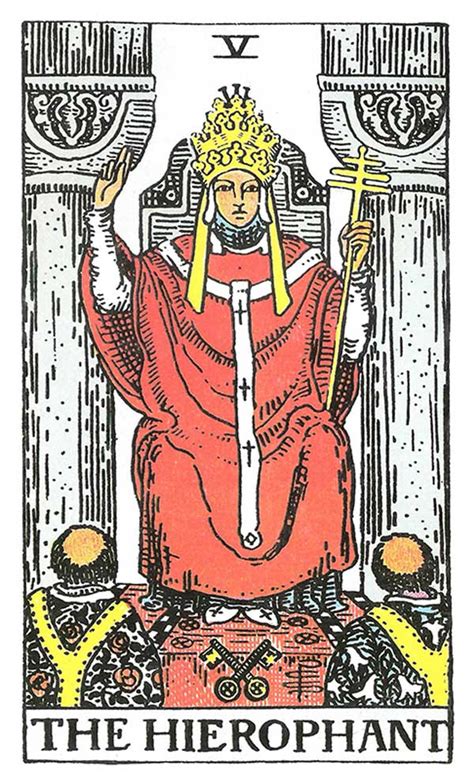
In many decks the Hierophant is represented by a priest or other religious figure, and in older decks this card was simply titled Le Pape (the Pope). But this card is not just about religion, it is about any sort of group identity. This card can even be associated with mystical or occult belief systems.
At his best, the Hierophant brings forth passion-infused teachings and order. This card sometimes receives a negative connotation for its association with belief systems that are forced upon, but in a positive sense this card reminds us of our power to define our own belief systems.
When the Hierophant appears, it may be useful to consider your relationship with societal authority figures. Would it be beneficial for you to engage in ritual or learn from an expert? This card can also ask you to revisit your own belief systems. Our pre-determined thoughts and viewpoints are always influencing us, and this influence often takes place on an unconscious level.
Read also: Encountering the Same Person
Core Meaning of The Hierophant in Tarot
The Core Meaning* of The Hierophant in Tarot is institution.
When I say "institution" I'm not only referring to an organization, though I'm not excluding it. I am also referring to an established practice. What, pretty much like the Church, is, or has been part of the landscape for a long period of time and has a set place in the world, society, or ultimately in the context of a reading, in the situation at hand.
This card in real-life has a nuance of permanence, though it is not to be mistaken with progress. While it can settle things down, it can also speak of a situation that will not develop further. It represents what's accepted as it is by virtue of habit and not necessarily by merit.
It's All About the Context! The Meaning of The Hierophant in Diverse Situations.
Attitudes and Behaviours
- Supports: A conservative approach to situations and challenges. Sticking to true-and-tested ways of making things work. Approaching institutions with reverence. Staying within the traditional. Working with institutions for the improvement of the circumstances of the people.
- Warns Against: Following traditionalism without criteria. Valuing institutions over people. Zealotry. Maintaining a façade at all costs. Using tradition to achieve one's ends or oppress.
The Hierophant can symbolize not only organized religion, but schools, businesses, and any kind of societal structure.
Read also: Missing Person Dream Interpretation
The Hierophant as a Personal Strength and Weakness
- Strength: Being stable and well-grounded. Able to adapt in a hierarchy. Able to find happiness in what is.
- Weakness: Too bound by societal / familiar / self-imposed expectations to break free. Overly conformist.
The Hierophant as a Personality
Usually strict and rule-abiding, good at presenting a front of having everything together. It represents a person that adapts easily to structures and can easily identify their role within an organization. This person usually lives by their values, even if they aren't always sure if those are inherited values that they have not subjected to inner scrutiny or their own.
Humans are naturally wired to form communities and going against society’s belief systems can be scary or even dangerous. But at its best, the Hierophant shows that group identities can be helpful. We can learn from the right authority figures, and participating in traditions and rituals can help us cultivate our individual sense of self.
The Hierophant in Relationships
- Describes a relationship: It represents a stable relationship, for sure, in which each partner's roles are very well defined. However, in situations in which things are not progressing or in relationships that lack commitment, it can be a sign of stagnation, unless there are cards around that support an evolution.
- Describes a break-up: A Hierophant break-up is the equivalent of excommunication. This is usually a break-up that has been well-thought of, and in which the person is not only certain about the decision but also willing to cut ties and apply zero contact. It can also speak of official separations.
The Hierophant in Problems and Opportunities
- Describes a problem: A widely-known issue that has been going on for a long time but it so deeply intertwined in the situation that it is hard to separate the good from the bad. A known downside.
- Describes an opportunity: A grant or scholarship. A tenure or long-term opportunity that comes from institutional channels. Alternatively, it can be a volunteering opportunity.
The Hierophant in Career and Academics
- Career Option: Legacy careers (a family of doctors, lawyers...) Institutional careers. Dean or head of a department. Upper management. Church related position. Working in a well-established company or multinational.
- Academic Option: Theology. Latin or classic languages. Ivy League / Legacy. Higher Studies. University. Formal education.
An Aritst: "Where there is no vision the people perish"- art provides the central vision - a focal point, a canvas from which all can learn, understand and disseminate the cultural norms.
The hierophant is rich in color, and deep hues as well as the depth of understanding, it need to effectively use all these tools to penetrate the diversity of the masses. I also see 5 as a great struggle, strife, sometimes even alienation, but the struggle is one of coming to an understanding after the bottoming/resting/ or attaining the norm of the fours, Five knows there is more and the struggle has only just begun. This is we move beyond self, and into other and commence the slow integration into the whole.
Artist are the glue that holds society together. They create the vision and understanding and make it easy to digest. YDM42... wow, an artist! Yes, I can see this... I could see this as the spiritual center of a foundation, I'm visualizing a cube with that steeple, a light beaming upward... that attracts and draws the focus to the center... into a single point of light.
Read also: Dead People and Gifts in Dreams: Explained
This could be a spiritual leader or since 5 is also the sign of man, a leader of the community, even of family, be it the nuclear family group or the family of man. Someone who has strong beliefs and values and seems to stand between opposite extremes. Perhaps in that case a moderate... or mediator between the common folk and a higher authority.
The Hierophant in Different Aspects
| Aspect | Description |
|---|---|
| Physical Characteristics | Respectable and dignified, with a presence that commands reverence and exudes wisdom. Their appearance may be marked by traditional or symbolic attire, reflecting their role as a keeper of age-old wisdom. |
| Emotional Characteristics | Stable, reliable, and often conservative in their emotions, valuing tradition and order. They approach life with a measured and thoughtful demeanor, often preferring the known paths to uncharted territories. |
| Astrological Influences | Likely influenced by Taurus, reflecting a love for tradition, stability, and practical wisdom. Their astrological chart may emphasize the importance of stability, practicality, and a methodical approach to life. |
| Career Paths | Works as an educator, religious leader, or in any role that involves imparting knowledge and upholding traditions. They are often found in positions where they can share their wisdom and guide others, be it in academic, religious, or cultural institutions. |
The Hierophant as a person represents someone who makes you feel guided and supported in your spiritual or moral journey, often providing a sense of structure and tradition. Their influence brings a sense of order and meaning, helping to navigate complex moral or spiritual landscapes.
The Hierophant Reversed as a Person
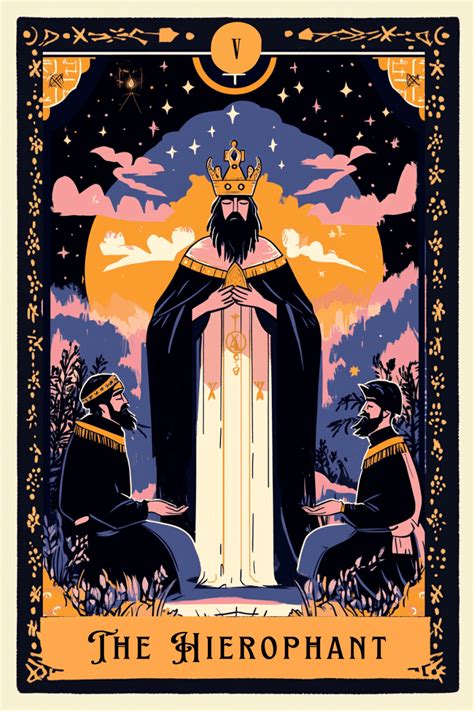
If the Hierophant reversed appears in a Tarot spread as a person, that means that this person is challenging traditional norms, or may be overly rigid in their beliefs. This reversal suggests a questioning of established systems or an inflexibility in adapting to new ideas.
Characteristics of the Reversed Hierophant
| Aspect | Description |
|---|---|
| Physical Characteristics | May appear unconventional or non-conformist, sometimes rebelling against traditional standards. Their appearance might defy societal norms, reflecting their challenge to conventional wisdom and practices. |
| Emotional Characteristics | Either too dogmatic or rebellious, often struggling with established norms and expectations. They may exhibit a rigid mindset, unwilling to consider alternative perspectives, or they might reject all forms of tradition, seeking to redefine their beliefs and values. |
| Astrological Influences | Grappling with the restrictive elements of their Taurus influences, like stubbornness or resistance to change. Their astrological chart may highlight a tension between the need for stability and the desire for progress, leading to internal conflicts or a struggle to adapt. |
| Career Paths | Works in fields where they challenge the status quo, or alternatively, where they are overly dogmatic. In the first case, they might be found in roles that advocate for reform or innovation, often questioning and redefining existing structures. |
The Hierophant reversed as a person represents someone who makes you feel either liberated from conventional beliefs or constrained by overly rigid ideologies. Their presence challenges you to examine your own relationship with tradition and change, prompting a reevaluation of your beliefs and values.
Hierophant Tarot Card Meanings
The RWS Hierophant is, as per usual, a visual feast of symbolism, with one of the most prominent symbols being the keys. Keys are such a core (key, lol) part of the Hierophant’s message that of my 120 odd decks (don’t judge me!), it’s unusual to find one that doesn’t feature them! The metaphor is pretty obvious - keys unlock things, and the Hierophant holds the keys to unlock spiritual knowledge and wisdom, the “keys to the kingdom of heaven”.
The keys can also be linked to Hades, who was another figure viewed as the holder of the keys to heaven (higher consciousness) and hell (unconscious or instinctual life). While he owns spiritual knowledge, he’s not hoarding it or keeping it all to himself. Instead he lays the keys before us in a gesture of giving.
The traditional RWS card also features two clergymen, kneeling before the Hierophant (you can see them sneaking into frame in the Broken Mirror Tarot, above) - one dressed in red roses, one in white lilies. The white lilies are meant to represent our spiritual life, and the red roses our physical life, with red being the colour of the blood that carries all we need around our bodies.
The Hierophant is between the two (ah, yes, Tarot’s favourite theme: BALANCE!) He doesn’t pertain absolutely to either one, any more than the High Priestess pertains to either one of her pillars. As the ‘teacher’ of the deck, part of The Hierophant’s job is to teach opposites what they need to know about each other. He is the ‘Earth’ that is between Heaven and the Underworld, the middle path between reason and intuition. And without The Hierophant’s wisdom and, yes, pomp, such opposites can’t understand each other.
The Hierophant, as Wang points out, is the one that everyone listens to. When he speaks, every one goes quiet and pays attention to what he has to say. When things are going wrong in the world, it is The Hierophant who “wades in, quiets the panic, and offers good, practical advice, as well as spiritual assurances. He is the teacher, therapist, counsellor, advisor, priest, or rabbi.
These cards illustrate to us that when the Hierophant turns up in a reading he is often asking us to seek guidance. He reminds us that problems are much bigger than us as individuals, and we can’t always fix them alone.
The Hierophant asks us to seek guidance, and embrace the wisdom passed down to us from those who came before. Tradition connects us to our culture and our lineage, “it’s grandma’s recipes, regional folk tales, and even how we celebrate birthdays…
Jessica Dore thinks this connection to all that has come before us is a key part of the Hierophant’s message, and that, when we see this card, it is a reminder of the importance of spiritual practice: “spiritual practice is a way of practicing relationships; it’s how we position ourselves as at once important and not all-powerful.
Positive meaning: the Hierophant speaks of long term relationships and even marriage. Positive meaning: a person in a position of power is playing an important role in your career. Positive meaning: Stability is in the cards. Positive meaning: the Hierophant is a spiritual guide or leader, a teacher, father figure. A man in a position of power in your work life.
The Swords and the Hierophant are often a heavy association.
Remember to take what works for you and question what doesn’t. I’ve tried to arrange these keywords by broad concept to help organize them and make them easier to learn.
Keywords
- Education, Knowledge, Experience
- Spiritual leadership, Religion, Doctrine, Divine masculine
- Stability, Institution, Hegemony, Gatekeeping
- Tradition, Community, Ancestry
- Taurus, Earth
Both are traditionally masculine figures of order and control, but their control is different: the Hierophant typically “rules” over a religion or school or other organization where there is a willing population who has consented to the organization whereas the Emperor rules over an area, and your consent to be governed doesn’t matter.
The Emperor is typically born into the role or conquers his way into that role, but the Hierophant is elected based on relevant qualifications, such as education and experience. As such, the Hierophant is often associated with expertise and the control that goes with organizing a tradition or community of the likeminded rather than domination.
As an elected or appointed leader, the Hierophant rules by consent, but he is the head of the hierarchy, so he does not rule by consensus. It’s an important distinction from the Lovers because the Hierophant is not engaged in a partnership with an equal peer as the Lover(s) is.
With that, there’s also a bit of a contrast between the maturity of the Hierophant and the youth of the Lovers, but that may be a minor factor when reading these cards.
We have the High Priestess and the Empress representing the divine and material feminine, and we have the Emperor and the Hierophant representing the material and divine masculine. They create natural pairs, and it places the High Priestess and the Hierophant as complementary archetypes.
The Hierophant is the tarot card that represents Taurus, so it is associated with the element of earth. The two other earth signs are Virgo and Capricorn, represented by the Hermit and the Devil, respectively, and we’ll look at those first because they’re pretty informative. Both carry forward the idea of wisdom, divine knowledge, and control.
The Hermit is a useful counterpoint to add to the pairing of High Priestess and Hierophant. If the Hierophant were to go off into a cave, then he would lose his public-facing power.
In this depiction of the Hierophant, our spiritual leader appears as a kind of personified lighthouse. A floral light appears around the muse’s head, and a similar design appears like the setting or rising sun, suggesting celestial wisdom and a connection point between human and divine.
With the Hierophant, it’s always worth asking what kind of wisdom or community or connection the leader offers. Is it spiritual, religious, educational, commercial, or something else?
tags: #the #hierophant #as #a #person