In the rich tapestry of Norse mythology, the Norns stand as enigmatic figures, wielding immense power over the destinies of gods and mortals alike. They are the weavers of fate, shaping the course of existence with their intricate designs. Let's delve into the world of the Norns, exploring their origins, roles, and significance in Norse belief.
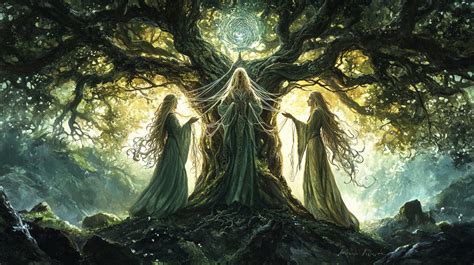
Mímer and Balder Consulting the Norns (1821-1822) by H. E. Lindeberg.
Origins and Etymology
The Norns spin the threads of fate at the foot of Yggdrasil, the tree of the world. The origin of the name norn is uncertain; it may derive from a word meaning 'to twine', which would refer to their twining the thread of fate. Bek-Pedersen suggests that the word norn has relation to the Swedish dialect word norna (nyrna), a verb that means 'communicate secretly'.
There are a number of surviving Old Norse sources that relate to the norns. The most important sources are the Prose Edda and the Poetic Edda.
The Three Principal Norns
Of the many Norns believed to exist in the realms, three sisters inspire more fear and awe than all the others together. They are Jötnar, giantesses, who have been given the role of commanding the fate of all nine realms. Their names are revealed in the Voluspa. They are Urd, Verdandi, and Skuld.
Read also: The Meaning of Jewish Luck Symbols
- Urðr: (Old English: Wyrd, 'weird') means 'fate'. Wyrd and urðr are etymological cognates, a situation that does not mean necessarily that wyrd and urðr share the same semantic quality of "fate" over time. Urðr also known as Udr and Urd, means ‘fate’ or ‘what has passed’. She is the oldest in appearance, a crone, and always looks backward to the past.
- Verðandi: Both Urðr and Verðandi are derived from the Old Norse verb verða, 'to become', which itself derives from Proto-Germanic *wurdiz, from Proto-Indo-European *wrti-, which is a verbal abstract from the root *wert- ("to turn"). Often, it is asserted that while Urðr derives from the past tense ('that which became or happened'), Verðandi derives from the present tense of verða ('that which is happening'). Verðandi, also known as Verdandi, means ‘what is passing into being’. She is young in appearance, strong and determined, looking fearlessly straight ahead as she weighs up the actions of the day.
- Skuld: The name of Skuld derives from the Norse verb skulu meaning ‘need/shall/must come into being’. Skuld means ‘what shall come to pass’, and is the most feared, least benign of the three sisters.
The three sisters daily water Yggdrasil, the world tree, to ensure its survival until the time of Ragnarok. Norns are the mistresses of Rune magic and carve symbols into the bark of Yggdrasil that shape the destinies of all the worlds. In the same way, they carve runes which guides, and ultimately determines the live arc of all humans.
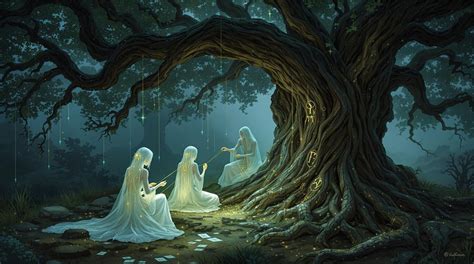
The Norns at Yggdrasil.
The Norns and Fate
As Snorri Sturluson stated in Gylfaginning, one's fate depended on the Norn's good or bad will. Fate cannot be separated from the actions of the gods. Because of this the Norns are ever-present in the greatest of their adventures.
In Guðrúnarkviða II, the Norns actively enter the series of events by informing Atli in a dream that his wife would kill him. Brynhild's solution was to have Gunnarr and his brothers, the lords of the Burgundians, kill Sigurd and afterwards to commit suicide in order to join Sigurd in the afterlife. Her brother Atli (Attila the Hun) avenged her death by killing the lords of the Burgundians, but since he was married to their sister Guðrún, Atli would soon be killed by her. In Guðrúnarhvöt, after having killed both her husband and son, Guðrún blames the Norns themselves for her misfortune.
Despite the questionable role they hold in the lives of the gods, the Aesir and Vanir regularly consult the Norns hoping to learn something of their futures. The three sisters are said to weave complex webs, the diverse colors of which foretell the kind of future they hold.
Read also: Symbolism in the Age of Aquarius
Norns and Death
A skaldic reference to the norns appears in Hvini's poem in Ynglingatal 24 found in Ynglingasaga 47, where King Halfdan is put to rest by his men at Borró. This reference brings in the phrase "norna dómr" which means "judgment of the nornir". In most cases, when the norns pass judgment, it means death to those who have been judged - in this case, Halfdan. Along with being associated with being bringers of death, Bek-Pedersen suggests that this phrase brings in a quasi-legal aspect to the nature of the norns. This legal association is employed quite frequently within skaldic and eddic sources.
Norns and Other Beings
There is no clear distinction between norns, fylgjas, hamingjas, and valkyries, nor with the generic term dísir. Moreover, artistic license permitted such terms to be used for mortal women in Old Norse poetry.
Norns in Sagas
Some of the legendary sagas also contain references to the Norns. The Hervarar saga contains a poem named Hlöðskviða, where the Gothic king Angantýr defeats a Hunnish invasion led by his Hunnish half-brother Hlöðr. In younger legendary sagas, such as Norna-Gests þáttr and Hrólfs saga kraka, the Norns appear to have been synonymous with völvas (witches, female shamans). One of the last legendary sagas to be written down, the Hrólfs saga kraka references the Norns as evil witches.
The story of the great skald Nornagesta derives from their direct intervention in his birth. Udr and Verdandi predict a great life for the newborn, but Skuld, offended by a mortal in the birth chamber the boy to live only as long as the taper survives. Udr cannot change her sister’s curse, but acting quickly she extinguishes the flame, saving the almost exhausted taper, and warns the mother to always keep it safe.
Norns and Ragnarok
The Norns are said to protect the worlds, but also to be the architects of Ragnarok, the end time of the gods. In the wake of Ragnarok however, the forces of malice will be destroyed. A new age of peace will come to pass in the Nine realms. Will the Norns survive this disaster of their own making?
Read also: Decoding Viking Symbols
Practices Related to the Norns
Norn Porridge was offered to Norse mothers after childbirth. This was an attempt to encourage the Norns to weave a happy fate for the newborn.
Comparisons to Other Mythologies
Interestingly, the three Norns share a lot of common traits and responsibilites as the Moirai (or Fates) in Greek mythology. They are said to weave the fates of all mortals and gods alike, even controlling (or simply foreseeing) natural disasters. When you dive into Norse mythology you do find that is has a lot of parallells with ancient Greek mythology. They weave the future and decide the destiny of all living beings in all 9 realms.
Here's a table summarizing the key aspects of the Norns:
| Aspect | Description |
|---|---|
| Role | Weavers of fate, determining the destinies of gods and mortals. |
| Location | At the foot of Yggdrasil, the world tree. |
| Main Norns | Urd (Past), Verdandi (Present), Skuld (Future). |
| Powers | Control over fate, knowledge of runes, influence on life and death. |