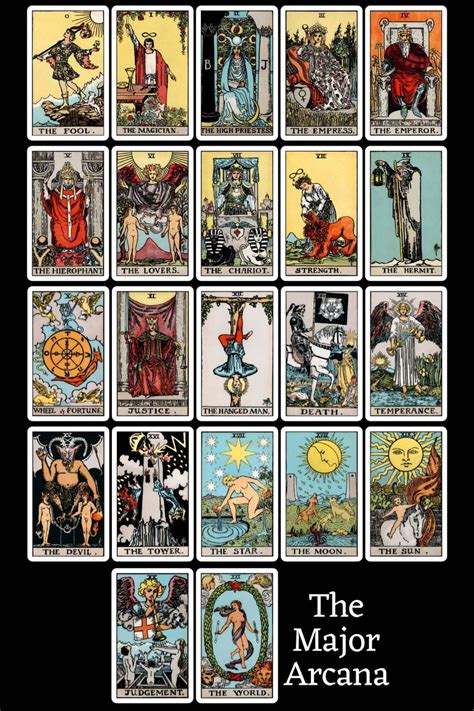
The Tarot, a deck of seventy-eight cards, has captivated minds for centuries. It is composed of twenty-two major arcana and fifty-six minor arcana. While its exact origins remain somewhat mysterious, it would seem that the Tarot first appeared in central Europe towards the fifteenth century.
The first known Tarot set is that of Charles VI (1430) but some of its cards have not come down to us. The first complete Tarot deck is that of Visconti (1450), imbued with Christian symbolism, followed by the famous “Tarot of Marseilles” which contains many astro-alchemical symbols. Different authors have studied and proposed different particular structures of the twenty-two major arcana.
In order to provide further insights into the arrangement of the Tarot proposed by Jean Carteret, we present the vision of the Tarot according to Carteret through various dialectic correspondences.
The Tarot as a Temple of the Word
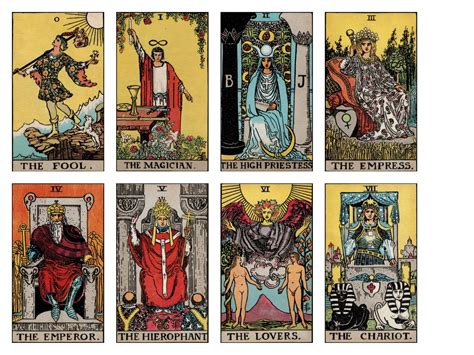
For Carteret, the Tarot is a fairytale which bears witness to the arrangement of the Logos… Jean notes this arrangement of the creation with respect to the creature thusly: “The Arcana of the Tarot form a panorama of the set of all possible formulas of the Word.
This revelation of the principles is a temple… The construction of a temple (value of state) is a structure, but the circulation within this qualifying space is a dialectic (dynamic value). The circle is the representation of the Word, the expression of the Principle.
Read also: Heartbreak and the Three of Swords
This “first figure of unity” is seen thusly: “The circle is a visible figure which is the transcendence of an invisible figure, which is to say that the circle as visible figure is the expression of a principle which itself is invisible. This is why we speak of the principle which is said to be the empty point which is transcended by the circle.”
What, then is the meaning of this central point? The empty point is to the circle as that which abides is to that which changes. The circle as divided into 360 degrees by the Sumerians introduces the becoming into the beyond-time, and the 360 degrees of the circle determine the 22 arcana.
“The triangle is the first polygon wherein the Word will articulate itself, it is the initiator of the series of the 21 others. These 22 polygons are articulations representing the “alphabet of the apprenticeship of all the possibilities of the Word.
👩🏻🏫🍀 СЕКРЕТ ИЗУЧЕНИЯ ТАРО для начинающих. Простые и сложные символы. #тароснуля
The Interplay of Name, Number, Image, and Idea
In his dialectics of the name and the number, Jean Carteret stated: “Crowned with the number and supported by the name, the card plays with the image represented and the idea that it expresses. The name is existence, it corresponds to what I think (to think is to name), whereas the number, the essence, indicates what thinks me (what constitutes me).”
And, he adds, “In the image itself, the name dominates the number. In the idea, the number dominates the name. In the name, the image dominates the idea. In the number, the idea dominates the image. The name is sound and heat, the number is light.
Read also: The Meaning of Tarot Suits
The Language of Colors in the Tarot
In the observation of the “images” of the Tarot, it is also necessary to interpret the colours which are obviously not randomly chosen. Let us recall the value of colours according to traditional symbolism…
- White indicates the purity of the eternal, divine Light (light has no colour).
- Yellow expresses the revolution or the revealed Light (golden yellow: constancy; pale yellow: treachery).
- Red is of course the colour of love, fire, and sacrificial blood.
- Pink (flesh colour) indicates love (red) of the divine (white).
- Blue represents wisdom, nobility and truth.
This is what Carteret had to say: “Yellow is the colour of tradition; pink is the colour of revolution. Red is the colour of activity, blue is the colour of passivity - but activity or passivity of the state, if it involves the trunk of the body for the state, capable of being active or passive, but activity or passivity of the action, if it involves the limbs of the body.
Astrological Correspondences
In the astrological correspondence of the arcana of the Tarot, Jean Carteret saw Justice as being to the head of the Black Sun as the Hermit is to the tail of this Black Sun. Temperance is the head of the Dragon (ascending lunar Node) as “Death” is to the tail of this Dragon (descending lunar Node). Whereas the Devil is analogous to the set of this axis of lunar Nodes.
The Structure of the Major Arcana
Before moving on to the particular symbolism of each arcanum, let us observe the arrangement of the 22 major arcana according to Carteret: “Thus, the first six arcana will express the six poles of the the state where the vertical dominates over the horizontal, the following six arcana (from VII to XII) will express the six poles of the action where the horizontal dominates over the vertical.
In Carteret’s metaphysical perspective, the spirit that comes from emptiness is to the immutable as life, which comes from fullness, is to the mobile. The major arcana are thus based on the trinity: three times six arcana. The first six arcana are the places of formation (of a state which ends in a situation) and the next six arcana are the passage from formation to transformation.
Read also: The Symbolism of Bad Bunny's Super Bowl Stage
The first arcana (cards I to VI) form a “senary of state” where the three principles are fixated in the four elements. The second senary (cards VII to XII) is that “of action”: the four elements are volatilised by the three principles.
The twin transcendence of the senaries of the state and of action are indicated by the two passages of cards XIII (volatilisation of the fixed of the second senary) and XIV (fixation of the volatile of the first senary) and by the double passage of arcanum XV representing “the two thresholds in simultaneity.”
Dialectic Correspondences in Detail
Let us examine the details of the structure of the Tarot according to carteret through various dialectic correspondences. The first card “opens all relations” and represents the articulation of the problem.
The Juggler symbolises the values of the inside which exteriorises itself towards the outside with respect to the Lover (VI), which represents an engagement towards the inside. “He is the passage of all which has preceded as origin to the end, and he will emphasise this end. He is indeed complementary to the Juggler, who, for his part, emphasises the origin. And while the Juggler is the passage from the private to the public, the Lover who is at the end will be the passage from the public to the private.
Between the cards II the Popess and V the Pope, on the one hand, and the cards III the Empress and IV the Emperor on the other, ”the dialectic is obvious.” … The Popess is an integrity in relation with the invisible, her book bears witness to sacred writing whereas the Pope speaks. Thus, the Popess symbolises the “introverted word” with respect to the Pope, “extroverted word.”
The Popess is a metaphysical value without physical reality and the Pope is united to the metaphysical by his relation with the Popess, “he is, in sum, the incarnation of the metaphysical and of the physical, and he bears witness to this vertical relation through speech; whereas the Popess, who does not exist but who is, cannot speak. The Popess is thus the silence filled by writing, that is to say, a collective where the invisible contains the visible.
In the image of the third card, that of the Empress, is depicted an eagle gazing to the left, and thus introverted with respect to the arcanum of the Emperor where there is an extroverted eagle looking to the right.
Still in the “Lesser Mystery” of the twelve first arcana, let us develop the second senary, that of action. The seventh card, the Chariot represents the “accelerator” with respect to the Wheel of Fortune (X) which corresponds to the brake… The Chariot is providence which, by the “two horses of the principle” is situated in becoming.
With Justice (VIII) we see the “seated fatness” paired with the “standing thinness” of the Hermit. In Justice there is a plenitude by heat, whereas in the Hermit we find the quest by light, which is the reduction and intensification of Justice. “The true is to existence what the just is to life; now, what the Hermit seeks is the passage from life to existence.
The Greater Mystery
We reach, at present, the “Greater Mystery” (cards XVI to XXI) of the last senary. If, in the God-House, the vertical wall of the Tower without a door (God has no need of a door) is demolished, we observe in the Sun (XIX) a rebuilt horizontal wall, and the two children fallen from the God-House find themselves standing upright and reunited.
We arrive at Arcanum XVII dear to André Breton and the Surrealists, the Star, who symbolises for Carteret “the deconditioning of the Earth and Heaven to the benefit of the natural influences” (Water element), whereas in the preceding card, there was a rupture (Fire element) in the relation between Heaven and Earth.
If the God-House “was a descent towards the base, the collapse of Heaven on Earth, since Revelation is the fall, as the shattering shows, on the contrary, the Moon is the exaltation in the sense of an ascent towards the summit.
If, with Justice, “Heaven grasps the Earth,” it is with Force that the Earth grasps Heaven. Force (XI) is an “antecedent vertical” and is paired with the Hanged Man (XII), “consequential horizontal.” We do not see the hands of the Hanged Man, legs crossed, as we do not see the feet (the birth) of Force, hands crossed.
The Threshold Cards
We now arrive at the three cards of the Threshold: “the work of Thrice-Greatest Hermes… The thirteenth card without a name which depicts a skeleton bearing a scythe is called “Death,” it is the door through which one leaves.” The severed right foot of the skeleton hinders the action of this passage from action to reaction.
This lunar illumination sees the drops rise (the downwards-pointing tips of the droplets symbolise the Water element) towards a Capricornian summit (with respect to the crayfish of that card indicating the zodiacal sign of Cancer, opposite Capricorn). On the other hand, in the arcanum of the Sun, the tips of the droplets are turned upwards, thus symbolising the Fire element.
The Judgment (XX) represents the conclusion of the four preceding arcana. In this confrontation, “the movement occurs from the top to the bottom, and from the bottom to the top, so much so that the top judges the bottom, as the bottom judges the top.” The Judgment is analogous to the engagement, but not to the wedding represented by the World (XXI) for there is yet separation between the Top and the Bottom.
We see in the arcanum the World “the belt of the life of the world,” laurel garland, and the poetry that surrounds the androgyne while the four evangelists correspond to the four “fixed” zodiacal signs (the middle of the seasons).
The Mate
There remains the Mate, card without number… Carteret found that the exact position of this “nomad” was situated between the Judgment (XX) and the World (XXI). Let us conclude with another of his remarks: “All that is crossed must represent a potentiality.”
Speaking of the Emperor, he used to say that only kings had the right to cross their legs.