Genre provides a classification for the audience to enable them to decide on a choice. Genre acts like a language, there are a list of codes and conventions which directors depend on to generate meaning for the audience. Setting a type a genre allows film producers to focus on a particular group of audience and to modify the film for that particular target. This allows them to stretch the boundaries to the level which they think will be acceptable.
The meaning is translated through various means. One technique is the way in which the camera produces shots to show us if something is about to happen and to highlight emotion. For example, dealing with the subject of death, torture and the supernatural is not something that will be considered in a film for children according to the BBFC guidelines.
The poster that I will be analysing is Zodiac (2007), through deciding what poster I should be examining on, I wanted a poster that best defined the genre of psychological thriller and Zodiac has effectively caught my attention. I thought the poster was very effective and was appealed by their layout and its use of mysterious dark colours successfully defined the meaning of the genre.
The film was released on the 18th May, 2007. Warner Bros. is the major company that had distributed this film.
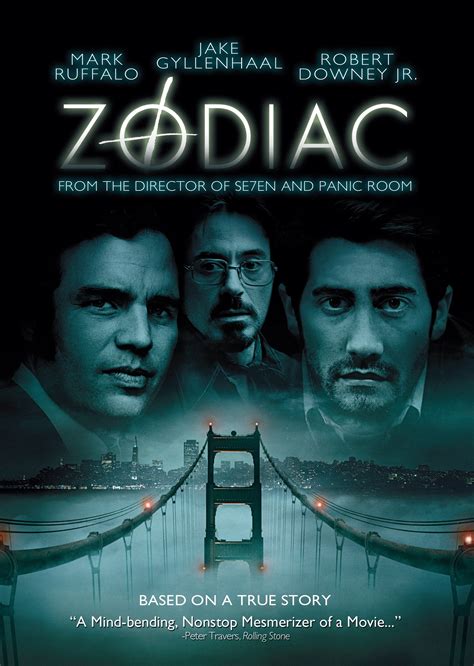
Zodiac film poster
Read also: Understanding Lucifer's Role
Synergy in Film Marketing
Posters aim to advertise a film, for the public to be aware of what movie will be soon released at what date. It’s an example of synergy. For the UK synergistic campaign, it represents an opportunity to expand on its competitive strengths internationally in respect of creative talent and content creation and thereby to enhance growth and productivity to develop skills. For the film industry it presents opportunities to reach wider audience to notice synergy, therefore to recongise the film from other media texts.
Synergy can be defined as a ‘strategy of synchronising and actively forging connections between directly related areas of entertainment.’ Synergy can be taken into one interrelated form: Star performer product synergy is one of them e.g.
The Role of Actors
The actors names are revealed as well as their photographs for the audience to be able to recognise what the character’s real names are and mainly because to attract the audience and to show good promotion.
Gyllenhaal has played many different genres, therefore is noticed by different target audiences. The Day After Tomorrow (2004) made $110,000,000 in DVD sales, bringing its total film gross to $654,771,772 in box office takings revealing its popularity for this film and Brokeback Mountain ranks tenth among the highest-grossing romantic dramas of all time. Additionally, he’s also seen as an attractive actor which gives a double bonus for the audience to look for something to look forward to as well as Robert Downey Jr.
Images are strong features to include in posters, as they provide hints to the narrative of the film. In this poster, it only contains images of the characters and a location. The images doesn’t really provide enough to explore the plot of the film, so it creates a sense of mystery and a sense of enigma.
Read also: The Meaning of Aries Zodiac Flowers
The character’s faces give out the language of concern, so it’s certainly not a comedy film. It is typical to see from a psychological thriller poster. Therefore, I would claim these actors are the main unique selling point in the poster.
It’s possible to also change around the character’s photographs, however, I think the positions of the character’s positions are located the way they are deliberately. The way in which the characters are portrayed physically/mentally is a reflection of the nature of the film.
Ruffalo’s and Gyllenhaal’s image are bigger than Downey Jr.’s, to emphasise that they are the two main characters the audience needs to look out for as they appear to be more significant. The connotation for Downey’s image is intimidation, or something that he has to hide from the others which makes him as significant, however, he seems to be the most mysterious character the audience may need to keep an eye on.
Teaser Posters
It usually mentions the major actors, guest stars, producers director, distributors depending on what type of poster it is. It does not mention which date the film will be released, the distributors and producers are also not mentioned to ‘tease’ the audience. Therefore, again, it makes this poster a teaser poster as it creates sense of enigma for the audience, to gain interest and expectation of the film. This is because they are still processing at completing their production, or that they are on their way of releasing it to the cinemas. Therefore, this poster will be utilised in the initial publicity for the film, well before the release of the film and before the main poster that will be produced. They are preparing the audience to recognise the poster before it is released for them to engage with the audience.
Colors and Typography
Colours subconsciously provide immediate meanings to the audience, therefore the editors need to be careful about what colours to utilise in advertisements especially when it comes to thriller and horror genres.
Read also: Criminal Minds: Unmasking the Zodiac Killer's Legacy.
TITLE - The title is strongly contrastingly white and seems to have an effective glowing effect all around each sharp letter. This successfully engages the audience as it will be the first text that they will see. As this is a teaser poster, the title itself creates mystery and sense of enigma. This sign/symbol is also utilised in their trailer, however, the poster is produced before than the trailer in order to create awareness for the public to able to recognise the advertisements on the media texts i.e. television and magazines. It’s also part of the synergistic campaign, the more they see this sign of symbol, the more they would want to know what it defines. In my opinion, I would relate this sign to a bullet as in thriller/sci-fi films, murderers usually ‘tick’ the individuals that they had killed.
The names of the A list starts are in different colours, which are in green. This also associates it with the text ‘from the director of se7en and Panic Room.’ They are all in the same fonts, and same use of effects.
The text are in upper cases for ‘’BASED ON A TRUE STORY’ to specify to the audience the significance in this film, that the narrative is not a fantasy film, it’s actually reflected in reality which the audience’s like to hear. This is because they like to know what possibility can go on in our world, and mainly they like to be told the truth. However, the quote is in non-capital letters as it is quoted from Peter Travis, Rolling Stone. This is to differ from the upper cases, which help to draw the audience’s attention as they can read it clearly. The colour is quite faded, as it possibly is not really relevant for the advertisement as there are other significant factors that make it a unique selling point (USP) for the audience.
Layout and Overall Impression
The layout of the poster, in my opinion, is effectively successful. I can tell there has been a lot of thought in the way how they should present this media text to the public clearly and effectively. The poster doesn’t reveal a lot of the narrative which I think it’s an effective way of encouraging the audience to read and examine the poster a lot closer which creates mystery and a sense of enigma. One of the most catchy areas is the bridge, as it invites the audience in encouraging the consumers to engage with the poster. Also, the title certainly catches the audience and uses perfect glowing tools as it’s the main information the audience needs to know. The contrast is very strong and bright, compared to any other features which makes the title stand out even more.
About the Film
Arnold W. Bradley J. Warner Bros. Zodiac is a 2007 American mystery thriller film directed by David Fincher and written by James Vanderbilt, based on the nonfiction books by Robert Graysmith: Zodiac (1986) and Zodiac Unmasked (2002). The case remains one of the United States' most infamous unsolved crimes.
Fincher, Vanderbilt, and producer Bradley J. Fischer spent 18 months conducting their own investigation and research into the Zodiac murders. Zodiac was released by Paramount Pictures in the United States and Canada and by Warner Bros. Pictures in international markets on March 2, 2007. It received largely positive reviews, with praise for its writing, directing, acting, and historical accuracy. The film was nominated for several awards, including the Saturn Award for Best Action, Adventure or Thriller Film. It grossed over $84.7 million worldwide on a production budget of $65 million. In the years since its release, the film has garnered a large cult following, with many claiming it to be David Fincher's magnum opus.
On July 4, 1969, an unknown man attacks Darlene Ferrin and Mike Mageau with a handgun at a lovers' lane in Vallejo, California. One month later, the San Francisco Chronicle receives encrypted letters written by the killer calling himself "Zodiac", who threatens to kill a dozen people unless his coded message containing his identity is published.
Political cartoonist Robert Graysmith, who correctly guesses that his identity is not in the message, is not taken seriously by crime reporter Paul Avery or the editors and is excluded from the initial details about the killings. When the newspaper publishes the letters, a married couple deciphers one, revealing it indeed did not contain the killer's name. At the office, Avery makes fun of Graysmith before they discuss the coded letters. Graysmith interprets the letter, which Avery finds helpful, and he begins sharing information.
Two weeks later, San Francisco taxicab driver Paul Stine is shot and killed in the city's Presidio Heights district. San Francisco police inspectors Dave Toschi and his partner Bill Armstrong are assigned to the case by Captain Marty Lee and work closely with Vallejo's Jack Mulanax and Captain Ken Narlow in Napa.
In 1971, Detectives Toschi, Armstrong, and Mulanax question Arthur Leigh Allen, a suspect in the Vallejo case. They notice that he wears a Zodiac wristwatch, with the same logo used by the killer, and Toschi thinks he is the killer. However, a handwriting expert insists that Allen did not write the Zodiac letters, even though Allen is said to be ambidextrous.
Avery receives a letter threatening his life; becoming paranoid, he turns to drugs and alcohol. He shares information with the Riverside Police Department that the killer might have been active before the initial killings, angering Toschi and Armstrong. By 1976, Avery has moved to the Sacramento Bee.
Graysmith persistently contacts Toschi about the Zodiac murders and eventually impresses him with his knowledge of the case. While Toschi cannot directly give Graysmith access to the evidence, he provides names in other police departments where Zodiac murders occurred. Graysmith continues his own investigation, profiled in the Chronicle, and gives a television interview about the book he is writing on the case. He begins receiving phone calls from someone breathing heavily.
As his obsession deepens, Graysmith loses his job, and his wife Melanie leaves him, taking their children. Graysmith learns that Allen lived close to Ferrin and probably knew her and that his birthday matches the one Zodiac gave when he spoke to one of Melvin Belli's maids. While circumstantial evidence seems to indicate his guilt, the physical evidence, such as fingerprints and handwriting samples, does not implicate him.
In 1983, Graysmith tracks Allen to a Vallejo Ace Hardware store, where he is employed as a sales clerk; they stare at each other before Graysmith leaves.
Casting
Robert Graysmith first sold the film rights to his true crime book Zodiac to Shane Salerno, with whom he had established a close relationship. James Vanderbilt had read Robert Graysmith's book Zodiac while in high school. Years later, after becoming a screenwriter, he got the opportunity to meet Graysmith, and became fascinated by the folklore surrounding the Zodiac killer. He decided to try to translate the story into a script.
Zodiac Making of Featurette 2007
One of Fincher's earliest conversations on the film's casting was with Jennifer Aniston. She talked about actors she had enjoyed working with; they were Jake Gyllenhaal (The Good Girl) and Mark Ruffalo (Rumor Has It).
While researching the film, Fincher considered Gyllenhaal to play Robert Graysmith. According to Fincher, "I really liked him in Donnie Darko and I thought, 'He's an interesting double-sided coin.
Initially, Mark Ruffalo was not interested in the project but Fincher wanted him to play David Toschi. He met with Ruffalo and told him that he was rewriting the screenplay. "I loved what he was saying and loved where he was going with it", Ruffalo remembers. For research, he read every report on the case and read all the books on the subject. Ruffalo met Toschi and found out that he had "perfect recall of the details and what happened when, where, who was there, what he was wearing. He always knew what he was wearing.
Fincher thought of Anthony Edwards for the role of Inspector William Armstrong, saying "I knew I needed the most decent person I could find, because he would be the balance of the movie. In a weird way, this movie wouldn't exist without Bill Armstrong. Everything we know about the Zodiac case, we know because of his notes.
Filming and Visual Effects
Fincher decided to use the digital Thomson Viper FilmStream Camera to shoot the film, having previously used it on commercials for Nike, Hewlett-Packard, Heineken, and Lexus, which allowed him to get used to and experiment with the equipment. Once shot on the Viper camera, the files were converted to DVCPro HD 1080i and edited in Final Cut Pro. This was for editorial decisions only.
Fincher had previously worked with director of photography Harris Savides on Seven (he shot the opening credits) and The Game. Savides loved the script but realized, "there was so much exposition, just people talking on the phone or having conversations. It was difficult to imagine how it could be done in a visual way."
Fincher and Savides did not want to repeat the look of Seven. The director's approach to Zodiac was to create a look mundane enough that audiences would accept that what they were watching was the truth. The filmmakers also did not want to glamorize the killer or tell the story through his eyes. "That would have turned the story into a first-person-shooter video game.
Fincher and Savides used the photographs of William Eggleston, Stephen Shore's work from the early Seventies, and actual photos from the Zodiac police files. The two men worked hard to capture the look and feel of the period as Fincher admitted, "I suppose there could have been more VW bugs but I think what we show is a pretty good representation of the time. It is not technically perfect. There are some flaws but some are intended."
The San Francisco Chronicle was built in the old post office in the Terminal Annex Building in downtown Los Angeles. A building on nearby Spring Street subbed for the Hall of Justice and the San Francisco Police Department.
Principal photography began on September 12, 2005. The filmmakers shot for five weeks in the San Francisco Bay Area and the rest of the time in Los Angeles, bringing the film in under budget, wrapping in February 2006.
Digital Domain handled most of the film's 200+ visual effects shots, including pools of blood and bloody fingerprints found at crime scenes. For the murder of Cecelia Shepard at Lake Berryessa, blood seepage and clothing stains were added in post-production. CGI was also used to recreate the San Francisco neighborhood at Washington and Cherry Streets where cab driver Paul Stine was killed.
| Aspect | Details |
|---|---|
| Director | David Fincher |
| Screenwriter | James Vanderbilt |
| Based on | Robert Graysmith's books |
| Main Cast | Jake Gyllenhaal, Mark Ruffalo, Robert Downey Jr. |
| Release Date | March 2, 2007 |
| Budget | $65 million |
| Worldwide Gross | $84.7 million |