The Dendera zodiac, a bas-relief ceiling from the temple of Hathor in Dendera, Egypt, is a widely known Egyptian artifact. It contains images of Taurus (the bull) and Libra (the scales). This sculptured zodiac is from the ceiling of the pronaos (or portico) of a chapel dedicated to Osiris in the Hathor temple at Dendera.
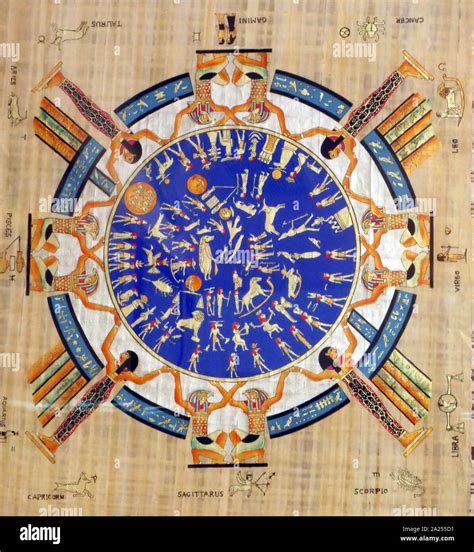
Dendera Zodiac on display at the Louvre Museum in Paris.
Historical Context and Discovery
This chapel was begun in the late Ptolemaic period; its pronaos was added by the emperor Tiberius. This led Jean-François Champollion to date the relief to the Greco-Roman period, but most of his contemporaries believed it to be of the New Kingdom.
During the Napoleonic campaign in Egypt, Vivant Denon drew the circular zodiac, the more widely known one, and the rectangular zodiacs. In 1802, after the Napoleonic expedition, Denon published engravings of the temple ceiling in his Voyage dans la Basse et la Haute Egypte. These elicited a controversy as to the age of the zodiac representation, ranging from tens of thousands to a thousand years to a few hundred, and whether the zodiac was a planisphere or an astrological chart.
In the early nineteenth century, it was blasted out of the temple’s ceiling by an antiquities collector and shipped to France after being discovered during Napoleon’s Egypt expedition. Sébastien Louis Saulnier, an antique dealer, commissioned Claude Lelorrain to remove the circular zodiac with saws, jacks, scissors and gunpowder. The zodiac ceiling was moved in 1821 to Restoration Paris and, by 1822, was installed by Louis XVIII in the Royal Library (later called the National Library of France). In 1922 the zodiac was moved from there to the Louvre.
Read also: Understanding Lucifer's Role
The controversy around the zodiac's dating, known as the "Dendera Affair", involved people of the likes of Joseph Fourier (who estimated that the age was 2500 BC). Sylvie Cauville and Éric Aubourg dated it to 50 BC through an examination of the planetary configuration.
Dating and Significance
Based on the position of the stars, paleo-astronomers have determined that it dates from 30 BC-30 AD, during the Late Period of ancient Egypt. The sandstone slab originally adorned the ceiling of one of the Osiris chambers in the Hathor Temple. The concept of the zodiac was invented by the Babylonians in the 5th century B.C., then taken up by the Greeks, and finally appeared in Egypt at the end of the 3rd century B.C.
The Dendera Zodiac is one of the best-preserved ancient depictions of the observable stars. Although it contains many of the Zodiac symbols as they are known today, it is more accurately described as a star map than an astrological chart. It shows all five planets known to the Ancient Egyptians in an alignment that occurs once every one thousand years, as well as both a solar and lunar eclipse.
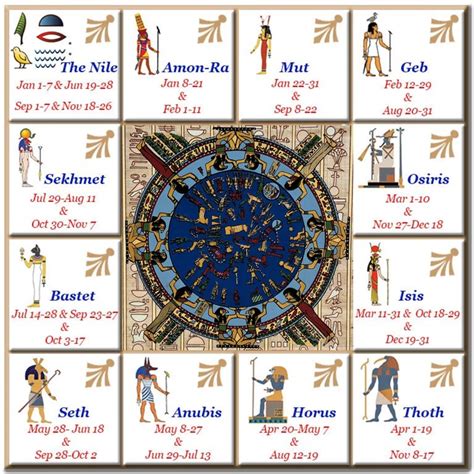
Details of the Dendera Zodiac symbols.
Components and Symbolism
Both Mesopotamian and Egyptian sky iconography are elegantly combined in the composition. The central disc represents the celestial realm which include Ursa Major, the great bear, and Tauret, the pregnant hippo-lion goddess. Another ring of figures outside of these circumpolar star groups depict Greco-Roman astrological signs such as the Ram, Lion, Bull, and Scorpion.
Read also: The Meaning of Aries Zodiac Flowers
The vault of heaven is held up by four women, assisted by falcon-headed spirits. The figures or spirits around the edge of the map represent 36 decans, or ten-day periods. Above their heads are the 12 zodiac signs, a combination of Egyptian and Greek. The five planets known at the time are situated with their associated signs. And two eclipses are represented on the exact date they occurred: the solar eclipse on March 7th, 51 B.C.
The sky disc is centered on the north pole star, with Ursa Minor depicted as a jackal. An inner disc is composed of constellations showing the signs of the zodiac. Some of these are represented in the same Greco-Roman iconographic forms as their familiar counterparts (e.g. Four women and four pairs of falcon-headed figures, arranged 45° from one another, hold up the sky disc, the outermost ring of which features 36 figures representing the 36 asterisms used to track both the 36 forty-minute "hours" that divided the Egyptian night, as well as the 36 ten-day "weeks" (decans) of the Egyptian year (with 5 days excluded).Key Elements of the Dendera Zodiac
- Central Disc: Represents the celestial realm, including Ursa Major and Tauret.
- Outer Ring: Depicts Greco-Roman astrological signs.
- Supporting Figures: Four women and falcon-headed spirits holding up the sky disc.
- Decans: 36 figures representing ten-day periods.
- Zodiac Signs: A combination of Egyptian and Greek signs.
- Planets: Representation of the five planets known at the time.
- Eclipses: Solar eclipse on March 7th, 51 B.C.
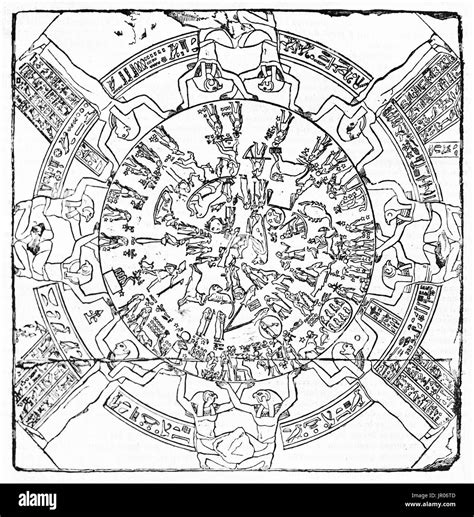
Detailed drawing of the Dendera Zodiac.
The zodiac is a planisphere or map of the stars on a plane projection, showing the 12 constellations of the zodiacal band forming 36 decans of ten days each, and the planets. These decans are groups of first-magnitude stars.
The Dendera zodiac is on display at the Louvre Museum in Paris, and has lost its original painted decoration.
The Dendera Zodiac of Egypt: An Ancient Babylonian Copy? | Ancient Architects
Read also: Criminal Minds: Unmasking the Zodiac Killer's Legacy.