The Tropic of Capricorn, also called the Southern Tropic, is an imaginary line that indicates the southernmost point where the Sun is directly overhead at noon. The latitude of this tropic currently lies about 23°26′11.2″ south of the Equator. It is one of the five major circles of latitude marked on maps of Earth.
The Tropic of Capricorn is not fixed, but constantly changes because of a slight wobble in the Earth's longitudinal alignment relative to its orbit around the Sun. Earth's axial tilt varies over a 41,000 year period from about 22.1 to 24.5 degrees and currently resides at about 23.4 degrees. This wobble means that the Tropic of Capricorn is currently drifting northward at a rate of almost half an arcsecond (0.468″) of latitude, or 15 metres, per year.
The Tropic of Capricorn is one of the five crucial latitudinal circles marked on the globe. When this line of latitude was named, the Sun was in the constellation Capricornus at the December solstice. This is the date each year when the Sun reaches zenith at this latitude, the southernmost declination it reaches for the year. The Tropic of Capricorn is the dividing line between the Southern Temperate Zone to the south and the Tropics to the north.
The Tropic of Capricorn (or the Southern Tropic) is the circle of latitude that contains the subsolar point at the December (or southern) solstice. It is thus the southernmost latitude where the Sun can be seen directly overhead. It also reaches 90 degrees below the horizon at solar midnight on the June Solstice.
The Tropical Zone - the region between the two tropics - is the hottest part of the Earth. The 23.5 degrees south latitude in the Southern Hemisphere is known as Tropic of Capricorn. There are approximately 13 hours, 35 minutes of daylight during the summer solstice. Parallels are shown in the table below.
Read also: Traits of the Capricorn Third Decan
| Parallels | States |
|---|---|
| Arctic Circle | A boundary from North frigid zone to the north |
| “Tropic of Cancer” | “Encloses the North Temperate Zone with the Arctic Circle” |
| Equator | The equator runs towards the northernmost part of the tropic of Capricorn. |
| “Tropic of Capricorn” | Circled south temperate zone with a circle of Antarctic. |
| Antarctic Circle | It mainly creates a boundary of the south frigid zone towards the south of the surface. |
Countries Lying on the Tropic of Capricorn
Countries lying on the tropic of Capricorn constitute 10 countries, 3 water bodies and 3 continents on the surface of the Earth. Countries such as Argentina, Chile, Namibia, South Africa, Madagascar and Australia, Brazil, Paraguay, Botswana, Mozambique. In Africa, this line of Capricorn passes through “Namibia, South Africa, Mozambique, Botswana and Madagascar”.
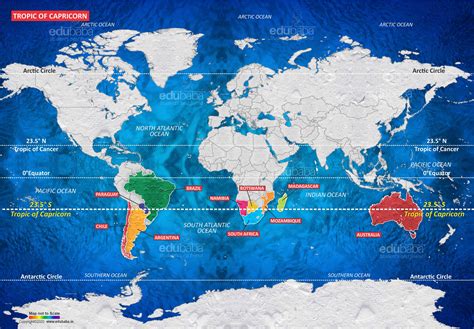
Map of the Tropic of Capricorn
Southern Africa: A Diverse Sub-Continent
Southern Africa is a most diverse and diabolical sub-continent. Southern Africa is the southernmost region of Africa. No definition is agreed upon, but some groupings include the United Nations geoscheme, the intergovernmental Southern African Development Community, and the physical geography definition based on the physical characteristics of the land.
Defined by physical geography, Southern Africa is home to several river systems; the Zambezi River is the most prominent. The Zambezi flows from the northwest corner of Zambia and western Angola to the Indian Ocean on the coast of Mozambique. Along the way, it flows over Victoria Falls on the border between Zambia and Zimbabwe.
Southern Africa includes both subtropical and temperate climates, with the Tropic of Capricorn running through the middle of the region, dividing it into its subtropical and temperate halves. Countries commonly included in Southern Africa include Angola, Botswana, Comoros, Eswatini, Lesotho, Madagascar, Malawi, Mauritius, Mozambique, Namibia, South Africa, Zambia, and Zimbabwe.
Read also: Capricorn Compatibility
In physical geography, the geographical delineation for the subregion is the portion of Africa south of the Cunene and Zambezi Rivers: Botswana, Eswatini, Lesotho, Namibia, South Africa, Zimbabwe, and the part of Mozambique that lies south of the Zambezi River.
The terrain of Southern Africa is varied, ranging from forest and grasslands to deserts. The climate of the region is broadly divided into subtropical in the north and temperate in the south, but also includes humid-subtropical, Mediterranean-climate, highland-subtropical, oceanic, desert, and semi-arid regions.
Across most of southern Africa, apart from the Western Cape in South Africa, the major rainfall season is during the southern-hemisphere summer, from December to February. There are a number of important rainfall-producing weather systems in southern Africa. These include tropical-extra-tropical cloud bands, tropical lows, and tropical cyclones, cut-off lows, and mesoscale convective systems.
The Tropic of Capricorn 1 of 20 - Namibia - BBC Travel Documentary
Notable Crossings of the Tropic of Capricorn in Southern Africa
An interesting comparison exists at three notable crossings of the twenty third parallel within this phenomenal portion of Africa. One of the most famous crossings of this line lies north of Mopani rest-camp in the world-famous Kruger National Park. The line is marked with bricks sunken into the paved north road between Mopani and Shingwedzi.
There is a tourist information panel set into rock at this site and one is allowed at own risk to alight from the vehicle and photograph the line straddling the road and the panel. Further west and still in South Africa’s Limpopo province lies another well-known crossing of Capricorn. Several kilometres south of the charming mountain and forestry town of Louis Trichardt on the great north road linking South Africa and Zimbabwe is another monument to the 23rd parallel.
Read also: Love and Relationships Under Capricorn New Moon
This one lies to the side of a typical bushveld koppie…a granitic dome all set about with candelabra shaped euphorbia succulents and jaundiced rock figs and standing sentinel like on a vast thorn scrub and grassland expanse. Much further west in the arid heartland of Namibia on the stark and endless dirt road between Solitaire and Walvis Bay is another regularly visited point on the Capricorn line.
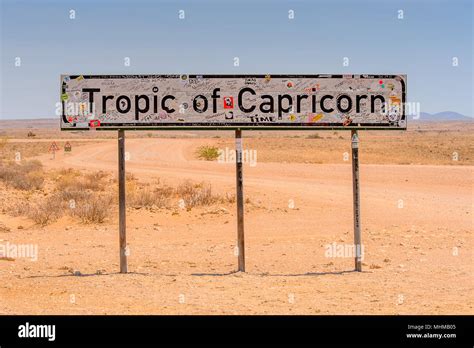
Tropic of Capricorn Sign in Namibia
Two simple signs…one on either side of the track advertise the significance of the spot. The road signs are covered in stickers and graffiti…a varied and colourful testament to the legions of desert adventurers who have passed by. The surrounding desert plains harbour scattered herds of Springbok and Oryx and the distant hills boast cave walls adorned with the ancient ochre paintings of first nation hunter gatherers…Bushmen…who plied that remote wilderness long before measured time.
Significance of Tropic of Capricorn
Significance of Tropic of Capricorn d Tropic of Capricorn lies within the constellation of Sagittarius that has reached its southernmost declination of eclipse. However, the line of tropic of Capricorn had previously occurred in the constellation of Capricorn during winter solstice due to which it has been named tropic of Capricorn… In Africa, this line of Capricorn passes through “Namibia, South Africa, Mozambique, Botswana and Madagascar”.
Another significance of this tropic is mainly being used to divide surface and make a southern boundary. It is also important in solar insolation of a surface that is based on sunlight and creation of seasons. It has been reported by various science experts that due to frequent change of Earth’s line of axis planet sun is expected to appear in the tropic of Capricorn in the next 24000 years.
It also varies on an amount of direct sunlight and also directly hits all subsolar points. In addition, it also creates an imaginary line and migrates a line between Capricorn and cancer with “Earth’s axial tilt”. sun.
Economic and Environmental Aspects
Southern Africa is set apart from other Sub-Saharan African regions because of its mineral resources, including copper, diamonds, gold, zinc, chromium, platinum, manganese, iron ore, and coal. These widespread mineral resources make this one of the wealthiest regions of Africa with the greatest potential for economic growth.
Across this large region pasture farming is widespread, where intensive, brief and rotational it helps to fertilise and stabilise the soil, preventing run-off and desertification. This approach is traditional to many tribes and promoted by government advisors such as Allan Savory, a Zimbabwean-born biologist, farmer, game rancher, politician and international consultant and co-founder of the Savory Institute.
Even though considerable disturbance has occurred in some regions from habitat loss due to human population density or export-focused development, there remain significant numbers of various wildlife species, including white rhino, lion, African leopard, impala, kudu, blue wildebeest, vervet monkey and elephant.