From place names to pronouns, the English language is full of surprises, many of which are thanks to the Vikings. They may have spent decades invading, but the Vikings and their descendants left their mark on the British Isles in more ways than one.
To understand the reasons behind the amount of Viking terms in today’s English vocabulary, we need to dive into important historical events. It all started hundreds of years ago, in the late VIII century. Today, we call this period the Viking Age, which continued until the XI century. It was when fearless warriors from Scandinavia embarked on raids and exploration and eventually settled in various parts of England. The Vikings, mostly of Norwegian, Danish, and Swedish origins, brought their language and many Old Norse words.
In the 9th and 10th centuries, Scandinavians crossed the North Sea in great numbers. As many as 35,000 Scandinavians may have relocated to England. Scandinavians lived and farmed alongside the Old English speakers in the time of Danelaw. Over time, as English evolved, the pronunciation and spelling of Viking words changed to align with the phonetics of the language. However, the influence of Scandinavians remains deeply ingrained in the modern lexicon.
Old English, the language spoken in much of the British Isles at the time, was quite a different language to the one we know today. English and Old Norse are both members of the Germanic language family. This means that Old English adapting to include some Old Norse words wouldn't have seemed particularly strange at the time.
Thanks to the cross-cultural fermentation that occurred in the Danelaw, the English language is much closer to those of its Scandinavian neighbors than many acknowledge. This is still in evidence today: Modern English grammar and syntax are more similar to modern Scandinavian languages than to Old English. Some linguists even claim that English should be reclassified as a North Germanic language (along with Danish, Norwegian, Icelandic and Swedish), rather than a West Germanic language (with Dutch and German). English is probably too much of a hybrid to ever neatly classify, but its Old Norse rót is clearly there among the tangle of Anglo-Saxon, French and Latin roots.
Read also: Decoding Viking Symbols
The English we speak today is riddled with lingual remnants leftover from a time when wearing ornately-decorated helmets was all the rage.
Let’s explore the famous Old Norse terms that have left an indelible mark on the English we speak today.
Place Names of Old Norse Origin
Even if you don't know the specifics, many people have heard that there are place names of Viking origin in England. I grew up just a few miles from a small village called Naseby. The hint? Look for a -by suffix at the end of the name. In the British Isles today there are hundreds of place names of Old Norse origin.
The suffix -by (from Old Norse býr, meaning farm or settlement) is one of the clearest markers of Viking influence. Other common suffixes include:
- -thorpe, from þorp, meaning a small village or secondary settlement.
- -kirk or Kirk-, from kirkja, meaning church.
Even the capital city of York bears a Norse name.
Read also: Exploring the World with Viking
Pronouns and Verbs
Among the most surprising Viking influences on English are the third-person plural pronouns: they, them, and their. This linguistic shift wasn’t purely random. It may have helped avoid confusion with similar-sounding singular pronouns like he and him, especially as dialects mingled.
The Vikings gave English a surprising number of common verbs. Even auxiliary verbs and conjugations were affected.
One of the most colourful additions is berserk, from berserkr, a compound of ber (bear) and serkr (shirt).
The 10 Most Famous Vikings That Existed!
Norse Influence in Dialect Speech
In the north and east of England, Norse influence remains visible in dialect speech. The word dale meaning valley likely comes from the Old Norse dalur, which has become dal in modern Norwegian. Some dialects retain Norse grammar too.
Perhaps the most direct descendant of Old Norse in the British Isles was Norn, once spoken in Shetland, Orkney and parts of Caithness. Norn was never a written language in the way Old Norse was, and it gradually gave way to Scots and English. Today, traces of Norn still echo in Shetlandic English, particularly in pronunciation and certain expressions.
Read also: Unveiling the Mystery of Space Aliens
Personal names in Britain also reflect Norse heritage. Names like Eric, Harold, Rolf, Gunnar, and Astrid are all of Old Norse origin and remain in use today.
Everyday Viking Words
We use Norse terms in different areas, from specific ones like maritime studies or geography to more common ones, describing emotions or everyday objects.
Here are some examples of Viking words and their meanings:
- Ugly: From the Norse word “uggligr,” meaning “fearful” or “dreadful.”
- Thrift: From the Norse lexicon: “prosperity” and “success.”
- Anger: This term comes from the Old Norse word “angr,” meaning “grief” or “sorrow.”
- Knife: Initially, it was called “knífr” and was also used to describe a tool with a sharp blade for cutting or stabbing.
- Husband: The word “husband” also has its roots in the Viking lexicon and comes from the term “húsbóndi,” meaning “master of the house.”
- Steak: This juicy word can be traced to the Old Norse word “steik,” which meant “to roast” or “to fry.”
- Egg: We do know that the word “egg” comes from the Old Norse language. Moreover, it even remains the exact spelling!
The following table lists common English words with Old Norse origins, along with their meanings:
| English Word | Old Norse Origin | Meaning |
|---|---|---|
| Sky | Sky | The atmosphere above the earth |
| Window | Vindauga | Wind eye |
| Cake | Kaka | A sweet baked good |
| Husband | Húsbóndi | Master of the house |
| Knife | Knifr | A cutting tool |
| Egg | Egg | Oval-shaped object laid by a female bird |
| Ugly | Uggligr | Fearful, dreadful |
Norse Words and Days of the Week: The Unexpected Connection
What is the first thing that comes to mind when you think about Nordic words? Probably, something unusual like “fjord” or “Ragnarök.” While these terms indeed come from Viking vocabulary, there are simpler examples of Norse words in English. And when we say simpler, we mean something as casual as the days of the week, one of the first things English students learn.
- Monday - Manadagr - Máni’s Day. This day is named after the god Máni, who represented the Moon. Vikings believed that he drove a chariot through the night sky.
- Tuesday - Tysdagr - Tyr’s Day (Tiw’s Day). The second day of the week is also called after the Norse mythology character, Tyr - son of Odin. This god was associated with bravery and war. In Old English, he was also called Tiw or Tiu.
- Wednesday - Odinsdagr - Odin’s Day. Odin was the chief god in Norse mythology, also known as the All-Father, and the ruler of the gods. The main honor for Vikings was to die in battle, enter Valhalla, join Odin, and have a drink with him. And the third day of the week is named after this almighty character.
- Thursday - Þórsdagr - Thor’s Day. The original god of thunder came from Norse mythology, and his fame and bravery were captured in the name of the fourth day of the week.
- Friday - Frjadagr - Freya’s and Frigg’s Day. The name of this weekday is connected with two Norse goddesses - Freya and Frigg. Both are associated with similar areas - love, fertility, motherhood, magic, and war. Freya was Odin’s concubine and Frigg - Odin’s wife, the Queen of Gods.
- Sunday - Sunnadagr - Sól’s Day. The last (or first in the US) day of the week is named after the sister of Máni called Sól or Sunna. Vikings referred to her as the goddess of the Sun, who, like her brother, drove a chariot through the sky, but during the day.
Saturday is the only day that didn’t take its name from Viking slang. It originated in Roman mythology, where they call it “Saturn’s Day.”
Viking Symbols and Their Meanings
Any true fan of Viking culture likes to wear clothes and accessories with tattoos and symbols from Norse mythology. Vikings saw Norse symbols as a link to fate and spirituality, the two things that were sacred to any Viking. Since the Vikings sincerely believed that symbols held power, it is not surprising that they wanted to have them on hand in times of danger or uncertainty. They lived in heat, cold, wind and rain.
Viking symbols were far more than decorative art - they carried deep spiritual meaning rooted in Norse mythology, pagan beliefs, and the Viking way of life. Each symbol acted as a spiritual bridge between the physical world and the divine, often used to invoke protection, courage, or guidance from the gods. The Vikings believed in fate (ørlǫg) and saw life as part of a greater cosmic order, which was reflected in sacred signs such as Yggdrasil, the Tree of Life.
These powerful symbols were often carved into weapons, etched into runestones, or worn as spiritual amulets to connect with higher powers and withstand the chaos of battle or sea travel. Today, wearing Viking symbols is more than a fashion statement - it’s a way to reclaim ancient wisdom, express personal spiritual strength, and feel connected to a legacy of courage, honor, and inner power.
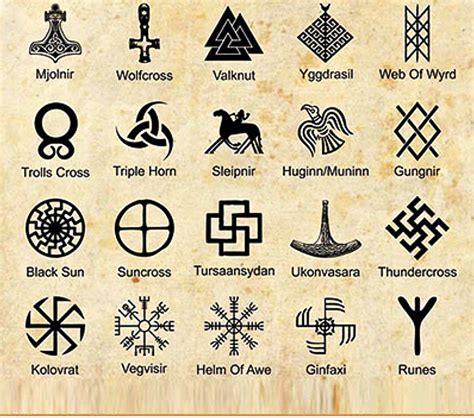
Runes
The word rune has its origin in the Old English word run (Old Norse runir), which means "a mystery or a secret". Therefore, it is not surprising that runes were only used to convey special and extraordinary messages. Runes are very similar to letters, with one exception. In addition to being related to specific phonetic sounds, runes also have individual meanings, like glyphs in other ancient cultures.
The Norse runic alphabets are named after the first six runes F, U, TH, A, R, K - the futharks. As we have already mentioned, the Vikings used runes only in extraordinary situations. They did not use these divine Viking Symbols for anything, but when runes were used, they were carved only in wood or stone.
Since the Vikings believed that runes had magical powers, it was common to engrave them on jewelry, shields and beads. Norse mythology tells us that runes are not created by men, but are part of their divine world. They are as old as Yggdrasil, the tree of life, and are engraved on its trunk. The runes had such power that even Odin, the god of gods, was willing to suffer much to understand them.
These early runes are known as the Old Futhark and were used by many Nordic and Germanic tribes until the very beginning of the Viking Age. It was then that the Young Futhark slowly began to take its place. The Young Futhark had fewer runes (16 in total). Today, twelve centuries later, we can still interpret the Elder Futhark.
Mjölnir
One source suggests that it means "white," symbolizing the color of lightning, while others say it means "thunderbolt." Other sources say that Mjölnir means "fresh snow", symbolizing the purity of the soul. Finally, some sources link Mjolnir to words such as "crush" or "crush". Thor used his hammer for many purposes, including blessing people and things. Mjölnir was a symbol of protection and security. Archaeologists have discovered hundreds of Mjölnir amulets in various Nordic archaeological sites and Viking tombs.
Valknut
Known as Odin's Knot, Valknut is undoubtedly one of the most famous symbols in Norse mythology. Since Odin was the one who welcomed heroes killed in battle to Valhalla, many Viking tombs contained figurines related to Odin with the Valknut symbol drawn next to them. Of course, Valknut has a deeper meaning. The symbol consists of three triangles with nine corners. What can these corners mean? The answer is very simple. Each corner is associated with one of the nine worlds of the Norse universe.
Ægishjálmr
The helmet of terror or fear (in Old Norse Ægishjálmr) is a Norse divine symbol of protection and victory. Several sagas (including Galdrabók) mention that it was used not only by Viking warriors but also by dragons (which seems hard to believe, no?!). Some sources claim that Ægishjálmr is a magical object, while others describe it as an invisible sphere of protection that instills fear in nearby enemies. The eight linear shapes that run from the center of the symbol represent the space between the eyes.
Vegvisir
The name of this symbol, Vegvisir, comes from the words "vegur" (meaning path) and "visir" (meaning pointer), and means "scout". Vegvisir is very similar to Ægishjálmr, so many people think they are one and the same. Like the Helm of Awe, Vegvisir consists of eight "beams" that meet in the center. The Vikings believed that this symbol had the power to show the right path to those who had gone astray. This symbol was of immense value as the Vikings often sailed into the unknown, and having this special tool at their side to guide them was invaluable.
Triskele (Horns of Odin)
The symbol of the "Triskele" (also known as the Horns of Odin) consists of three linked drinking horns. The meaning of the Triskele is still a bit unclear. The most common belief is that it tells how Odin stole the mead from the poet. The drinking horns are called Boðn, Óðrœrir and Són. The two oldest discoveries of the Triskele symbol date back to the 8th or 9th century. The oldest discovery is in Sweden, on the Larbro stone, and it is believed that these discoveries date back to the 8th century.
Viking Axe
Viking axes were the most used and famous of all Viking weapons. They were built in different sizes, from one-handed battle axes to two-handed battle axes. Making an axe took far less time and iron (not to mention skill) than making a sword. In addition, every farm had to use an axe to chop wood every day. For these reasons, the Vikings practically grew up using axes, which made them one of the most feared warriors. The symbol of the axe represents strength and bravery.
Yggdrasil
Yggdrasil is a vast mythical tree that grows in the middle of the cosmos and connects the nine kingdoms of the Nordic universe. Yggdrasil is one of the main Viking Symbols that indicates the mutual connection of all things in the Nordic universe. For starters, the gods preserved their youth by eating Yggdrasil fruit. Also, the tree of life plays a vital role in preserving the Norse universe after Ragnarok. According to a myth, a man and a woman will hide under its trunk and survive the final battle, after which they will populate the world again. Another important part of Nordic history is linked to Yggdrasil.
Gungnir
Odin's spear, Gungnir, is a symbol closely linked to Odin. Gungnir is a powerful artifact inscribed in magical runes, so it will never miss its target. This symbol had many different uses in Viking times. In his quest for wisdom, Odin had to stab himself with Gungnir and hang himself on Yggdrasil for nine days before the runes revealed themselves to him. Another interesting thing related to the Gungnir symbol is that the Vikings would throw their spears over the heads of their enemies while shouting "Óðinn á yðr alla! ("You all belong to Odin"). Well, during the Aesir-Vanir war, Odin threw Gungnir on the heads of the Vanir gods, shouting "You are all mine!". To summarize, in Norse mythology, Gungnir is a symbol related to Odin.
The Norns and the Wyrd Web
The Vikings believed in many things, one of which was that no one can escape their fate, not even the gods. The idea of fate was so fundamental at the time that the Scandinavians used six different words for it. In Norse mythology, the beings who shape fate are called the Norns. They live under the world tree and guard the well of Urd (fate). The Wyrd Web symbolizes the tapestry. There is no written evidence that this symbol was used in Viking times.
Swastika
What is the first thing that comes to mind when you think of the swastika? Of course, World War II and Nazi Germany. Yet, this symbol was created centuries ago and was often associated with sanctity, continuity, power and luck. In the Nordic religion, its significance was linked to Thor.
Svefnthorn
Most of the magical properties of this symbol were different in each myth, except one. The only power that Svefnthorn possessed (in all the tales) was his ability to put enemies to sleep. This symbol originated in Sweden and was carved in the form of the rune Othala. The Vikings believed that wearing this symbol decreased the chances of encountering danger in their path.
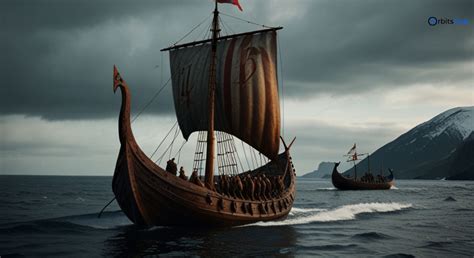
Viking Longship
We all agree that the Vikings were great and fearless warriors. The unique design of their ships was ahead of its time. With its incredibly shallow draft, the maneuverability of Viking longships was unmatched. This is precisely what made the Vikings so superior in terms of mobility and military dominance. Do you know who else was able to do that in the 8th century?
Apart from the advantages mentioned above, longships were built for speed. With their longships, the Vikings had an element of surprise on most occasions. As there are records of Vikings sailing to England, Iceland, the Mediterranean, and even Greenland and North America, you can imagine how unprepared their enemies were for the battles ahead. Viking longships are also known as "dragon ships". The Skíðblaðnir and the Nalgfar are the two most powerful ships in the Nordic universe.
The Skíðblaðnir was a magical ship that belonged to the god Freyr. It was big enough to carry all the Asgardian gods. They used it quite often on their journeys on sea, land and even in the air. The ship was built by the best dwarven craftsmen so that it could be folded to fit in the owner's pocket. The other ship, Naglfar (Old Norse for "nail farer"), was built with the nails of the dead! And who could own this ship if not Hel, the goddess of death herself!
Let's be clear. The longships were not "real ships" as we can imagine them today. They were simply larger ships, whose "sailors" were fully exposed to wind, cold and heat. And these are the types of boats that the Vikings used to cross the ocean! This kind of commitment, courage and desire to venture into the unknown can only be understood by true Vikings.
Sleipnir
Sleipnir is an eight-legged horse, probably the most famous horse in Norse mythology, which belonged to Odin. He was conceived when Loki turned into a mare to sabotage the construction of the walls surrounding Asgard, by seducing Svaðilfari, a stallion of the giant who built the wall. Archaeological findings show that many ancient civilizations (before the Viking era), from Korea to Northwest Europe, used symbols of eight-legged horses. For the Vikings, however, the Sleipnir symbol had more significance. It was used as a sign of speed, luck for travelers and transcendence.
Raven
Among the animals most often associated with the Vikings, the raven deserves its place on our list. Odin had two ravens named Muninn (meaning "memory") and Huginn (meaning "thought"). They would only leave him to fly around the nine realms and gather information that they would then whisper in Odin's ear. The importance of ravens in Norse culture is illustrated by the way Odin is usually depicted.
Another reason for the popularity of the raven symbol is a Viking whose popularity has increased nowadays thanks to the TV series Vikings. He lived in the ninth century and claimed to be a descendant of Odin himself. His name was Ragnar Lothbrok. Countless myths tell of Ragnar's adventures throughout Europe. Wherever he went, his raven banner followed him. The raven's banner continued to bring victories until 1066. As for the meaning of this symbol for the Vikings, it was used to represent Odin, wisdom, intelligence, insight and glory in battle.
Boar
From Norse mythology and art we know that many gods had their spirit animals, called fylgja. As far as boars are concerned, two Norse gods had them as fylgja. These were Freya and her brother Freyr. In addition to having a boar for her fylgja, the goddess Freya also had black or gray cats that pulled her chariot on her travels.
Bear
There are few things that Vikings fear, and bears are one of them. As one of the strongest and fiercest animals, bears made even the bravest Viking recoil. Since the Vikings always tried to bend nature to their will, it is not surprising that some Viking kings had bears as pets. Another connection to bears comes from the berserkers. These were Viking warriors who fought in a state of ecstatic fury and frenzy. The word berserker derives from Old Norse words meaning "bearskin" or "bearshirt". This only strengthens the written evidence suggesting that berserkers entered battle wearing bear armor or without any kind of armor. The bear symbol represented incredible strength, fury, courage and warrior spirit.
Wolf
The symbol of the wolf has contradictory meanings in Norse mythology. It can symbolize both the best and the worst in people. What is the reason for these conflicting meanings? There are some important wolves in Nordic folklore. The most famous is undoubtedly Fenrir, the wolf who was so powerful that even the gods were afraid of him and therefore decided to imprison him (these attempts resulted in many complications). However, it was predicted that Fenrir would break free from his magical bonds at the beginning of Ragnarok.
Two other wolves play an important role in Norse mythology. They are not as evil as Fenrir, and they accompany Odin, the father of fathers, in his adventures. In addition to its direct connection to animals, the wolf symbol is also linked to the Viking warriors known as úlfheðnar (which means "wolf skin"). It is unclear whether úlfheðnar was a synonym for berserkers or another type of Viking warrior altogether. Some sources suggest that úlfheðnar fought in small packs, unlike berserkers who fought alone in front of the shield wall. However, one thing is certain.
Dragon
Norse mythology has many myths involving dragons and giant snakes. However, let's pause for a moment to explain what the word "dragon" meant to the Vikings. To the Vikings, dragons were far from the dragons we imagine today (the giant, terrifying beasts with broad wings that breathe fire and wreak destruction). On the other hand, some dragons in Norse mythology were more than just terrifying monsters. They were themselves cosmic forces.