The United States is home to people of many ethnic, cultural, and religious backgrounds, with generations living together peacefully. And there is no better representation of it then a look at the various NFL logos. From the fleur-de-lis of the Saints, to the Norse-inspired design of the Minnesota Viking logo, there are many historical and cultural details for someone with a keen eye for such details.
Today, the Vikings logo is one of the most recognizable brands in the NFL, with a classic design that is hard to miss and easy to remember. With the franchise joining the NFL in 1960, they have been playing the game professionally for over six decades now. So the question in everyone’s mind right now is; what did the Vikings logo look like back then? Did it look the same as today, or was there a major difference? And if it was different, how did it evolve to represent the NFL franchise successfully for so long?
Many of the NFL teams currently playing in the league have gone through a number of logos over the years, while some have barely tweaked their design a couple of times over decades. That is because it is difficult to come up with an evergreen logo design that lasts the business a lifetime.
So, let’s dive in and discover whether the logo for the Minnesota Vikings was one of the evergreen ones, or it too had evolved multiple times before transforming into its current shape. We will also discuss the essence and secrets of the Vikings logo, and how you can incorporate that essence in your logos with the help of a logo design services professional.
Let’s begin by taking a look at the inception of the Minnesota Vikings franchise, and discover how it has fared over the years.
Read also: The Meaning of Jewish Luck Symbols
The twin cities of Minneapolis-St. Paul in Minnesota have an old history of professional football that harks back to the start of the 20th century. The Minneapolis Marines joined the American Professional Football Association in 1921, but shut down in 1924. Then, they were restructured into the Minneapolis Red Jackets in 1929, but they ended up being merged with the Frankford Yellow Jackets just two seasons later.
After that, it wasn’t until 1959 that the region became a contender for professional football again, when three local businessmen were awarded an AFL franchise. However, the team passed on the American Football League’s franchise offer and opted to join the NFL when they were offered the 14th NFL franchise in 1960, playing their first game in 1961.
Since their inception, the franchise has had one of the highest win percentages in the entire NFL, including teams that have been with the League since its inception. However, despite that, the Vikings have only one Championship win and that too in 1969, a year before the AFL-NFL merger.
For a team that has been unsuccessful in winning a single Super Bowl, their stats are quite good. As of the 2022 season, the team has won three or more games per regular season, barring the 1962 season. Moreover, they are one of seven NFL franchises to have won fifteen or more games in a regular season. In addition, with 28 playoff appearances, they have the third-highest playoff qualifying record, trailing behind the Cowboys and Steelers.
While the team has not won a Super Bowl so far, it is not for lack of trying. The Minnesota Vikings have reached the Super Bowl 4 times, qualifying for the 1969, 1973, 1974, and 1976 seasons. However, due to serial bad luck, they have lost all four times. That bad luck also extends to their NFC conference championship as well, as they have faced defeat in their last six NFC Championship appearances, going back all the way to 1978.
Read also: Symbolism in the Age of Aquarius
Coming back to the origins of the franchise, the name for the Minnesota Vikings is an homage to a large, predominantly immigrant Scandinavian-descent American population of Minnesota. In fact, Minnesota is often considered the center of Scandinavian-American culture. That, combined with their penchant for playing intense, highly interesting games with no chance of predicting the outcome until the play starts, makes for a team that is highly revered by its fans.
The motivating chant of the team is also inspired by the Nordic origins of the franchise, with fans yelling “Skol” while slapping their hands to the beat of a drum. Even Prince, legendary musician, and Minneapolis native, was a fan of the team, recording the song “Purple and Gold’ to be used as the Viking’s fight song.
Overall, the Minnesota Vikings are one of the more successful franchises of the NFL, despite no Super Bowl win to their name. That is the reason for the team’s loyal fan base, and the fact that Vikings can claim 15 Pro Hall of Fame players today, a metric that teams far older than them have a hard time achieving.
Minnesota Vikings are the name of a professional American football club, which was established in 1961 and today competes in the National Football League as a member of the North Division. The club has U. S. Bank Stadium as its home arena and Kevin O’Connell as the head coach.
Minnesota Vikings definitely has a large number of fans in Northern European countries, as the region where the team is located has a very strong Scandinavian tradition. And you can feel it only by looking at the logo of the club.
Read also: Decoding Viking Symbols
Minnesota is one of the states of the USA, which was founded by Scandinavian people, so to reflect the historical legacy of the state, the professional football club from Minnesota adopted the Vikings name in 1960. Minnesota Vikings is a very strong member of the National Football League. The club was established at the beginning of the 1960s, and since then has sent twenty-two players to the Hall of Fame.
Viking Warriors: The Real History Behind the Legends
Significance of the Minnesota Vikings Logo in American Culture
As we mentioned earlier, the Minnesota area has a high density of Scandinavian-descent Americans. With Scandinavian cultural ties and practices still strong within the community, it is no wonder that an NFL team from the area would have a predominantly Scandinavian slant to its design. If we take a look at the Minnesota Vikings logo, it features the helmeted head of a Viking warrior as its mascot.
Now, many of the teams in the NFL use some kind of symbolism in its logo’s design, such as the prominence of the mustang in the Denver Broncos logo. As the Denver area has long been known for the wild mustangs that roamed the plains of Colorado, that imagery pays homage to the area’s history.
Similarly, the Viking warrior is a reminder of the area’s cultural roots. The horned helmet of the wild-mustachioed blonde warrior, combined with the “Skol” chant of the fans supporting the teams, lend a wild quality to the noble and resilient history of the Norsemen. And that is what the Vikings logo and that of many other teams in the League is all about, giving the fans a relatable symbol to rally behind, come rain or shine.
The “Minnesota Vikings” emblem, featuring a Viking’s head, visually confirms the football team’s name. The emblem’s symbolism focuses on the name, origin, and characteristics inherent to the brave Scandinavian warriors.
The Minnesota Vikings are the first NFL team whose name bears the state’s name, not the city’s. Moreover, its logo is also closely related to Minnesota, as it reflects the historical heritage of this administrative-territorial unit. The image of a Viking is part of local culture, as a significant portion of the state’s population is of Norwegian descent. In a sports context, it symbolizes willpower, unwavering spirit, and the pursuit of victory.
The idea for the emblem belongs to artist Carl Hubenthal, who in 1961 provided the club with a finished drawing: the image of a stern warrior’s head in a horned helmet. Special emphasis was placed on the long mustaches, eyebrows, and braided hair-characteristic features of Scandinavians.
Throughout its long history, the Minnesota Vikings football team has had two official mascots - Ragnar the Viking, and the current one, Viktor the Viking. It is a smiling blonde Viking in a traditional helmet with two horns, wearing the team’s uniform, consisting of a purple jersey with the number “1” on the chest, and white pants.
The official color palette of the Minnesota Vikings football club is composed of just three shades: purple, golden-yellow, and white. But the quantity means nothing here, as the shades work brilliantly together, creating a strong contrast and making the players stand out on the field.
The letters “M” and “V” look unique due to the unusual shape of the script.
The helmets of the Minnesota Vikings club are definitely one of the coolest in the NFL in terms of colors and design. Here purple works as the main color, and yellow is only used for small decorative elements, the rings around the massive white horns, which are drawn on the sides of the players’ helmets.
Evolution of the Minnesota Vikings Logo through the Decades
So far, we have taken a look at the history and inception of the Vikings franchise, and discussed the significance of its brand symbol on the fans and other people across the US. After that, you may be wondering; what is it about the Minnesota Vikings logo that has the fans rallying behind the team, despite an unlucky track record of losing when it matters the most?
Moreover, how did the brand symbol manage to retain that fan loyalty over an era that spans more than six decades? These questions can also be asked for other NFL team symbols, such as the Detroit Lions logo that has managed a fan following despite an absolute abysmal track record; a phenomenon rarely seen outside the world of sports.
Let’s dive in and take a look at the various iterations of the design throughout the Minnesota Vikings logo history, and see what value each new transformation brought to the brand.
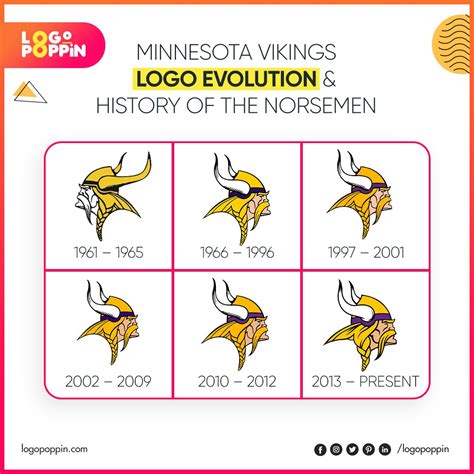
All the versions of the Minnesota Vikings logo may look rather similar as all of them feature the profile image of a Norseman. And yet, if you compare them side-by-side, the differences between them become obvious.
The strong and sharp logo of Minnesota Viking was created at the beginning of the 1960s and arrived in the 2000s with almost no major changes.
Over time, designers changed the graphic sign, giving it a modern look. They turned the Viking to the right, emphasized the gaze, and brought the skin color closer to its natural shade. In 2013, the shape of the helmet’s horns was updated: developers achieved a three-dimensional effect, adjusting the fine details.
The badge did not lose its recognizability but became more modern and powerful, as the team itself.
Here is a summary of the Minnesota Vikings logo evolution:
| Years | Description | Image |
|---|---|---|
| 1961 - 1965 | This version of the “Minnesota Vikings” logo embodied the history and traditions of the ancient Vikings. It depicted a steadfast, brave warrior who feared no obstacles. The design featured a left-facing Viking head, outlined in black, with a long, bushy moustache and an angular yet weathered face with a frown on it. The character wore a large, lightly pointed Viking helmet, with long and curving horns coming out the side of it on both sides. Underneath it, you could see that the Viking wore its hair in a braid on the side, while it flowed down at the back. For the face and the moustache, the design featured these elements just outlined in black, devoid of any other color. The helmet and the hair on the other hand, were colored a dark yellow-gold, outlined and accented in black, with the helmet having a thick black band running all around the circumference of the rim. |  |
| 1966 - 1996 | The redesign of 1966 changed the direction of the emblem and the Viking got turned to the right, looking into the future, being ready to step in and fight. The color palette of the logo was also switched and now the face of the man gained a light-beige skin tone, and the mustache became yellow, the same color the Viking’s hair and helmet were colored in. The thick purple stripe was added to the helmet’s bottom part, to create a contrast between the elements and add an adventurous and creative feeling the purple color usually stands for. The horns on the helmet were now colored white, which gave a better balance to the whole image. The Viking looked to the right, flipping the design 180 degrees on its vertical axis. Even the color scheme was changed, with the head now colored a tan pink, while the moustache was now the same color as the hair and the helmet. The band running around the helmet was also refined, with cleaner lines, and better visibility. It was colored a deep, rich purple, which contrasted with the yellow-gold of the helmet and the hair perfectly. Finally, the horns were made somewhat shorter and were now colored white instead of being the same color as the helmet previously. |  |
| 1997 - 2001 | In 1997 the yellow color on the Minnesota Vikings logo was intensified, which created a stronger look from the whole image. As for all other elements, they remained untouched. The golden-yellow of the helmet and the hair was not changed, not was the pink of the Viking’s face. The overall design was made cleaner, with the use of digital design tools to clean up and smooth out the strokes of the logo’s design. The one element that was changed however was the purple band that ran around the helmet. In the previous iteration of the logo, the purple colored band was colored a shade so dark that unless you looked at it closely, and with a bright enough light, you would think that it was a shade of black. |  |
| 2002 - 2009 | With the redesign of 2002 the yellow shades of the Minnesota Vikings logo got even deeper, and this time it was not only about the hair of the Viking, but also about his skin, which gained a new shade. This time they made the purple shade a few degrees darker. However, they deepened the shade for a more regal, luxurious look to it, leveraging its known from color theory principles. This new purple contrasted far better with the golden-yellow than either of the previous iterations, standing out and drawing the eye to the most important element of the design - the horned helmet. |  |
| 2010 - 2012 | In 2010 the color palette of the Minnesota Vikings visual identity came back to its version from the 1960s, with a more naturalistic skin tone of the man, and a lighter shade of yellow for his hair. The black contours of all elements were slightly emboldened, creating a more brutal look of the badge. This time, still fiddling with the purple band, they decided to lighten it just enough that it could still be viewed as purple in dark surroundings, while still deep enough to retain that regal feel. The result was a purple shade that was quite close to the purple shade used on the logo today, albeit the rest of the color combinations in the design may not be the same. |  |
| 2013 - Present | Other minor changes were applied to the Minnesota Vikings logo in 2013, with the braids of the Viking getting slightly shorter and thicker, and the horns of the helmet getting reduced in their lengths too. The white areas of the composition became cleaner, with less black accents, which makes the whole badge look stronger and more professional. The badge did not lose its recognizability but became more modern and powerful, as the team itself. This meant that the dark golden-yellow was now a brighter yellow, with the deeper purple standing out in an aesthetically pleasing manner. Moreover, the moustache of the Viking was made longer, while the braid was made thicker and smaller. The horns were also made thicker, with the points made shorter with thicker bases compared to the previous iterations. Overall, the result was a stockier, more muscular-looking logo, which lent well to the Nordic origins of the franchise and its symbol. |  |
Minnesota Vikings Logo Evolution
Anniversary Logos
The Minnesota Vikings football club was established in 1960, as many other NFL teams. Hence, the club has had quite a significant amount of anniversaries today. And for each of them, the designers did create special celebration badges.
- 1985: For the 25th season of the club, the logo was set in a gray and purple color palette, with the white Vikings emblem on it it was a classic circular medallion with a gray background and purple frame, accompanied by purple digits and lettering.
- 1989: The color palette of the 20th-anniversary emblem was already more intense and delightful - blue and golden-yellow. The medallion was underlined by a rectangular banner with the “40 For 70” inscription. As for the main element, the coin, its central part only contained the emblem of the club, while all the lettering was written around the golden frame of the logo.
- 1995: For the 35th anniversary, in 1995, the logo of the Vikings was drawn in a new, triangular shape. That was a crest, formed by two overlapping triangles pointing down, inserted in a white ring with the blue and yellow “35” on it. The emblem of the club was drawn on top of the composition, it the blue, white, and yellow color palette.
- 2000: In 2000, for the 40th season of the club, the logo was drawn more ornately. A wide crest with an arched top border was executed in a dark yellow and blue color palette, with the white rays coming from the center point behind the Viking’s head. The dates were written on the sides from the emblem, and the celebration lettering - on a solid blue ribbon, which was stretched under the banner.
- 2010: The emblem, designed for the celebration of the 50th anniversary of the club featured the shape of a Viking ship, with a solid purple body and a striped yellow and white sail. On the sail, there was a bold purple “50”, while the emblem of the Vikings was overlapping the ship in the middle. The dates were written in white on the sides of the emblem.
- 2020: For the 60th anniversary of the Minnesota Vikings football team, the logo was introduced in 2020. It was a classy and elegant badge in the shape of a roundel standing on a horizontally stretched ribbon. Both elements were set in a gradient purple and yellow color palette.