The appearance of the Moon, or its phase, gradually changes over a lunar month. This change happens as the relative orbital positions of the Moon around Earth and Earth around the Sun shift.
A lunar phase, or Moon phase, is the apparent shape of the Moon's day and night phases of the lunar day as viewed from afar. The cycle of phases takes one lunar month and moves across the same side of the Moon, which always faces Earth, because the Moon is tidally locked to Earth.
Key Lunar Phases
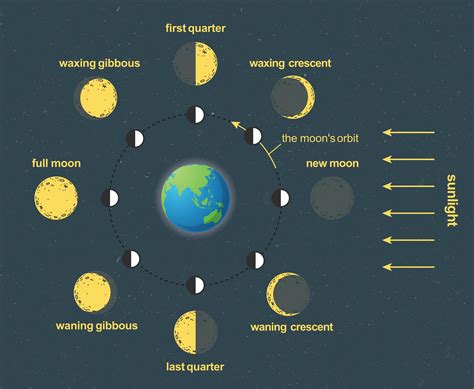
In common usage, the four major phases are the new moon, the first quarter, the full moon, and the last quarter. The four minor phases are waxing crescent, waxing gibbous, waning gibbous, and waning crescent. Between the principal phases are intermediate phases, during which the apparent shape of the illuminated Moon is either crescent or gibbous.
- Waxing: The term "waxing" is used for an intermediate phase when the Moon's apparent shape is thickening, from new to a full moon.
- Waning: The term "waning" is used when the shape is thinning.
The Moon rotates as it orbits Earth, changing orientation toward the Sun experiencing a lunar day. A lunar day is equal to one lunar month (one synodic orbit around Earth) due to it being tidally locked to Earth. Since the Moon is not tidally locked to the Sun, lunar daylight and night times both occur around the Moon.
When the Sun and Moon are aligned on the same side of the Earth (conjunct), the Moon is "new", and the side of the Moon facing Earth is not illuminated by the Sun. As the Moon waxes (the amount of illuminated surface as seen from Earth increases), the lunar phases progress through the new moon, crescent moon, first-quarter moon, gibbous moon, and full moon phases.
Read also: Interpreting Blood Dreams
If the half-ellipse is convex with respect to the half-circle, then the shape will be gibbous (bulging outwards), whereas if the half-ellipse is concave with respect to the half-circle, then the shape will be a crescent.
Phases of the Moon - Viewed from Southern Hemisphere
The Moon in the Southern Hemisphere
Each phase would be rotated 180° if seen looking northward from the Southern Hemisphere. In the Northern Hemisphere, if the left side of the Moon is dark, then the bright part is thickening, and the Moon is described as waxing (shifting toward full moon). If the right side of the Moon is dark, then the bright part is thinning, and the Moon is described as waning (past full and shifting toward new moon).
Closer to the Equator, the lunar terminator will appear horizontal during the morning and evening. When the Sun appears above the Moon in the sky, the crescent opens downward; when the Moon is above the Sun, the crescent opens upward. The crescent Moon is most clearly and brightly visible when the Sun is below the horizon, which implies that the Moon must be above the Sun, and the crescent must open upward. This is therefore the orientation in which the crescent Moon is most often seen from the tropics.
When the Moon seen from Earth is a thin crescent, Earth viewed from the Moon is almost fully lit by the Sun. The dark side of the Moon is dimly illuminated by sunlight reflected from Earth, called earthshine, which is bright enough to be easily visible from Earth.
Timekeeping and Lunar Cycles
Archaeologists have reconstructed methods of timekeeping that go back to prehistoric times, at least as old as the Neolithic. The natural units for timekeeping used by most historical societies are the day, the solar year and the lunation. The first crescent of the new moon provides a clear and regular marker in time and pure lunar calendars (such as the Islamic Hijri calendar) rely completely on this metric.
Read also: Decoding Common Dreams
The number of days counted from the time of the new moon is the Moon's "age". The approximate age of the Moon, and hence the approximate phase, can be calculated for any date by calculating the number of days since a known new moon (such as 1 January 1900 or 11 August 1999) and reducing this modulo 29.53059 days (the mean length of a synodic month).
The phase is equal to the area of the visible lunar sphere that is illuminated by the Sun.
Lunar libration causes part of the back side of the Moon to be visible to a terrestrial observer some of the time. The Earth subtends an angle of about two degrees when seen from the Moon.
Eclipses: Why They Don't Happen Every Month
It might be expected that once every month, when the Moon passes between Earth and the Sun during a new moon, its shadow would fall on Earth causing a solar eclipse, but this does not happen every month. Nor is it true that during every full moon, the Earth's shadow falls on the Moon, causing a lunar eclipse.
Solar and lunar eclipses are not observed every month because the plane of the Moon's orbit around the Earth is tilted by about 5° with respect to the plane of Earth's orbit around the Sun (the plane of the ecliptic). Although an eclipse can only occur when the Moon is either new (solar) or full (lunar), it must also be positioned very near the intersection of Earth's orbital plane about the Sun and the Moon's orbital plane about the Earth (that is, at one of its nodes). This happens about twice per year, and so there are between four and seven eclipses in a calendar year.
Read also: Understanding Mercy as a Gift
The phases are not caused by the Earth's shadow falling on the Moon, as some people believe. They are caused by the Moon's shadow on itself, just as the Earth's shadow makes it night on one side of the Earth.
| Phase | Description |
|---|---|
| New Moon | Moon is not visible from Earth. |
| First Quarter | Half of the Moon is illuminated. |
| Full Moon | The entire Moon is illuminated. |
| Last Quarter | The other half of the Moon is illuminated. |
| Waxing Crescent | The moon's illuminated surface is thickening. |
| Waxing Gibbous | More than half of the moon is illuminated and the illuminated surface is thickening. |
| Waning Gibbous | More than half of the moon is illuminated and the illuminated surface is thinning. |
| Waning Crescent | The moon's illuminated surface is thinning. |