The tufted titmouse Baeolophus bicolor is a small North American songbird, a species in the tit and chickadee family Paridae. A petite grayish-colored bird with expressive and large doll-like eyes, a short beak, and an elegant crest give these birds a quiet but eager expression. Rarely measuring more than six inches long, tufted titmice are considered somewhat large among the small birds that come to feeders, an impression that comes from their large heads and eyes, thick necks, and full-bodied.
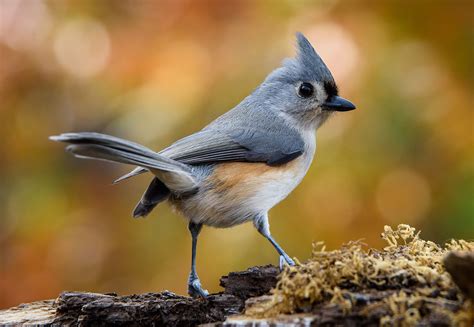
A Tufted Titmouse perched on a branch.
Etymology
Its genus name Baeolophus hails from two Greek words for “small” and “crest” and bicolor means two-colored. Where does the word “titmouse” come from anyway? The name originates from the Anglo-Saxon root words - “tit,” a word meaning something small, and “mouse,” from a word applied to any small bird, as well as a little rodent.
Appearance
Males and females are similar in plumage with the males tending to be larger in size than the females. They are a soft silvery gray above and white below, with a rusty or peach-colored wash down the flanks. Their large eyes are surrounded by a white ring that reaches their beak. A black patch located just above the beak makes the bird look snub-nosed.
Habitat and Distribution
Tufted titmice can be found in woodlands, shade trees, gardens, groves, or mixed evergreen-deciduous woods with tall trees, typically in areas with a dense canopy and many tree species. They are also common in orchards, parks, and suburban areas if the trees are large enough.
Read also: Understanding anemia spiritually
Diet and Foraging Behavior
Insects make up close to two-thirds of the annual diet of the tufted titmouse. During the summer, tufted titmice eat mainly insects, including caterpillars, beetles, sawfly larvae, ants, wasps, stink bugs, and treehoppers, as well as spiders and snails. Similar to the chickadee, titmice do not eat right at the bird feeder. While observing these birds, you will notice that they always choose the largest seeds they can when foraging. While sorting through seeds, they will judge which seeds are optimal in weight and easiest and therefore guess which ones have the highest fat content. Once they are back in the woods, titmice will hold their seeds between their feet and use its beak to hammer and pry them apart for consumption. Personally, these birds consume black sunflower seeds at the feeders before flying away.
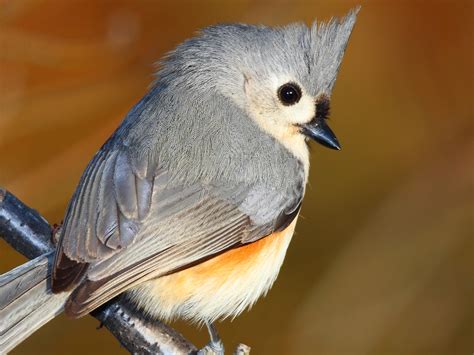
The Tufted Titmouse diet consists of insects and seeds.
Tufted titmice are acrobatic foragers. They often flock with chickadees, nuthatches, and woodpeckers and are regular visitors to feeders, where they can be observed to be more assertive over smaller birds. While observing these birds, I found them to be as bold and fearless as the black-capped chickadees in their behavior, especially at my feeders. These birds are acrobatic, methodical in their choice of food sources, and overall quite amusing to watch.
Vocalization
The song of the tufted titmouse is a fast-repeated, clear whistle: peter-peter-peter. These birds repeat this up to eleven times in succession or up to an estimated thirty-five songs delivered per minute. Titmouse calls are both nasal and mechanical. A scratchy, chickadee-like tsee-day-day-day is the most common.
Tufted Titmouse Sounds and Calls (with Audio Examples)
Nesting and Reproduction
Pairs of titmice may remain together all year, joining small flocks with others in winter. Flocks break up in late winter, and pairs establish nesting territories. The male feeds the female often from the courtship stage until after the eggs hatch. The nest site is in a hole in a tree, either a natural cavity or an old woodpecker hole; averages about thirty-five feet above the ground, ranging from three feet to ninety feet up. Unlike chickadees, they do not excavate their own nest hole. They will also use nest boxes.
Read also: Light Blue: Calmness and Healing
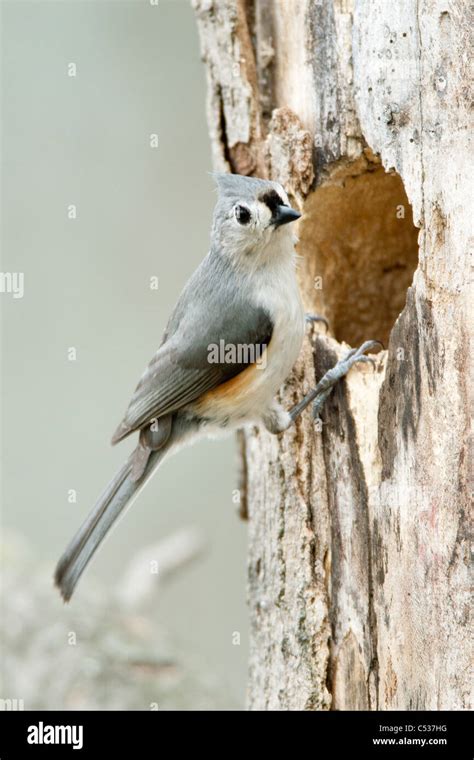
A Tufted Titmouse nest in a birdhouse.
The nest (probably built by females) has a foundation of grass, moss, leaves, and bark strips, lined with soft materials, especially animal fur. Birds may pluck hair from live woodchucks, dogs, or other animals, even from humans. There are five to six, sometimes three to nine eggs. They are white, finely dotted with brown, reddish, or purple. Incubation is done by the female for only twelve to fourteen days. The female stays with the young much of the time at first, while the male brings food; later, the young are fed by both parents, sometimes by an additional helper.
Attracting Tufted Titmice
The tufted Titmouse is a regular visitor at backyard bird feeders, especially during the winter months. Also, being that tufted titmice are cavity nesters, you can also try putting up nest boxes, as this is a good way to attract breeding titmice to your yard. Make sure to put it up well before breeding season.
Symbolic Meanings
It is said that the tufted titmice are symbols of good luck if seen by chance in a dream or vision. Your breakthrough is just around the corner. If you’ve been struggling for years, this spirit animal appearing on your radar is letting you know that your life is about to change completely. Moreover, their meaning represents living in the present moment. The Tufted Titmouse is a message that you may think that your contributions or abilities are mere, ‘gifts’ but they are impactful and empowering to so many that you may not yet be aware of. You spread hope and indemnify spiritual illnesses, sometimes without even trying. You make a difference.
Read also: Explained: Spiritual Blessings