When planets in our Solar System go into retrograde, you’ll often hear them being blamed as the source of a person’s woes, restlessness, or burnout. More optimistically, it is sometimes seen as representing a time for reflection. But what exactly does retrograde mean? What causes the apparent retrograde motion of the planets? This article delves into the explanation of this fascinating astronomical phenomenon.
Apparent retrograde motion is the apparent motion of a planet in a direction opposite to that of other bodies within its system, as observed from a particular vantage point. When a planet seems to reverse its direction in the sky, it’s called retrograde motion (from the Latin word retrogradus - "going backward").
Retrograde is most commonly an adjective used to describe the path of a planet as it travels through the night sky, with respect to the zodiac, stars, and other bodies of the celestial canopy. Although planets can sometimes be mistaken for stars as one observes the night sky, the planets actually change position from night to night in relation to the stars.
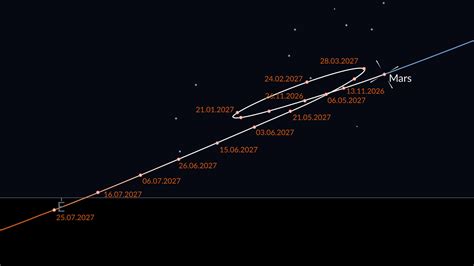
A composite image showing the apparent reversal of Mars's movement in the night sky, known as retrograde.
What Causes Apparent Retrograde Motion?
The apparent retrograde motion is caused by differences in the planets’ orbital speed. All the planets travel in the same direction around the Sun, and if you imagine a spot above the Earth’s north pole, they would be seen to travel anticlockwise.
Read also: Interpreting Blood Dreams
Day to day and week to week, as the Earth revolves around the Sun, the planets usually drift from west to east against the background of stars. Astronomers call it direct or prograde motion. This motion shouldn’t be confused with the daily motion of the planets and the Sun in the sky, which goes from east to west and is caused by the Earth’s rotation on its axis.
At specific periods of time, a planet can start moving “backward” - from east to west. This westward movement is called apparent retrograde motion.
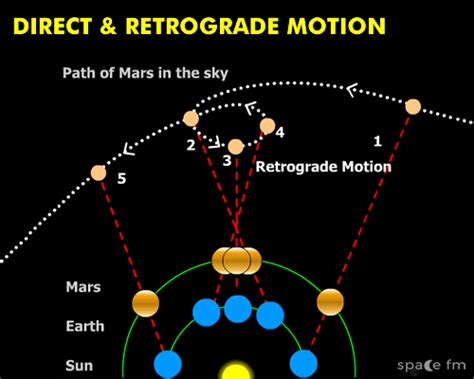
Let's use Mars as an example. Mars is a superior planet, meaning its orbit is farther from the Sun than Earth's. Because of this, Mars moves more slowly in its orbit than Earth. When we pass Mars, it seems to be moving “backward” because we're moving faster than it is. The same thing happens when you pass by a slower-moving car on the highway - for a moment, it appears to move in the opposite direction.
As Earth overtakes another planet, let’s say Jupiter, it overtakes on the inside and from our viewpoint on Earth, this results in Jupiter appearing to zigzag across the sky.
Animation showing the apparent retrograde motion of a planet in the outer solar system, such as Jupiter.
Read also: Decoding Common Dreams
The outer (or superior) planets move slower than the Earth in their orbits. When we pass them, they appear to reverse courses in our sky.
The inner (or inferior) planets move faster than the Earth in their orbits and also seem to reverse directions in the sky. However, during retrograde motion, inferior planets are positioned near the Sun in the sky. Mercury is often completely lost in the Sun’s glare, while Venus can still be observed around sunrise or sunset.
Mercury retrograde, explained WITHOUT astrology
Retrograde Motion of Inner and Outer Planets
Traveling the fastest out of all the planets, it only takes approximately 88 days for Mercury to orbit the Sun (and earning it the nickname the Swift Planet). This means it overtakes us three or four times every year, and therefore goes into retrograde three or four times a year, lasting around three weeks at a time.
It takes 225 days for Venus to orbit the Sun and goes into retrograde every 18 months, lasting around six weeks at a time.
Mars goes into retrograde approximately every 26 months, beginning around five weeks before opposition. Mars in retrograde lasts for a few weeks before the planet appears to move forward again.
Read also: Understanding Mercy as a Gift
Pluto goes into retrograde for around half the year, every year. It’s the largest-known object in the Kuiper Belt (a doughnut-shaped region of icy bodies beyond Neptune) and last went into retrograde on 29 April 2022, lasting until 28 October 2022.
Historical Perspective
Ancient astronomers were rather puzzled by the retrograde motion phenomenon - especially those who thought that the Earth was at the center of the Universe.
In 150 AD, the Greek astronomer Ptolemy theorized that the Earth was at the centre of the Universe, with the Moon, Mercury, Venus, the Sun, Mars, Jupiter and Saturn on ‘spheres’ around the Earth, in that order. Put simply, Ptolemy explained this by proposing that the planets moved in small circles (called epicycles), which in turn circled the Earth on their respective spheres (cycles).
It wasn’t until 1610 that Galileo Galilei disproved the Ptolemaic model by discovering that, like the Moon, Venus went through phases; something incompatible with Ptolemy’s take on the Solar System.
Only in the 16th century did Nicolaus Copernicus introduce his heliocentric model and explain retrograde motion as an apparent effect. Copernicus's work put the Sun at the centre of the Solar System and helped explain retrograde motion of planets.
Observing Retrograde Motion
To observe retrograde motion, record a planet’s position in the sky at the same time each day. Over the course of several weeks, these marks will gradually reveal the retrograde loop that the planet traces.
If we mark the position of Mars in the sky every day at the same time and combine the results, we’ll see the planet outlining a loop.
You can do this manually (but it'll take at least several weeks) or you can do it in 3 steps with the stargazing app Sky Tonight. It has a special feature that allows you to instantly build a curve showing the annual movement of any planet.
Retrograde Motion in 2026
Mars is the only planet that won't go retrograde in 2026. Its retrograde period begins on January 11, 2027, and ends on April 2, 2027.
| Planet | Retrograde Start |
|---|---|
| [Planet Name] | [Start Date] |
| [Planet Name] | [Start Date] |
Does Retrograde Motion Affect Us?
Astrologers may warn you against signing contracts during Mercury retrograde or buying metal tools during Mars retrograde. It’s your choice to believe them or not.
However, you now know that retrograde motion is just an illusion that can’t possibly affect your everyday life - at least from the scientific point of view.