The Xbox One is a home video game console developed by Microsoft, announced in May 2013 as the successor to the Xbox 360, marking the third console in the Xbox series. It was first released in North America, parts of Europe, Australia, and South America in November 2013, and in Japan, China, and other European countries in September 2014. It is the first Xbox game console to be released in China, specifically in the Shanghai Free-Trade Zone.
The Xbox One received positive reviews for its controller design, multimedia features and quieter internals, but criticism was initially given to its user interface.
The Xbox One S, a revised version, replaced the original in 2016, featuring a smaller form factor, HDR10 support, 4K video playback, and upscaling of games from 1080p to 4K. It was praised for its smaller size, its on-screen visual improvements, and its lack of an external power supply, but its regressions such as the lack of a native Kinect port were noted.
A high-end model, named Xbox One X, was unveiled in June 2017 and released in November; it features upgraded hardware specifications and support for rendering games at 4K resolution.
Let's delve into the specifications and upgrades that differentiate the Xbox One X from its predecessor, the Xbox One. Previously codenamed Project Scorpio, the new console features a custom 2.3 GHz, octa-core processor, a custom 40-core graphics processor with 6 teraflops of performance, 12GB of GDDR5 RAM, and high dynamic range support. The system also has a Blu-ray drive with support for 4K video playback.
Read also: Descent into Madness
The system was succeeded by the Xbox Series X and Series S consoles, which launched on November 10, 2020.
The Xbox One X is the company’s first game console designed to run games at 4K resolutions, with some titles playable at up to 60 frames per second.
Technically, this isn’t Microsoft’s first 4K-ready game console. The Xbox One S could also handle some ultra HD content… and by content, I mean streaming video. What makes the Xbox One X special is its support for playing games at native resolutions on ultra HD displays.
The Xbox One X should also be backward compatible with games designed for the Xbox One and Xbox 360.
Meanwhile, if the Xbox One X seems too pricy, Microsoft is also dropping the price of the Xbox One S to $249.
Read also: Playing Old Games on Xbox Series S
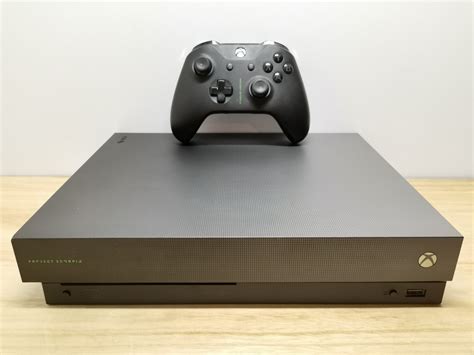
The difference between the two versions of the console is that the Scorpio edition is a very limited edition of the same console that has "Project Scorpio" printed in green on the controller and the console. It also will come in special packaging that resembles the original Xbox. The Scorpio edition is a limited edition console that doesn't cost you anything extra. "Project Scorpio" was the in-development code name for the console at Microsoft.
Buying the Scorpio edition is the only way to get the controller and console with the printed green title on them. The controller and console have the name project scorpio on it and i think it comes with a stand whereas i believe the regular one does not. They were a limited edition model.
Also it has a grey gradient on the paint and comes with a vertical stand (the standard version doesn’t, sold separately)
Hardware and Design
The original Xbox One's exterior casing consists of a two-tone "liquid black" finish; with half finished in a matte grey, and the other in a glossier black. The matte side of the top of the console consists of a large air vent. Xbox One S utilizes a refreshed version of this design, with a case that is 40% smaller in size and supports vertical orientation with a stand.
The main Xbox One S SKU is colored in an entirely matte "Robot White" finish, with half of the console adorned with machined holes, and a visible circular vent on top of the console's right half.
Read also: Choosing the Right Headset
The Xbox One is powered by an AMD "Jaguar" Accelerated Processing Unit (APU) with two quad-core modules totaling eight x86-64 cores clocked at 1.75 GHz, and 8 GB of DDR3 RAM with a memory bandwidth of 68.3 GB/s. The APU is built on TSMC's 28nm process. The memory subsystem also features an additional 32 MB of "embedded static" RAM, or ESRAM, with a memory bandwidth of 109 GB/s.
For simultaneous read and write operations, the ESRAM is capable of a theoretical memory bandwidth of 192 GB/s and a memory bandwidth of 133 GB/s has been achieved with operations that involved alpha transparency blending. The system includes a non-replaceable hard drive and a Blu-ray Disc optical drive. 138 GB of hard drive space is used by the operating system, with the remainder available for the storage of games.
Since the June 2014 software update, up to two USB drives can be connected to Xbox One to expand its capacity.
The original Xbox One supports 1080p and 720p video output; unlike the Xbox 360, the Xbox One does not support 1080i and other interlaced resolutions. The console can monitor its internal temperature and adjust accordingly to prevent overheating; alongside increasing fan speed, additional measures can be taken, including throttling the hardware to a low-power state-a feature that was not present on Xbox 360.
The Xbox Wireless Controller maintains the overall layout found in the Xbox 360's controller, but with various refinements to its form. Among its changes include a smoother form, textured analog sticks, a four-way directional pad, and redesigned triggers and shoulder buttons with a curved shape for ergonomics. "Menu" and "View" buttons have replaced the Start and Back buttons.
Each trigger features independent rumble motors called "Impulse Triggers", which allows developers to program directional vibration. The Elite Wireless Controller was released in October 2015. In May 2018, Microsoft announced the Xbox Adaptive Controller-a special controller designed for users with disabilities. It features two large dome-like buttons, and a series of connectors corresponding to standard Xbox controller buttons-which are used to attach specific types of buttons and other assertive peripherals.
As of the November 2018 update, developers may now optionally allow their titles to support computer mice and keyboards as input.
Kinect 2.0 features a wide-angle time-of-flight camera and a 1080p camera, in comparison to the VGA resolution of the Xbox 360 version, and processes 2 GB of data per second to map its environment. Kinect 2.0 has an improved accuracy over its predecessor; it can track up to 6 people simultaneously, referred to as "skeletons", perform heart rate tracking, track controller gestures, and read QR codes to redeem Xbox Live gift cards.
By default, voice recognition is active at all times, so the console can receive voice commands from the user, even when the console is in sleep mode.
Prior to and after the mandate, all Xbox One consoles initially shipped with the Kinect sensor included. On June 9, 2014, cheaper Xbox One bundles were introduced, which did not include the Kinect sensor.
Microsoft stated the decision to offer Xbox One bundles without Kinect was to "[offer] a choice to people that would allow people to buy an Xbox One and then ramp up to Kinect when they can afford to", while also allowing games to use processing power that was previously reserved for Kinect. An updated Xbox Development Kit issued in June 2014 allows developers to explicitly disable motion tracking functionality in games, allowing access to additional system resources that represent about 10% of the GPU processing power.
The Xbox One S lacks the Kinect connection port, requiring a USB/power adapter to use the accessory. A free USB adapter was provided by Microsoft to Kinect owners who registered their ownership of Kinect and Xbox One S online up until March 2017.
Xbox One's user interface uses Microsoft's Fluent Design System; previous iterations of the console's software used the Metro design language. The dashboard is divided into "Home", "Mixer", "Community", "Entertainment", and "Store" sections, with the "Home" page further divided into "blocks" that can display pinned games/apps, as well as other content. Pressing the Xbox Guide button opens a sidebar with access to common functions such as the friends list, apps, the user's party, and settings.
Users can go back to the dashboard while using games or apps using either the Xbox button on their controller or a voice command; up to four apps can run (either actively or in the background) at once, but only one game can run at a time. Use of Kinect enables the ability to control the console via voice commands. The UI was refreshed again in April 2017, adding the new Guide sidebar and other new features.
At this time, the ability to "snap" apps as a sidebar for multi-tasking was removed. The UI was further revamped in October 2017, adopting Windows 10's "Fluent" design language.
The console provides the ability to feed live television by serving as an HDMI pass-through for an existing television provider's set-top box or an optional Digital TV Tuner accessory that allows use of digital terrestrial television. The console provides its own electronic program guide known as OneGuide, augmenting the existing streaming functionality to provide show recommendations based on viewing history, integrated access to "App Channels" corresponding to online video services, and voice control via Kinect.
Players can use the Upload Studio app to edit and share clips from the last five minutes of gameplay footage that is automatically recorded by the console. Games can also be developed so that recording can automatically be triggered in response to notable events, such as achievements. Xbox One supports streaming directly to the service Twitch.
Here's a comparison table highlighting the key differences between the Xbox One and Xbox One X:
| Feature | Xbox One | Xbox One X |
|---|---|---|
| Processor | Custom 1.75 GHz 8-core AMD Jaguar | Custom 2.3 GHz 8-core |
| Graphics | AMD Radeon (1.31 TFLOPs) | Custom AMD Radeon (6 TFLOPs) |
| RAM | 8 GB DDR3 | 12 GB GDDR5 |
| 4K Gaming | No | Yes |
| Release Price | $499 | $499 |